

A technician under a bonnet has two hands on a wrench and no hand for a light. That single constraint decides the purchase, and it is why the torch that everyone carries is the wrong tool for half the jobs in the bay. An LED flashlight for workshop duty earns its place when it reaches into a bolt hole; a work light earns its place when the job needs both hands and a whole surface lit. Buying one and hoping it covers both is what produces the complaint that the light is never where it is needed.
Hands-Free First: Why a Work Light and a Torch Solve Different Problems
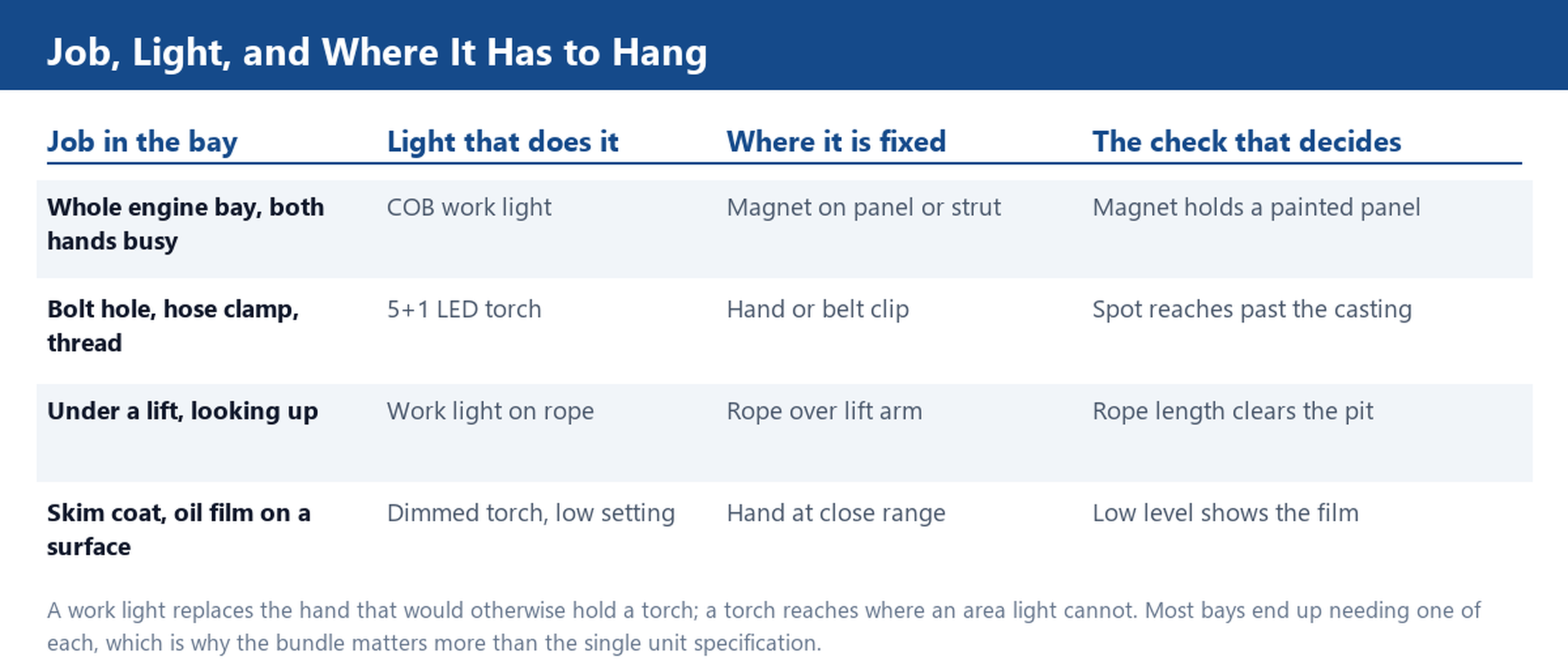
The two products answer different questions. A torch answers where is the fastener, and it is carried, aimed and put down. A work light answers what am I looking at, and it is fixed in place so that the answer stays visible while both hands work. In a bay the second question comes up more often than technicians expect, which is why a torch alone reads as inadequate even when it is bright.
The COB magnetic work light is built around that second question. It runs 28.6 cm tall on a 4 cm body, weighs 80 g, and carries a magnetic base plus a rope, so it can stand on a panel, cling to a strut, or hang from a lift arm. Two push switches separate the functions, which matters with gloves on. At 80 g it is light enough that a magnet can hold it on a vertical surface without creeping down over the course of a job.
The 5+1 LED torch covers the carried role: it goes into a pocket or clips to a belt, it is aimed by hand, and it reaches into places a fixed lamp cannot light. Neither product replaces the other, and a bay equipped with only one of them will keep borrowing from the next bay.
Magnetic Base, Rope and Belt Clip: Where Each One Holds
A magnet is only as good as the surface under it. Body panels hold well; plastic covers, aluminium skins and underseal do not. Paint thickness and any filler under it reduce grip, and a magnet that creeps a centimetre an hour will be on the floor by lunchtime, which is a real failure mode on a vertical panel and a non-issue on a horizontal one. Test the magnet on the surfaces the technicians actually use before you approve a batch: inner wing, strut tower, lift column, subframe.
The rope is the second holding method and the more reliable one under a lift, where a magnet has nothing ferrous at the right height. A rope also survives the case a magnet cannot: hanging from a bonnet catch, a hose, or the arm of a two-post lift. Length matters, and it should be long enough to clear the pit and short enough that the lamp does not swing into the technician face.
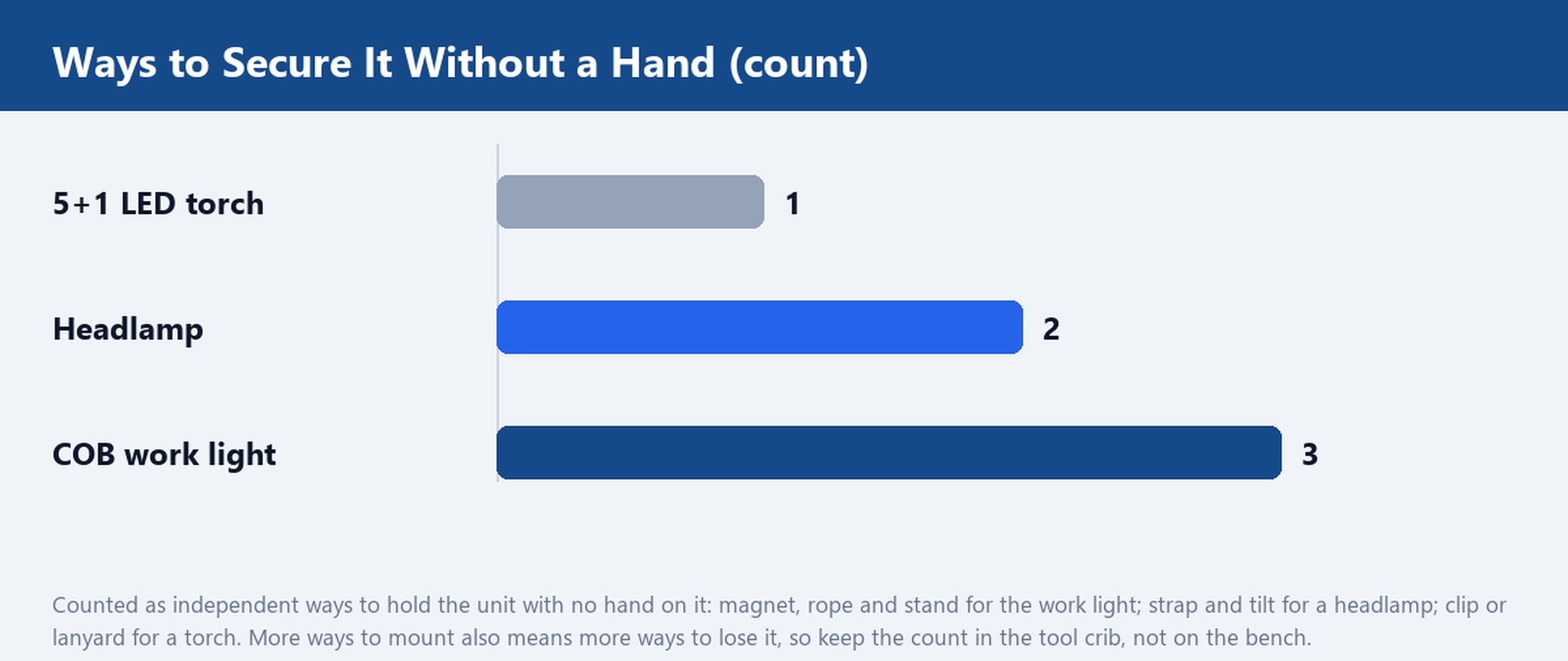
A torch holds differently again. A belt clip keeps it on the person, which is where a torch is useful and also where it gets lost. The practical arrangement is one work light per bay and one torch per technician, so the fixed light stays fixed and the carried light travels. Counting the ways each unit can be secured is a quick way to see the difference: the work light offers magnet, rope and stand, a headlamp offers a strap, and a torch offers a clip or a hand.
COB Area Light vs 5+1 LED Spot: Beam Shape Under a Bonnet
A COB emitter is a large continuous surface, so it produces a broad, even wash with no hot centre. That is exactly what an engine bay wants: the whole casting, the hose runs and the firewall are visible at once, and there are no shadows sharp enough to hide a leak. The cost is reach. A large emitter cannot be focused into a tight beam, so it lights the first metre well and fades beyond it.
A multi-emitter torch head behaves the opposite way. A cluster of small emitters behind a reflector gives a brighter centre and a longer throw, which is what a bolt hole, a thread or a hose clamp needs. Read the 5+1 designation as an emitter count rather than a mode count, and confirm with the supplier what the sixth emitter is positioned to illuminate, because that detail decides whether the torch can also do close work at the tail end of a job.
In practice the split is: work light for the bay, torch for the detail. A technician who has to hold a torch in the teeth to see a whole engine bay is using the right tool for the wrong question, and no increase in lumen output fixes that.
Dimming, Battery Format and Runtime Through a Shift
The catalogue sheets for this family list eight hours of lighting period almost across the board, on a work light, on a 3xAA torch and on a rechargeable torch alike. Treat that as a category claim rather than a measurement. A shift is eight hours, so a unit that reaches eight hours at full output has no reserve, and the honest question is what runtime looks like at the brightness the job actually needs. Dimming is the answer, and it is also the feature buyers under-specify. A stepless or two-level dimmer on a dim workshop ceiling lets the technician drop the output to see an oil film or a scratch instead of blowing the contrast out.
Battery format is a policy decision more than a technical one. A rechargeable unit needs a charging discipline: a dock, a rotation, and someone responsible when a lamp comes back flat. A torch running on three AA cells turns that into a consumable line item, which some workshops prefer because it never leaves a bay without light. Neither is wrong, but the choice has to be made once and applied to the whole fleet, because a mixed policy is how half the lamps end up in a drawer.
The body rating is the number that gets ignored and then generates returns. The work light in this range is rated IP33, which covers tools and limited water spray, and it is the unit most likely to be dropped in a pit or splashed with coolant. A dimming SMD torch carrying IP65 handles dust and jets. Match the rating to the environment rather than to the price, and state it on the purchase order.
Stocking Both Without Doubling the SKU Count
The tempting mistake is to stock one model per technician and let each person choose. That produces a drawer of near-identical lamps with different charging habits. The cheaper arrangement is two SKUs: one fixed work light per bay, one carried torch per technician, with a spare of each per ten units. Two lines cover the work patterns, and the spares absorb the failures without a special order.
Bundling is where a workshop order becomes more than a lighting order. A bay kit that pairs a work light, a torch and a charging arrangement sells as a handover package to a fleet, and the same logic carries into gift and seasonal programmes where lighting sits beside other categories in one carton. Cross-category mixed containers are the practical way to hit a container volume without inflating a single SKU, and the lights and lighting range is the place to start that list. Keep the bundle to items that share a use case: a work light, a torch and a power bank for the same technician travels as one kit, while unrelated items in the same carton only add picking errors.
Finally, set the acceptance test in writing. Magnet hold on a painted vertical panel for ten minutes, a runtime run at the brightness the job uses, a drop from bench height onto concrete, and a splash test against the rating on the label. A lamp that passes those four in the workshop will survive a fleet, and the LED flashlight range covers the carried side of the same kit.
Send us a photo of the bay or the pit your technicians work in, and we will send a magnetic COB work light and a 5+1 LED torch so both can be tested on the same job, in the same hands, before the order is fixed.