

A stylus order goes wrong on purpose, not on price. The buyer picks the model that looks right on the quote sheet, ships it to a shop floor where customers carry a mix of phones and tablets, and half of them come back saying it does not work. The fix is a sequence: tip type first, barrel size second, extra functions last. Getting that order right is most of how to choose stylus pen stock that sells through a counter rather than sitting in a clearance box.
Capacitive Ball Tip vs Active Stylus: What Each Actually Works On
A capacitive ball tip is a conductive dome on the end of a plastic barrel. It works on any capacitive screen ever made, needs no battery, no pairing and no app, and it cannot tell the screen how hard it is being pressed. What it gives up in precision it pays back in universality: a shop that sells to a mixed fleet of phones and tablets can hand out one model and know it will work on everything the customer owns.
An active pen is a different product wearing the same shape. It carries a cell, it may pair with the tablet, and it only functions on devices that support that pen protocol. Put one in front of a phone that was not built for it and nothing happens, which is exactly the complaint a returns desk hears. An active pen is worth stocking when the customer base is known, for example a tablet accessory shelf next to the tablets themselves, and the supported list belongs on the pack rather than in a footnote.
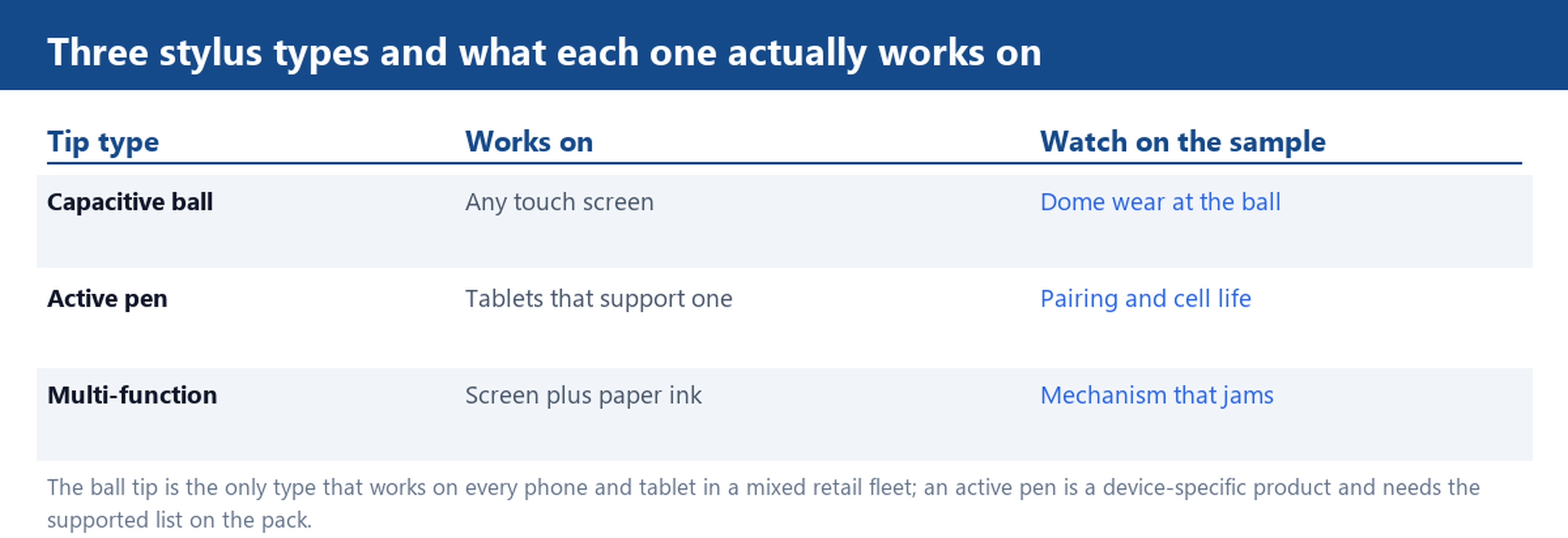
The commercial consequence is simple. For a mixed retail row, the ball tip is the base SKU and the active pen is the add-on for a defined device. The reverse arrangement, an active pen as the volume line and ball tips as a novelty, produces the support calls.
Barrel Sizes: 1/2 Inch Diameter and 5-1/2 Inch Length Against Case and Pocket Fit
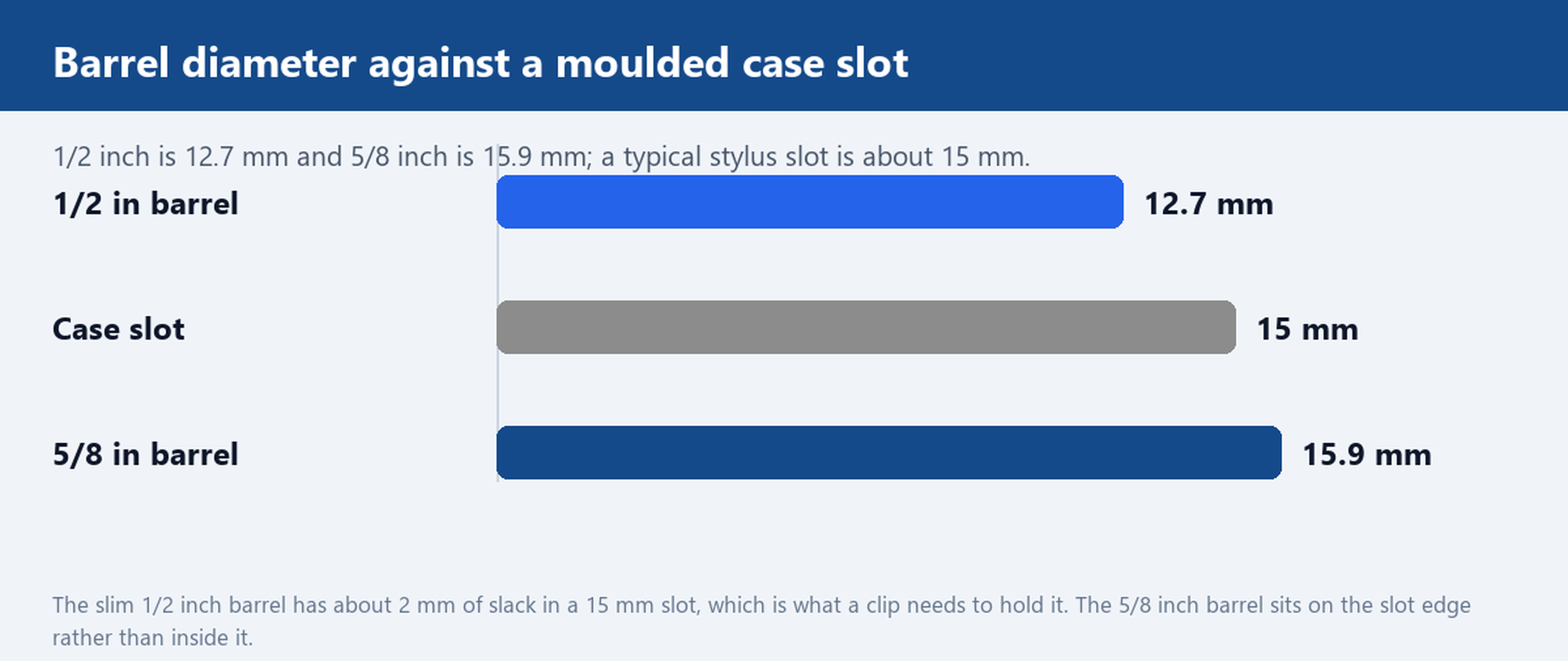
Barrel size decides whether the stylus lives in a case slot, a pocket or a drawer, and it is quoted in inches on most factory sheets. The plunger ballpoint stylus measures 1/2 inch by 5-1/2 inch, which is 12.7 mm by 140 mm: a slim barrel at full pen length. The active model is quoted at 5/8 inch by 5-1/2 inch, so 15.9 mm in the same length.
Those two millimetres of diameter make the difference between fitting a moulded slot and resting on top of it. A stylus slot in a phone or tablet case runs about 15 mm across, which leaves the slim barrel roughly 2 mm of slack for a clip to take up and leaves the wider one sitting proud. If the order is aimed at case-attached use, the slim barrel is the specification, not a preference.
Length works the other way. At 5-1/2 inch the stylus is a pen, which suits a counter, a reception desk and a pocket, and needs a display pocket of about 150 mm. Shorter keychain units trade writing comfort for portability and belong on a clip strip rather than a pen cup. Measure the display fixture before the order, because a 140 mm barrel in a 120 mm pocket is a merchandising problem that no sample will reveal.
Multi-Function Bodies: Ballpoint, LED and Screen Cleaner in One Barrel
Every extra function adds a mechanism, and every mechanism is a place where a cheap stylus fails. The plunger body is the honest version of the idea: push down and the ballpoint extends, push again and it retracts so the stylus tip is exposed. One barrel, one moving part, no cap to lose, and the two functions never argue because only one can be out at a time.
Twist action does the same job with a rotating collar, which feels more expensive and wears differently: the collar can loosen until the tip creeps out in a pocket. LED bodies add a button cell and a switch, so the battery door and the contact spring become inspection points. Bodies that add a highlighter or a cleaning pad add a third material to the assembly and a third way for the unit to look worn on the shelf.
The buying rule is one extra function per SKU. A pen and stylus in one body is a product a customer understands in a second. A pen, stylus, light and screen cleaner in one barrel is four failure modes at a landed cost that leaves no margin for the returns.
Keychain and Tablet Formats for Counter Display
Format follows the fixture. A counter display wants volume in a small footprint, so the 5-1/2 inch barrels go upright in a cup or lie in a shallow tray, and the keychain units hang on a clip strip at eye level. Mixing the two on one display splits attention and makes the shelf look picked over, which is why a mixed carton is a warehouse convenience rather than a merchandising plan.
A tablet-adjacent display is the one place where an active pen earns its space, because the customer is already holding the device it works with. Keep the supported device list on the header card, keep one ball-tip model beside it for the customers who walk up with a phone, and price the two so the difference reads as a feature rather than a jump.
The stylus pen range covers the slim plunger, the wider twist body and the keychain formats in the same plastic family, so a display can be built from one supplier without three sets of packaging.
Sample Checks: Tip Wear, Clip Retention and Carton Mix
Three checks on a sample answer most of the questions a carton cannot. First, tip wear: write and tap on a screen protector for a few hundred strokes and look at the dome. A ball tip that has flattened or gone shiny has lost the conductive contact area and will start skipping at the edges. Second, clip retention: bend the clip out and let it spring back ten times, then check that it still grips a 2 mm case edge, because a clip that has gone slack is the most common reason a stylus is lost rather than returned.
Third, carton mix. Count the units by barrel size and tip type against the purchase order, not by total quantity, because two models with the same colour and length are indistinguishable in a photograph and easy to swap in a mixed carton. Confirm spare tips if the model has a replaceable one, and confirm that the logo method quoted, silk screen or heat transfer, matches what the sample shows.
Send the device mix your buyers use, and we will put together a mixed stylus sample pack with tip type and barrel length marked on each unit.