

Most solar torch cartons arrive with the lights working. The failures that cost money are quieter: a second dimming state that barely differs from the first, a panel that tops the pack up but never fills it, a carton that measures wider than the figure on the quotation. This guide sets out five checks for an incoming solar LED torch shipment, in an order that catches the expensive problems before you sign the receipt. You need a tape measure, a kitchen scale, a clear patch of sun and a white wall.
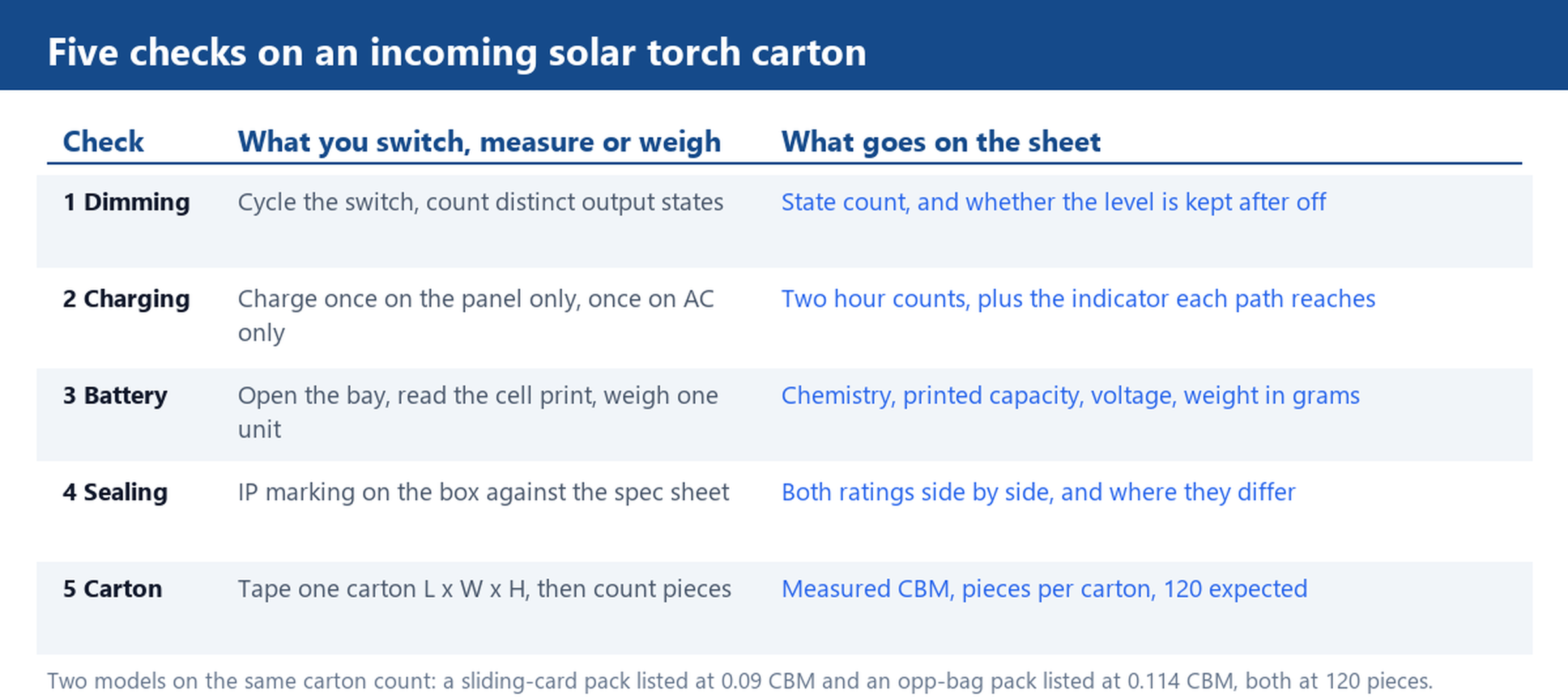
An inspection sheet is not a wish list. Every line on it should record something a person can switch, measure or weigh, and every line should end in a number or a named state that a second person can re-check without asking what you meant. A line that can only be answered with a tick does not belong on the sheet, because a tick cannot be argued with when a batch goes wrong three months later.
The models on this site split into two families, and they cannot be inspected the same way. The SMD2835+COB LED Torch Flashlight (LGP6475) carries eleven SMD2835 emitters plus a COB panel and a 1 W LED in a 19.2 x 6 x 6 cm body, runs on a 550 mAh pack, and offers two dimming states with a USB port for topping up a phone. The 5+1 LED Torch Flashlight (LGP6493) puts a Cree emitter on a lead-acid pack and is rated IP65. Write the sheet for one and you will pass a bad batch of the other.
Pull three pieces from three different inner boxes rather than three from the top layer. Pieces from one layer share a packing shift, so a fault that runs through that shift either shows up three times or not at all, and neither result tells you about the carton.
Check 1: 120 pieces per carton, and the cube you actually paid for
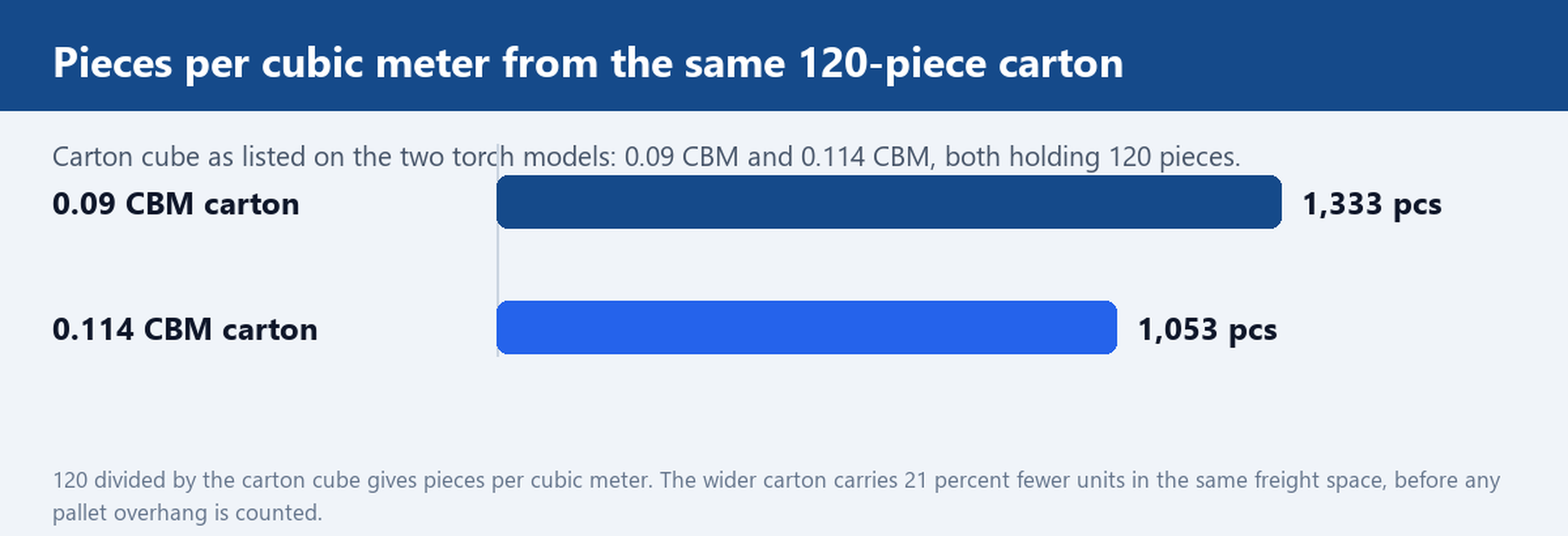
Both solar body styles are packed at 120 pieces per carton on this site, and the stated cube differs. The 5+1 torch ships one piece per sliding card at 0.09 CBM per carton; the SMD2835+COB torch ships one piece per opp bag at 0.114 CBM. Divide the piece count by the cube and the gap becomes freight: 1,333 pieces per cubic meter against 1,053, a 21 percent loss of loading density for the same number of units.
Measure the carton while it is still sealed and square, because a carton that has been opened and repacked does not measure the same as one that came off the pallet.
- Tape the outside length, width and height in centimeters and multiply. A 60 x 40 x 37.5 cm carton works out at 0.09 CBM, which is a way of checking the stated figure against the box in front of you rather than trusting either one.
- Cut the tape and count the pieces. Two people counting separately is faster and more reliable than one person counting twice.
- Weigh one full carton if a pallet scale is available. Gross weight is the number the forwarder bills against, and it moves whenever the pack format changes.
- Record single-wall or double-wall board, and whether the inner pack is a sliding card or a bag. That difference in pack format is the ordinary reason two models with identical piece counts land in different cubes.
If the measured cube runs above the stated figure, the freight for that shipment is already booked wrong. That is worth raising before the second container rather than after it.
Check 2: two dimming states, and what each switch really does
A listing that says two dimming tells you the driver has two output levels. It does not tell you that both are usable, that the lower state is meaningfully lower, or that the torch returns to the same level after it has been switched off. Cycle the switch five times and count the distinct states you can see, not the states the sheet promises.
Set the torch one meter from a white wall and mark where each state lands. Photograph both marks with the same camera settings. The two spots should differ clearly in size and in brightness; a difference you have to squint at is a difference your customer will not notice either, and it will read as a single-mode torch in the review that follows.
- Level memory: switch off at the low state, wait ten seconds, switch on again. If it comes back on high, the retail box and the listing should say so.
- Flicker: point a phone camera at the beam in both states. Visible banding on the screen means visible flicker to some eyes and to most video.
- Switch count is not dimming count: the portable solar torch with three switches (LGP6413) and the solar hand crank torch with compass (LGP6381) offer three and two switches, which is not the same as three and two brightness levels. Cycle each switch with the pack at a full charge and again at a discharged pack, then write down the function you observe.
- Switch feel: press it the way a customer would, with a thumb, not with a fingernail against a bench. On this class of torch the push switch is usually the first part to fail in the field, and a switch that needs a precise press fails early.
Check 3: solar and AC charging, tested as two separate paths
Every solar model here can be charged two ways, and the two paths rarely perform the same. Testing them as a single number is the most common mistake on an incoming sheet, because the AC path almost always looks healthy and will hide a panel that cannot keep up.
Drain the torch until it cuts out. Cover the panel with card and charge on AC only, timing how long the indicator takes to reach full. Drain it again, then charge on the panel alone under clear sun, timing the same indicator state and noting whether it reaches full at all. Two hour counts go on the sheet side by side, or the batch is unverified no matter how good the first number looks.
- Resting drain: charge fully on the panel, leave the torch switched off overnight, and confirm the next morning that it still starts at the level you left it.
- Indicator honesty: if the light turns green within minutes on the panel while the runtime afterwards is short, the indicator is reading panel voltage rather than pack state.
- Adapter match: the plug in the box should match the input printed on the carton. The round-plug solar bodies take a different connector from the USB-charging models, and a swapped adapter is a return that arrives before the light is ever used.
Check 4: the cell print, the chemistry and the unit weight
Open the battery bay on one piece per carton and read what is printed on the cell: chemistry, voltage, capacity. Photograph the cell next to the carton label so the two numbers sit in one frame. The 550 mAh pack in the SMD2835+COB model and the lead-acid pack in the 5+1 model are different products with different shipping paperwork, and a substitution between them is invisible from the outside of a sealed torch.
Weigh one complete torch with the pack fitted. The portable solar body at 17 cm by 6.3 cm is listed at 80 g. Weight is the cheapest available proxy for a pack swap, because a unit that comes in well under the approved sample tells you something changed before the runtime test has finished running.
- Printed capacity against measured capacity: a slow discharge at the rated current separates the two honestly, and it takes about a day. Run it on one piece, not on a hundred.
- Bay fit: the pack should not move when the torch is shaken. A loose pack wears through its own leads and the fault appears weeks later, out of your control.
- USB output where it is fitted: plug a phone in and confirm the port actually charges, rather than only lighting up when the torch is on.
Check 5: the IP marking on the box against the spec sheet
Two ratings run across these models: IP33 on the portable solar bodies and IP65 on the 5+1 torch. The second digit is the one buyers misread. A 3 means protection against spraying water at up to 60 degrees from vertical; a 5 means protection against water jets. Neither number makes a torch submersible, and an IP33 unit is a covered-shelf and emergency-drawer product rather than a light for a wet campsite.
That is a positioning decision, not a defect, as long as the retail box states the same thing as the spec sheet. Put the two ratings side by side on the sheet and write down where they differ. A box that claims waterproof against a spec that says IP33 is a reprint, and a reprint discovered after printing is a write-off.
The same logic applies to the switch count printed on the front of the box. A number on the artwork that no sample in the carton can reproduce is worse than no number at all.
Put the five numbers on one sheet before the next container
None of this needs a laboratory. A solar LED torch incoming inspection needs one hour, one carton, and a sheet with five rows that a second person can re-check on their own. The value is not in the checking itself but in having the numbers recorded when a customer complaint arrives eight weeks later.
Send your target price band and carton quantity, and we will ship a solar torch sample with the dimming and charging results already recorded on your inspection sheet. If you are still choosing between the sliding-card pack and the opp-bag pack, start from the LED flashlight range and compare the stated carton figures model by model, then send the sample request through the contact form.