

Knowing how to test phone holder stock means testing four different structures, not one product: a suction cup either holds vacuum or it does not, an adhesive pad either survives repeated pressing or it lifts, a clip either keeps its jaw tension or it slackens, and a weighted base either resists a nudge or tips. Each one fails in a way that shows up in a single day on the bench, and each has a reject line worth writing into an intake sheet.
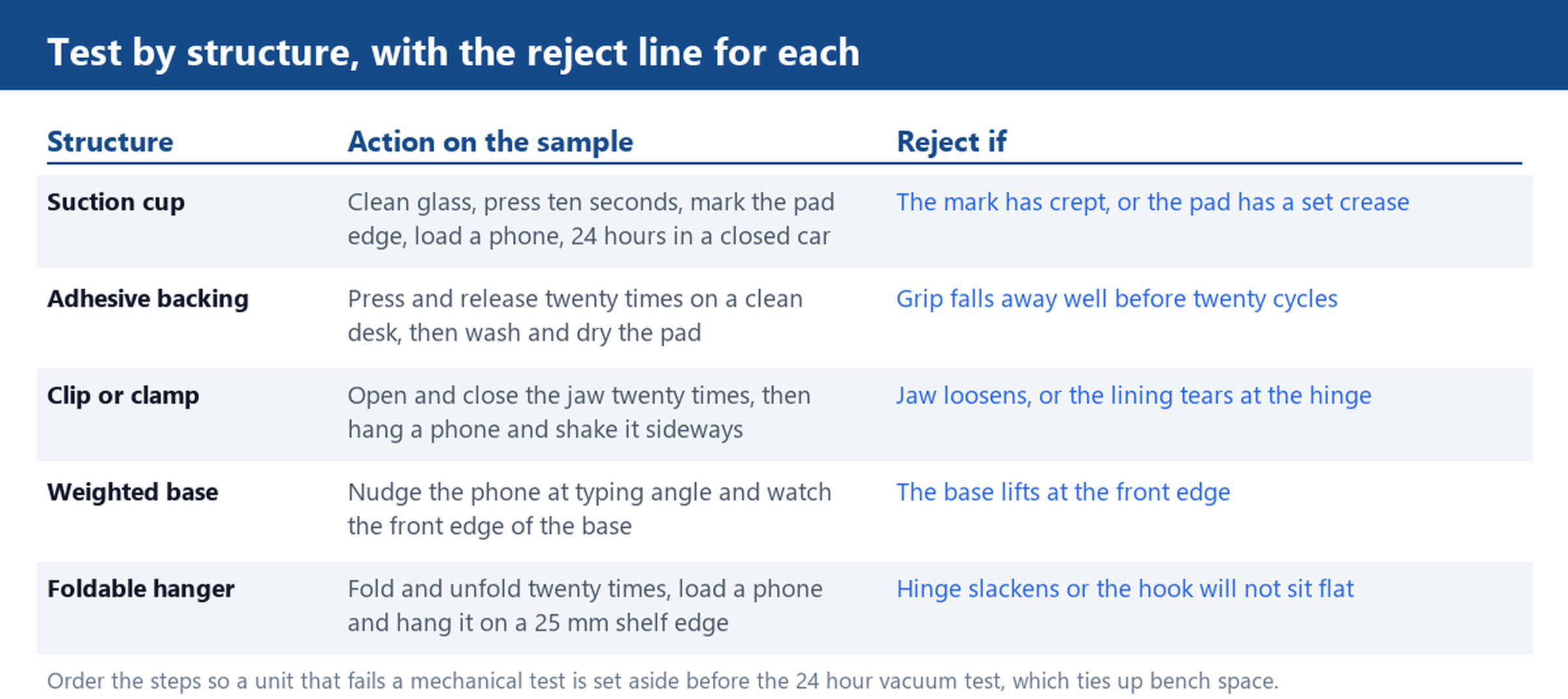
Start by sorting the shipment by structure, because the tests do not transfer. A suction unit cannot be judged by press cycles and a wooden base cannot be judged by vacuum. Once sorted, run the mechanical tests first and the 24-hour tests last, so a unit that fails a clip or a hinge is set aside before it occupies bench space overnight.
Sort the Shipment by Structure Before Testing Anything
Five structures cover the range: suction cup on glass, adhesive pad on a desk, clip or clamp, foldable hanger, and weighted base in wood or silicone. The suction magnetic car holder is packed 48 to an inner box and 192 to a carton, the silicone car holder runs 150 to a carton at 6.7 kg net, and the wooden universal holder ships one per colour box. Those three packing patterns are your first sort, because they map almost exactly onto the three test families, and the whole mounts and stands range is packed one of those three ways.
Write the SKU on the sample bag as you pull it. The suction unit is LGP486, the silicone car holder LGP487 and the anti-skid desk holder LGP484, and a mixed carton with three SKUs on one sheet is how test results get attributed to the wrong model.
Suction Cups: Marking the Pad Edge and Reading Vacuum Loss
Clean the glass with water, dry it, press the pad down for a full ten seconds and then engage the lever. Before loading anything, draw a pencil line on the glass along one edge of the pad. That line is the whole test: vacuum loss shows up as creep, not as an instant drop, and a pad that has moved a millimetre or two overnight will let go under braking.
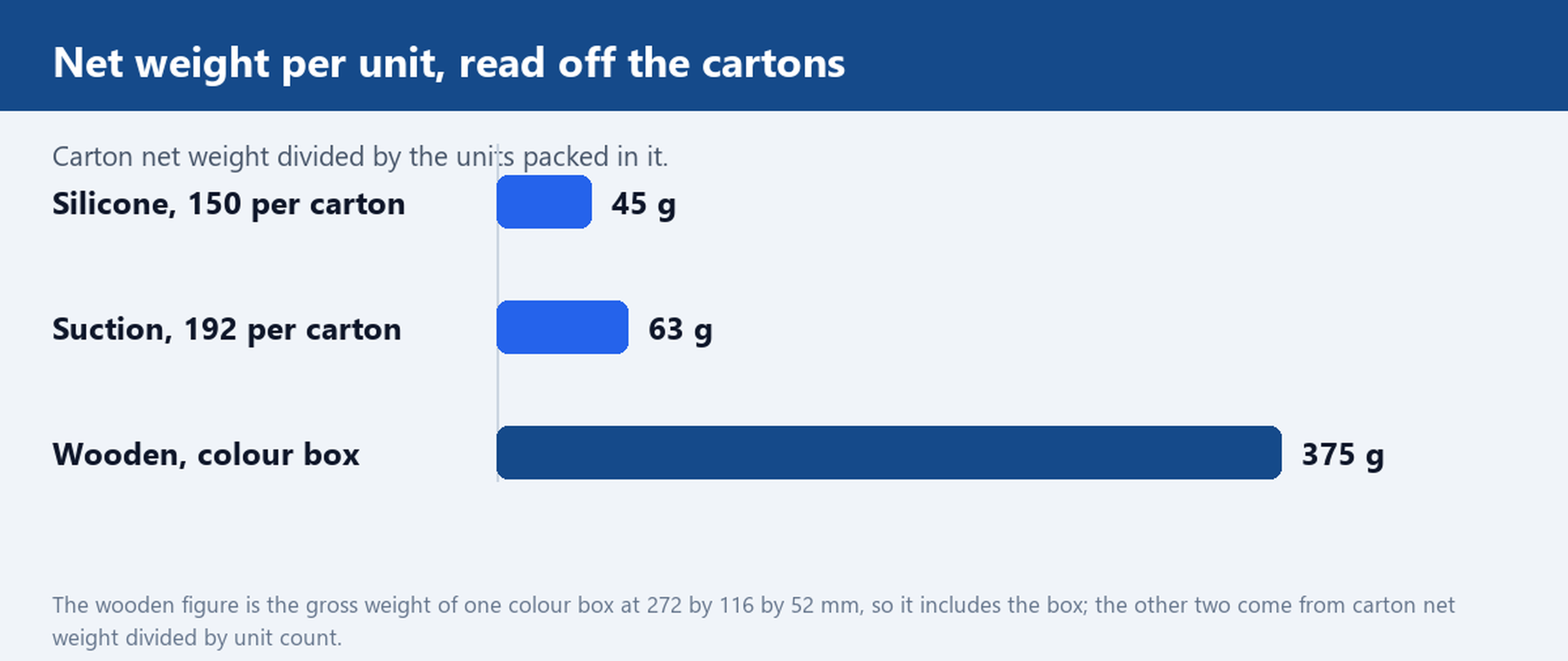
Load a real phone rather than the bare holder. The suction unit weighs about 63 g net per piece, worked out from 12.1 kg net over 192 pieces, so the phone dominates the load and a holder tested empty proves nothing. Leave the assembly in a closed car for a day, then compare the pad edge against the pencil line and check for a crease where the lever presses, since a pad stored folded keeps the set and seals badly from the first use.
Adhesive Backing: Twenty Press Cycles and a Wash
Put the pad on a clean desk, press and release twenty times, and watch where the grip goes. Dust transfer is the mechanism: the first few cycles pick up whatever is on the surface, and by the tenth the pad is sticking to the dust rather than to the desk. A pad that holds through twenty cycles, then holds again after being rinsed and air dried, is a usable product; one that lifts by the third cycle has the wrong adhesive for a desk that gets wiped.
The silicone desk units are the ones to watch here. The anti-skid desk holder is 125 by 70 by 26 mm in silicone and ABS, and that footprint is the whole claim: a base that small relies on the compound rather than on mass, so the press test is the one honest measure of it.
Weighted Bases: What a 375 g Box Tells You Before You Open It
Mass is the mechanism on a weighted base, which is why the carton data is worth reading first. The wooden holder ships in a colour box of 272 by 116 by 52 mm at 375 g gross, against roughly 45 g per silicone unit from a 6.7 kg net carton of 150. That is a factor of eight between the two structures, and it explains why one resists a nudge and the other slides.
Then test the behaviour rather than the weight. Stand the base on the desk, load a phone, and press the top of the phone at the angle a hand would use while typing, roughly 30 degrees from vertical. Watch the front edge of the base: a unit that lifts there will tip in normal use, however much it weighs. Repeat on a surface with a slight slope, because a wood base with a hard foot pad slides on a polished desk where a silicone foot grips.
Packing and Carton Marks: What to Note Before Signing
Check the carton against the packing list in three places. First the unit count: 192 for the suction holder, 150 for the silicone one, and one per colour box for the wood. Second the carton cube, which for the suction model is 60.5 by 46.5 by 35.5 cm at a stated 0.09987 CBM, so roughly ten cartons to the cubic metre and a container plan that follows from it. Third the gross and net weights, since a carton that arrives heavier than declared usually means a substituted material rather than extra units.
Marks are the last thing and the cheapest to fix before shipment. The SKU on the carton has to match the SKU on the unit and on the imprint, and the imprint area should be agreed in writing with the artwork file, not with a photo of a previous order. For a mixed order, one carton mark per SKU rather than one mark for the shipment.
Send your holder mix list for free samples and a bulk quote.