

Choosing a led light for outdoor work and camping comes down to four decisions that decide whether the unit survives a real shift: the ingress rating, the head output and run time, the power plan, and the way the light mounts. Brightness on a spec sheet is the easy part; the failures buyers actually see are water getting into a lamp sold as all-weather, a run time that only holds on the dimmest mode, and a magnet that drops off a van panel. This guide keeps to those four decisions and uses figures taken from listed models so every number can be checked before a carton is released. 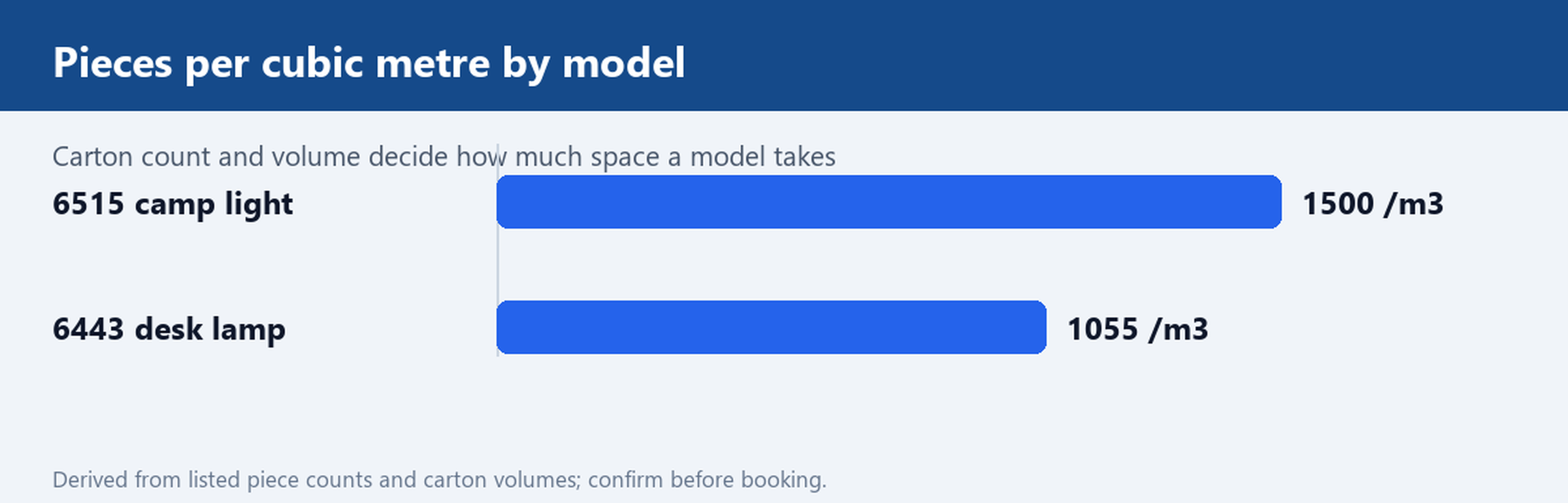
IP33, IP44, IP65 and IP68: what each rating actually survives
The IP scale describes two things: resistance to solid objects and resistance to water. The two digits are not marketing tiers. IP33 means protection against solid objects above 2.5 mm and against spraying water at a narrow angle. IP44 raises the solid-object threshold and resists splashing water from any direction. IP65 adds protection against water jets from any angle, and IP68 covers continuous immersion under the conditions stated by the maker. Reading the digits this way turns a vague claim such as waterproof into a question you can put on a drawing.
The outdoor failure mode is simple: a lamp marked for rain is used where a jet or a puddle reaches it. One work light in the range, the 28.6 cm COB model, is rated IP33, which suits a sheltered porch, a covered bench or the inside of a van, not an exposed campsite in heavy rain. A camping light in the Lights & Lighting range carries IP65 and belongs outside. If a supplier quotes a higher rating than the listed part shows, ask for the rating printed on both the body and the carton, and treat the lower of the two as the real specification. 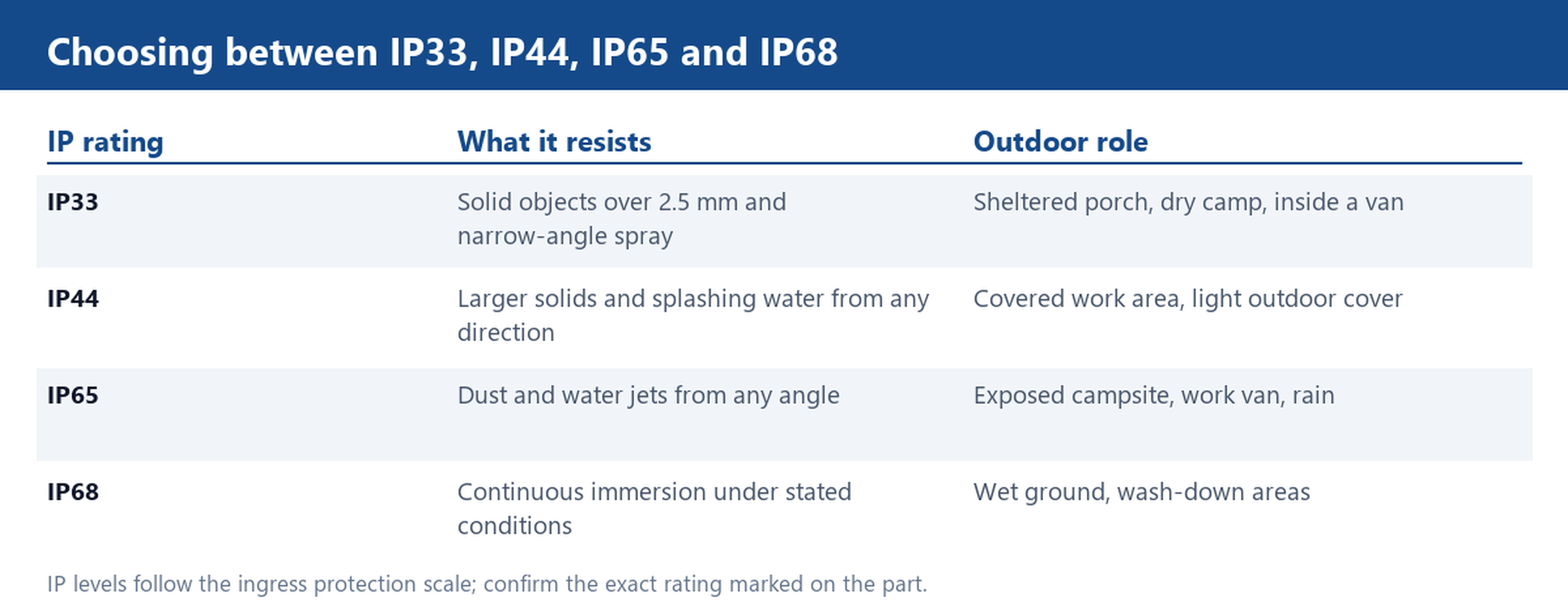
320 lm heads: 80 lm per watt, CRI 80 and the eight-hour run claim
One camping head in the range is specified at 320 lumens, 80 lumens per watt and CRI 80 in cool white. Those three figures answer different questions. The 320 lm value is total light output; 80 lm per watt is efficiency, which implies a roughly four watt draw; CRI 80 is a measure of how faithfully the light renders colour. A buyer comparing two quotes should compare all three at the same conditions, because a high peak lumen number with poor efficiency simply means a larger battery or a shorter run. The listed SMD5730 magnetic camping light puts those figures on one part, which makes it a useful reference point.
The eight-hour run claim needs the same care. Ask at which mode it was measured. A light can hold eight hours on a low, dim setting and fall far short at full output, so a single run-time line is not a specification. Ask instead for output across the run and the battery capacity behind it; at 320 lm and 80 lm per watt, a four watt head running for eight hours needs roughly 32 watt-hours. If the supplier cannot state capacity, treat the run claim as indicative only and ask for a measured curve before you commit.
USB rechargeable, solar option or 3xAA: matching the power plan to the site
Power plan is where a campsite light and a work-van light part company. A rechargeable head, such as the 5+1 LED torch with its internal rechargeable battery, suits a base where a USB source is available each day. A 3xAA torch like the SMD2835 dimming model suits a van or a site where spare cells are easy to carry and a charging point is not. Some work lights accept both a charge cable and 3xAA cells, which removes the dependency on a single power source.
Solar is a genuine option for a campsite with long daylight, but it must be confirmed on the exact part rather than assumed. Not every outdoor light in a catalogue has a panel; some listed torches are rechargeable only. The failure mode is a panel that keeps a light alive in strong sun and does nothing under cloud or inside a van, leaving the buyer with no power. When solar matters, ask whether a panel version exists, what it adds to the carton, and whether the light still runs from a cable or cells when the panel cannot keep up. Choose the power plan from the site conditions, not from a single word on a listing.
Mounting: magnet, hook, rope loop and the 28.6 cm COB bar
How a light is held often decides where it can be used. A magnet on the base lets a camping light stick to a steel van panel or a tent frame, which is fast and needs no fixture. A rope loop or hook suits a branch, a rail or a peak, and a 28.6 cm COB work bar with a rope gives a wide wash of light across a workbench. A belt headlamp, such as the COB headlamp with belt strap, keeps both hands free for the task.
Each mount has a failure mode. A magnet drops off an aluminium or painted surface and can slide on a vibrating panel; a hook that is too light bends under a loaded bar; a rope loop wears where it rubs a sharp edge. Ask how many magnets a base carries, what the rope is made from, and what load the hanging point is rated for. Matching the mount to the surface on site avoids the common result of a capable light that never gets used because it cannot be fixed where it is needed.
Mixed cartons, carton density and marking the IP claim
Outdoor lights are usually mixed into a shared carton rather than shipped alone, so packing figures matter to a buyer planning a container. One camping light is listed at 120 pieces per 0.08 cubic metre, which works out to about 1,500 pieces per cubic metre. A smaller desk lamp is listed at 96 pieces per 0.091 cubic metre, close to 1,055 pieces per cubic metre. Those two figures show why carton data belongs in a quote: two similar lamps can occupy very different space. Ask for the piece count and carton volume of the exact model, then confirm how mixed cartons are split.
Finally, check that the IP claim printed on the carton matches the rating on the body of the lamp inside. A box that says water resistant while the part carries IP33 creates a dispute the supplier will lose. Write the rating, the power plan and the mount into the order, and ask for a sample to test in the conditions the light will actually face. Send your market and IP requirement and we will ship an outdoor light sample for testing; you can also reach us through our contact page.