

One purchase order covering three lighting lines is ordinary business: the torch sells through hardware and petrol-station racks, the headlamp through outdoor and fishing trade, the bike light through sports and commuting shops. What is not ordinary is the carton that comes out of it. A buyer working with one LED light wholesale supplier usually wants the second and third line out of the same shipment, because freight, inspection and the customs entry are the fixed costs. Three lines in one shipment forces three decisions that a single-line order never raises: how many units go into a master carton, what the label says when one carton holds more than one SKU, and whether the cells inside change the shipping paperwork. All three cost nothing to settle before the order, and all three cost a week to fix afterwards.
Why buyers mix three lighting lines: one season, one account, three sell-through rates
The reason is sell-through, not discount. A torch moves steadily through the year, a headlamp spikes when the outdoor season opens, a bike light set moves in the weeks before a commuting season and then goes quiet. Buying all three on one shipment keeps one freight booking, one customs entry and one inspection trip, and lets a small account reach a volume tier it could not reach on a single line.
The trap is that quantities on a mixed order are set by carton multiples, not by the unit count in the plan. A torch line packed at 120 pieces per carton with 0.09 CBM per carton sets the rhythm: a target of 1,000 pieces becomes 8.3 cartons, which is why the real order lands at 1,080 pieces across nine cartons. Ask for the carton multiple and the carton volume of every line before the quantities are fixed, and the order sheet stops fighting the pack.
Read the packing line on the product page as a buying document. The 5+1 LED torch in this range is listed at one piece per sliding card, 120 pieces per carton, 0.09 CBM, shipped 15 days after payment. Those four numbers decide the freight, the pallet pattern and the delivery date, and none of them appear on a quotation that only lists unit price.
Building the carton: inner box counts, mixed master cartons and the weight your forwarder allows
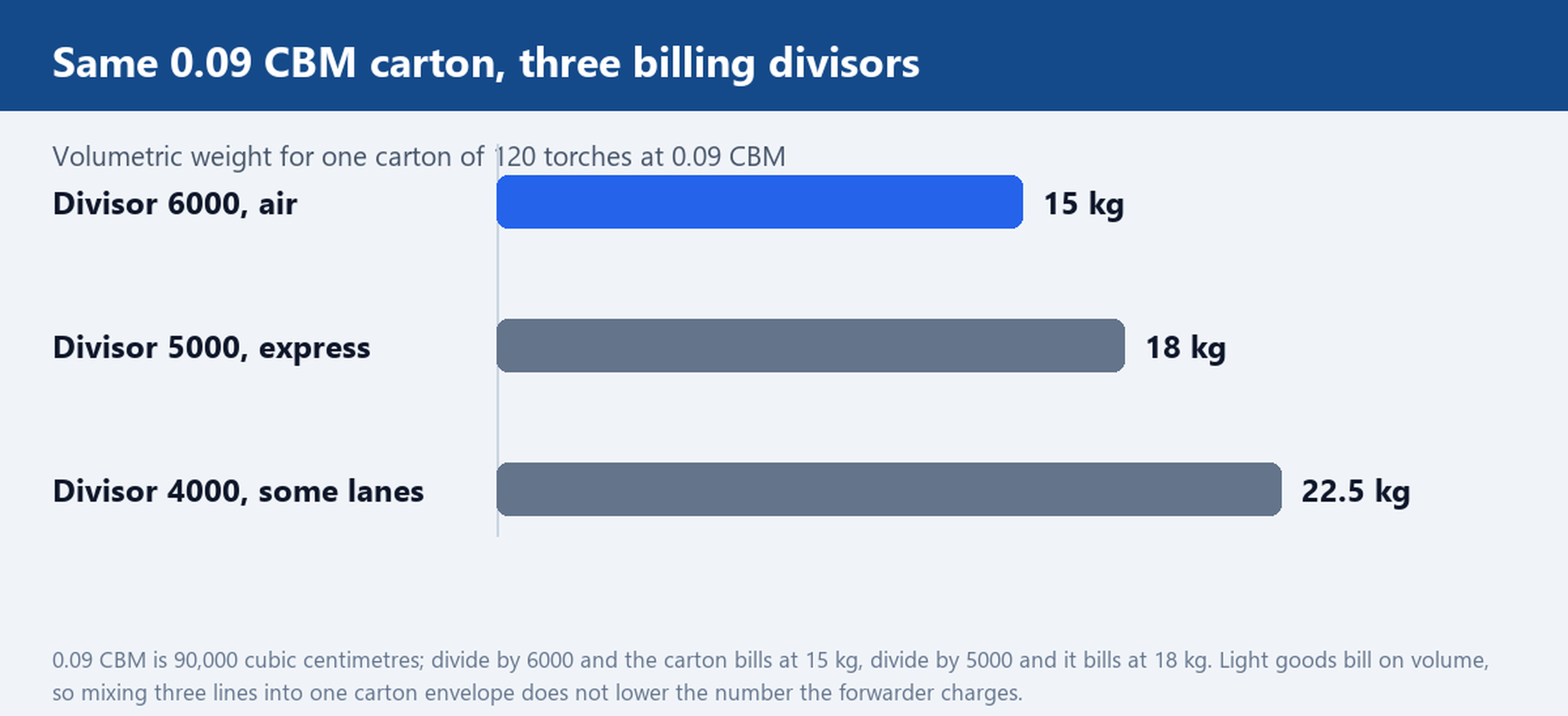
Once the multiples are known, the mixed carton becomes an arithmetic problem rather than a negotiation. Keep the carton envelope and split it: 40 torches, 40 headlamps and 40 bike light sets occupy roughly the same 0.09 CBM as 120 torches, so the forwarder bills the same volumetric figure either way. Mixing does not lower the freight per carton; it removes the second carton minimum and the second pallet position.
Inner boxes are the constraint underneath. A retail-ready inner of 12 pieces cannot be split without opening it, so a line ordered at 50 pieces ships as four full inners and two loose units, and the loose two are what a warehouse loses first. Round each line to whole inners before rounding to whole cartons.
Weight is rarely the limit on lighting. A carton of 120 torches sits far below the 20 to 23 kg that manual handling and most express tariffs accept, which is exactly why light goods bill on volume instead of mass. The limit that does bite is stacking: cartons of different heights cannot share a layer, so if the three lines come in three carton sizes, plan the pallet by layer rather than by total carton count.
Labels and barcodes when one master carton holds three SKUs
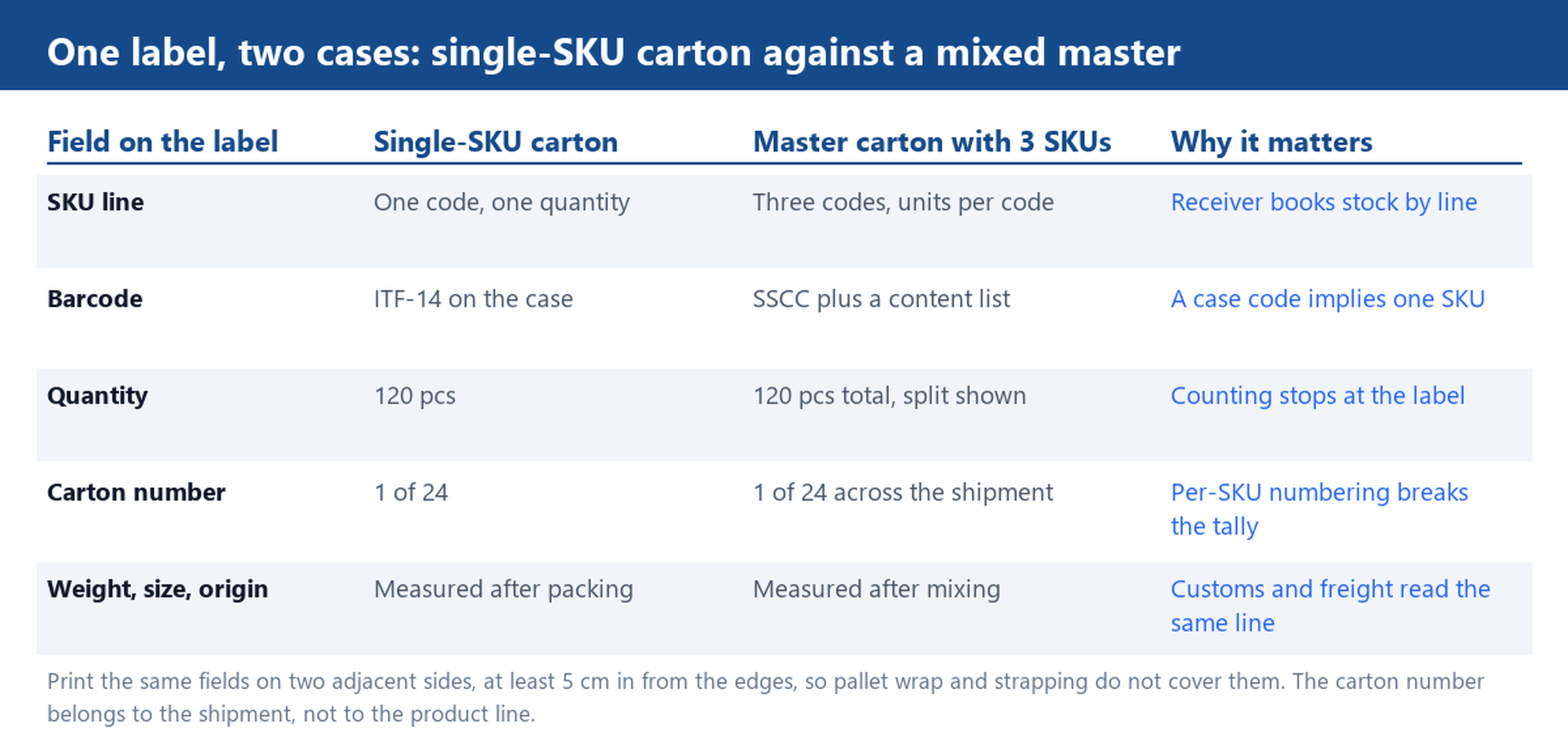
A homogeneous carton has one job: identify one SKU. A mixed carton has two: identify the contents and stop anyone treating it as a single SKU. That difference is where most mixed shipments go wrong, because the label that was fine for a single line is actively misleading on a mixed one.
The fields themselves do not change. SKU or SKU list, quantity, purchase order number, carton number in the form one of twenty-four, gross weight, dimensions and country of origin all stay. What changes is the quantity line, which now needs a per-SKU split, and the barcode, which should be a shipment-level logistics label with a content list rather than an ITF-14 case code that implies 120 identical units.
Carton numbering follows the shipment, not the product. If the torch cartons run one to nine, the headlamp cartons ten to sixteen and the bike light cartons seventeen to twenty-four, a receiver counting against a single sequence will reconcile the delivery; if each line restarts at one, the tally needs three passes and a phone call.
Print position matters more than most buyers expect. Put the same fields on two adjacent sides, at least 5 cm in from the edges, so pallet wrap, strapping and corner protectors do not cover them. A label that can only be read after the pallet is broken down is a label that gets ignored.
Cells in the same shipment: AA, AAA and 18650 fitted or loose, and what changes at customs
Lighting lines carry cells in three different arrangements, and the arrangement decides both the packing and the paperwork.
Dry cells are the simple case. A headlamp built around three AAA cells can ship with the cells fitted or loose in a bag, and fitted is the better default for a retail box, provided the cells are reversed or a tab insulates the contact. A light that switches itself on inside a carton arrives warm, flat and sometimes discoloured, and the customer reads that as a quality problem rather than a packing one.
Lithium cells are the case that changes the shipping file. A torch or bike light built around an 18650 pack travels as a lithium battery in equipment, which puts the shipment in the dangerous goods class that requires a test summary and a shipper declaration with the airway bill. Sea freight accepts the same goods with the same documents, but the booking is not the same booking as a dry-cell shipment, and a forwarder who is told late will re-quote.
Keep the two apart on the packing list even when they travel in one container. Mark which cartons carry lithium, never split a lithium set across two cartons, and keep the fitted-cell declaration consistent with what is actually inside, because an inspector opening a carton and finding a loose cell where the document says fitted is a delay that no supplier can argue away.
One PO, three lines: how the order sheet and the packing list stay in step
Both documents describe one shipment, so they should be the same table read twice. The order sheet carries the commercial view: line, SKU, units, units per inner, units per carton, cartons, CBM and gross weight, with a total row. The packing list carries the physical view: the same rows plus the carton number range that each line occupies.
Three reconciliation checks catch nearly every mixed-order error before the container is sealed. The carton ranges must be continuous with no gap and no overlap. The CBM total must equal the sum of the cartons, not the sum of the lines. The gross weight must be weighed after mixing rather than added up from single-SKU figures, because a mixed carton takes a different amount of filler and a different inner arrangement.
Then keep one carton intact as the reference. When the second shipment of the same three lines arrives, that carton is the standard the new one is compared against, and a shifted print position or a changed inner count shows up in a minute instead of a month.
Send the SKU list you want in a single shipment with the quantity per line, and we will come back with a packed carton plan, a mixed-order quote and the label layout for your warehouse. The lighting range groups the three lines, the LED flashlight line carries the 120-piece carton described here, the LED headlamp line covers the three-AAA and rechargeable builds, the bicycle light line holds the front and rear sets, and the 5+1 LED torch and the 1000 lumen aluminium headlamp are the two units used as examples.