

Three torches on the same shelf can carry the same 8-hour lighting rating and still age in completely different ways. What buyers call led flashlight lifespan is really three separate ageing stories. The rating describes one fresh charge under test conditions. It says nothing about how a dry cell bay corrodes, how a lead acid pack self-discharges in a drawer, or how a 550mAh solar unit fades after repeated cycles. For a hardware or emergency-supply buyer restocking once a year, that distinction matters more than the headline number. This article separates the platforms behind the rating and gives the inspection questions that keep a carton from turning into returns. 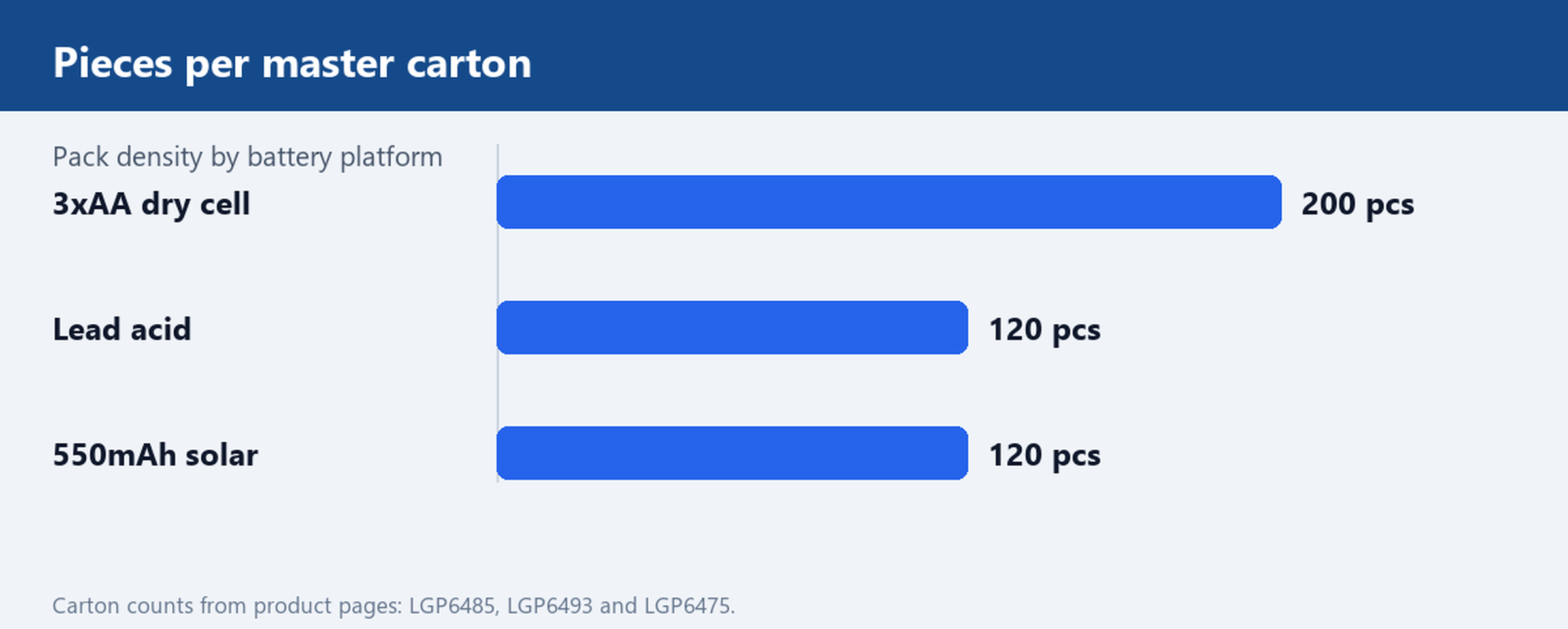
One 8-Hour Rating, Three Battery Platforms
The listed lighting period is 8 hours on the LGP6493 5+1 torch, the LGP6485 3xAA dimming torch, and the LGP6463 push-button model. Each reaches that figure through a different power source. The LGP6493 runs on a rechargeable lead acid pack and carries an IP65 rating. The LGP6485 is built for three AA dry cells and carries IP65 as well. The LGP6475 pairs a solar panel with AC charging and a 550mAh battery, with two dimming levels and a USB port for charging a phone. The LGP6463 uses three AAA cells on a rechargeable basis and is marked IP33. None of these ratings is a lifespan claim. Treat 8 hours as a starting comparison point, then ask what happens to the light after a season in stock. 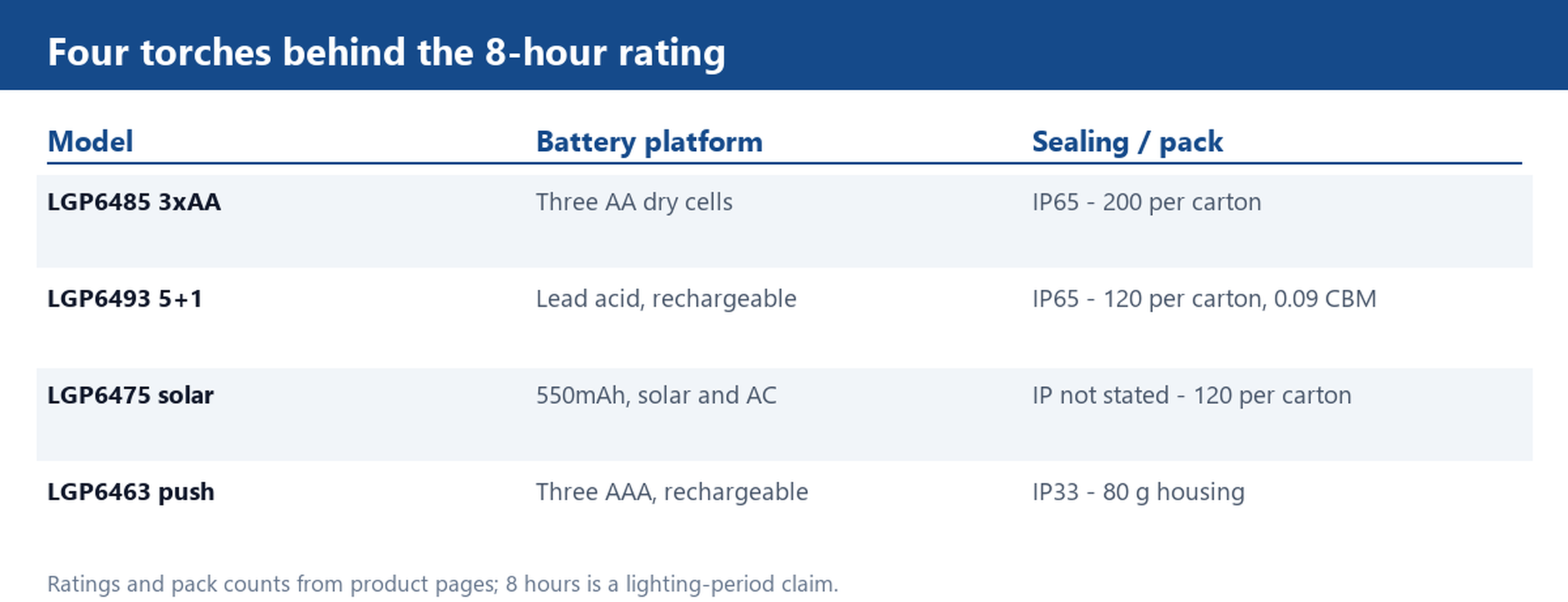
Dry Cell Bays: Contact Corrosion Before Capacity Loss
In a dry cell torch, the usual failure is not an empty battery. Alkaline cells can seep electrolyte when left in a bay for months, and that residue attacks the spring and plate contacts first. The light then flickers or refuses to start even though a fresh cell would work. Inspection should begin at the bay: check whether the contacts are sprung metal with a corrosion-resistant finish, whether a cell can be dropped in without forcing the polarity, and whether the compartment wall separates the terminals from the body seam. Ask the supplier how the bay is treated and whether replacement contact parts are available in the carton. For a restock programme, a torch that accepts standard AA cells and can be cleaned is easier to keep in service than one with a sealed pack. The 3xAA model is the reference here; specify dry cell power in writing so a lead acid variant is not substituted silently.
Lead-Acid Self-Discharge in a Drawer
A lead acid pack loses charge while it sits, even with the switch off. A torch that left the factory at a good state of charge can arrive weak after a long warehouse hold, and the buyer then blames the LED. The fix is a stock policy, not a redesign. Ask the supplier for the state of charge at packing, the recommended top-up interval, and whether the pack can be charged at low current without removing it from the housing. The LGP6493 is listed with a lead acid, rechargeable source, IP65 sealing, and 120 pieces per carton at 0.09 CBM. That carton density is useful for planning: 120 pieces in 0.09 CBM works out to about 1,333 pieces per cubic metre. Compare that with the 550mAh solar model at 120 pieces in 0.114 CBM, roughly 1,053 pieces per cubic metre. Keep lead acid stock turning on a quarterly cycle and avoid placing one large order for the whole year.
The 550mAh Solar Unit and Its Cycle Count
The LGP6475 is the solar-and-AC model: a 550mAh battery, a solar panel, two dimming levels, and a USB port that can charge a phone. Its weak point is the small buffer between charges. Every deep discharge and recharge consumes part of that buffer, and a panel of modest area cannot recover a fully drained battery quickly in weak daylight. The honest questions for a supplier concern the battery chemistry, whether the cell can be replaced, how long a full charge takes from AC, and what the written warranty covers. Do not accept a verbal cycle figure that is not in the specification. For an emergency kit, the practical test is simple: run the light on both dimming levels, let it discharge, then confirm it returns to full output after a normal charge. A unit that needs a long sun exposure to recover will disappoint the end user.
Gaskets First: IP65 Against IP33
Water and dust enter at seams before the battery does. An IP65 housing is sealed against dust ingress and low-pressure water jets; an IP33 housing resists splashing water at an angle and is not dust-tight. The LGP6493 and LGP6485 are marked IP65, while the LGP6463 is marked IP33. For a torch that lives in a workshop, a boat bag, or a rainy site, that difference decides whether the contacts stay dry through a season. Ask how the lens and the switch boot are sealed, whether a gasket is fitted at the end cap, and whether the rating is printed on the carton or only claimed in a catalogue. Specify the IP level in the purchase order rather than assuming all 8-hour torches are built alike. Send us the retail price band and the battery platform you want, and we will quote the torch, the carton count and the warranty terms.