

When the power goes out at night, the first two hours follow a predictable pattern. People reach for a phone, burn a quarter of the battery on the torch, then start opening drawers for something better. What they want is not the brightest object in the house; it is a light that is already where they left it, that can be put down and left running, and that does not need a free hand. That is the requirement an led light for home emergency use has to meet, and it is a room-by-room question rather than a lumen contest.
What a Home Actually Reaches For in the First Two Hours of a Cut
The phone goes first because it is in a pocket. It is also the worst tool for the job: the torch runs the battery down at the moment the household needs the phone for calls, and it has to be held. The second choice is usually a candle, which is a fire risk on a stairwell and useless for reading. The third choice, if the house has one, is the lamp somebody bought for camping and put in a cupboard without charging it.
Three requirements fall out of that sequence. The light has to be stored where it will be used, not in a garage. It has to stand, hang or stick on its own so both hands stay free. And it has to be charged as a matter of routine, because a lamp that has sat in a drawer for a year will have lost charge even with a healthy cell, since lithium packs self-discharge a few percent a month.
For a wholesale buyer building an emergency assortment, those three requirements translate into a set rather than a product. One lamp per room, chosen by how the room is used in the dark, serves the house better than one very bright lantern carried from place to place.
Reading and Desk: 500mAh SMD5730 Lamps and Where They Stop
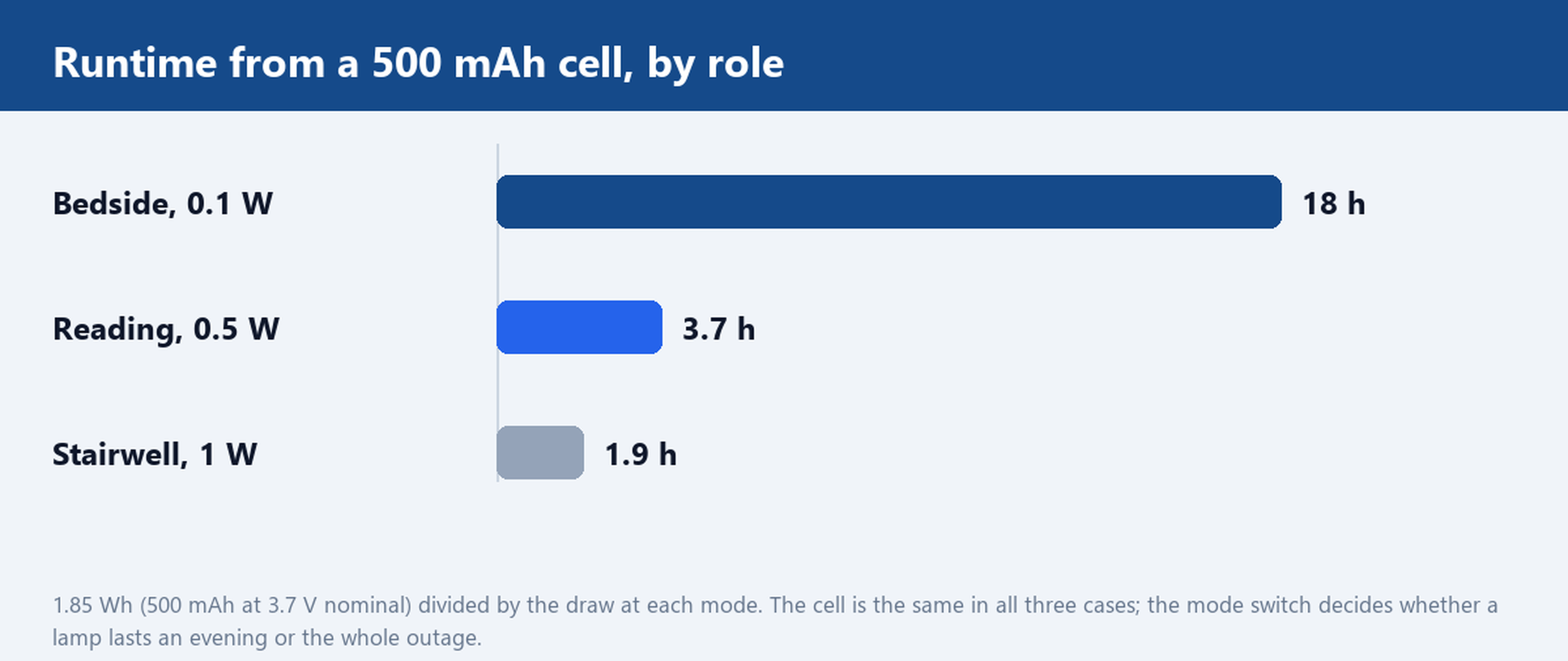
A reading lamp is the most demanding unit in the set, because it has to light a page evenly for an hour or more without being held. The common build uses an array of mid-power emitters behind a diffuser panel, with a small cell in the base. A 500 mAh pack at 3.7 V holds about 1.85 Wh, and that number sets the honest limit of the product.
Divide it by the draw and the trade-off becomes visible. At 1 W the lamp runs for under two hours; at half a watt it runs for close to four; on a low night mode at a tenth of a watt it will last several evenings. That is why the mode switch matters more than the emitter count: a reading lamp with a real low setting serves a whole outage, while the same hardware that only has full power serves one evening and then sits dark.
The diffuser is the second thing to check. An array of emitters behind a proper panel produces an even pool of light with no hard shadows, which is what makes text comfortable. The same array behind a clear cover produces a bright spot and glare at the edge of vision, and buyers return it as harsh even though the output is identical. Our SMD5730 reading desk lamp with a 500 mAh cell is built around that trade-off, with the diffused panel and the lower mode carrying the runtime.
Stairwell and Hallway: Magnetic, Hanging and Hand-Carried Forms
A stairwell needs light that stays put, because the person using the stairs needs a hand on the rail. That single constraint rules out the torch and points at two forms: a magnetic base that sticks to a steel door frame or a distribution box, and a hook or folding bail that hangs from a rail or a nail. Both leave the hands free, and both cost very little to add at the tooling stage.
Placement matters as much as the form. Light mounted at eye level throws glare straight at the person coming up the stairs, which is worse than no light at all on the treads. Light mounted low, angled down the flight, shows the tread edges without blinding anybody. A lamp with a tilting head or a directional panel solves this in one movement; a fixed globe does not.
Output can be modest here. A hallway does not need reading-level light, and a unit that runs at a lower draw for longer is the better emergency product. A magnetic SMD5730 magnetic lamp is the form most buyers settle on for this role, because the same unit also clips into a tent or hangs in a shed, which widens the season it sells in.
Bedside and Night Duty: Constant-On Against Motion-Triggered
The bedside lamp has a different job from the other two: it has to be findable in the dark and gentle when it comes on. Constant-on at a low level does both. The lamp glows enough to show where the door is, nobody has to search for a switch, and a child or an older person can get up without a bright light in the face.
Motion-triggered units look like a better idea than they are in this position. The sensor wakes the room when somebody turns over, the light comes on at whatever level the sensor is set to, and the effect on sleep is worse than the small drain it saves. Motion sensing belongs in a hallway or a cupboard, where the light is only wanted when somebody walks through.
Two details decide whether the bedside unit gets used. The switch has to be physical and findable by touch, because a capacitive button that needs a precise press is useless at three in the morning. And the lowest mode has to be genuinely low, not the same output dimmed by a plastic cover. Test it in a dark room rather than on a bench, since that is the condition that reveals it.
Building a Three-Lamp Emergency Set for a Wholesale Carton
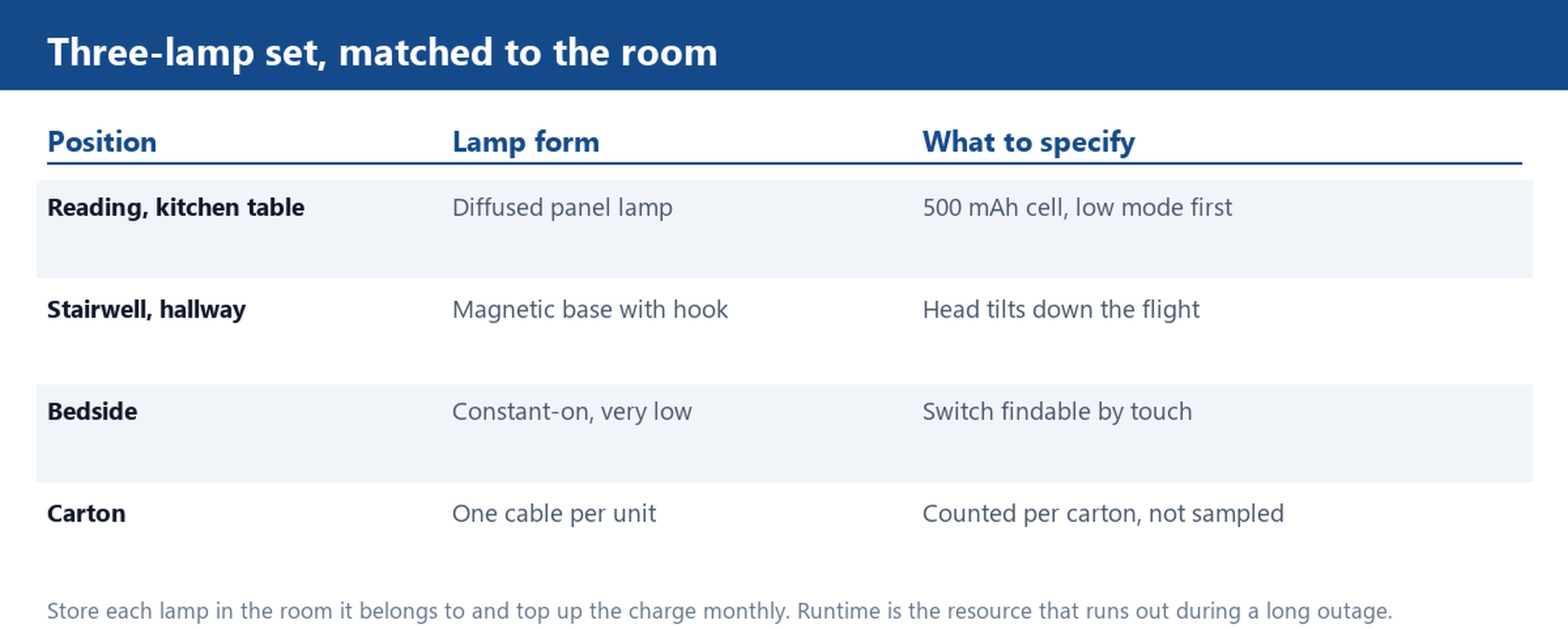
A three-lamp set covers a house without overloading the carton: a reading lamp for the desk or kitchen table, a magnetic unit for the stairwell or hallway, and a low bedside unit. Pack them as a set with one page of instructions, because the instructions are what turn three products into a programme a retail buyer can merchandise.
The page should say three things. Keep each lamp on charge and top it up once a month. Store each lamp in the room it belongs to, not in a central cupboard. And use the low mode first, because runtime is the resource that runs out during a long outage. Those three lines reduce support calls more than any specification improvement at this price point.
Two specification lines belong in the purchase order. State the runtime at each mode, not just the maximum output, and state the cell capacity and chemistry so the set can be compared against another quote. Then require the charging cable to be packed per unit and counted per carton, because a missing cable in an emergency product is a return in the first week.
Send the room list you are buying for and we will put together a three-lamp emergency set sample, with lamp form and battery size matched to each room. The lights and lighting index groups the forms by type, the LED lamp and LED lantern categories cover the two shapes most emergency sets use, and the LED flashlight range covers the hand-carried option for buyers who want one in the carton.