

The most common reason a desk phone holder comes back is not the material and not the finish. It is the base, and specifically what happens when someone pulls the charging cable while the phone is docked. A holder that survives that pull stays on a desk for years. One that tips does not, and the return lands on the importer rather than the user. Choosing on material first, then footprint, then weight, is how to choose phone holder models that survive a real desk instead of a product photo.
Three Materials, Three Buying Reasons: Wood, Silicone and Plush
The material is not a style choice. Each one belongs to a different channel and carries a different set of expectations.
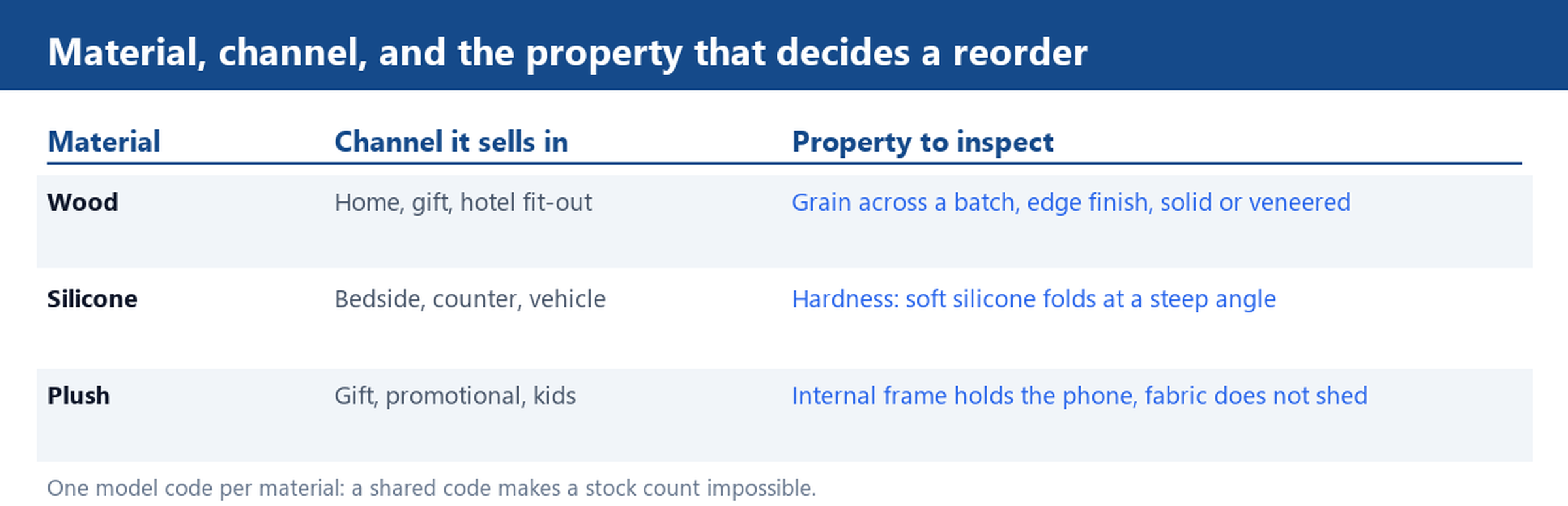
Wood reads as furniture. It sells in home and lifestyle retail, in gift shops and in hotel or office fit-out catalogues, and the buyer is usually matching a finish rather than comparing specifications. The properties that matter are the grain consistency across a batch, the finish on the cut edges and whether the base is solid timber or a veneered board. A veneered base that swells at the edge will be the first complaint.
Silicone reads as practical. It grips, it does not scratch a phone, and it survives being knocked across a desk. This is the material for bedside tables, kitchen counters and vehicle-adjacent use, and the important property is hardness: a soft silicone that folds under a phone at a steep angle will not hold the angle at all.
Plush reads as a gift. It sells as a toy-adjacent item, as a promotional piece and as an add-on in a kids range, and the buyer is choosing a character and a size rather than a specification. What matters is that the internal frame holds the phone and that the fabric does not shed after handling in a store.
Mixing the three in one purchase is normal for a gift wholesaler. The mistake is treating them as one product line with three finishes, because they are judged by three different buyers against three different standards.
Base Footprint and Tip-Over: 83 x 55 mm Against 185 x 108 mm
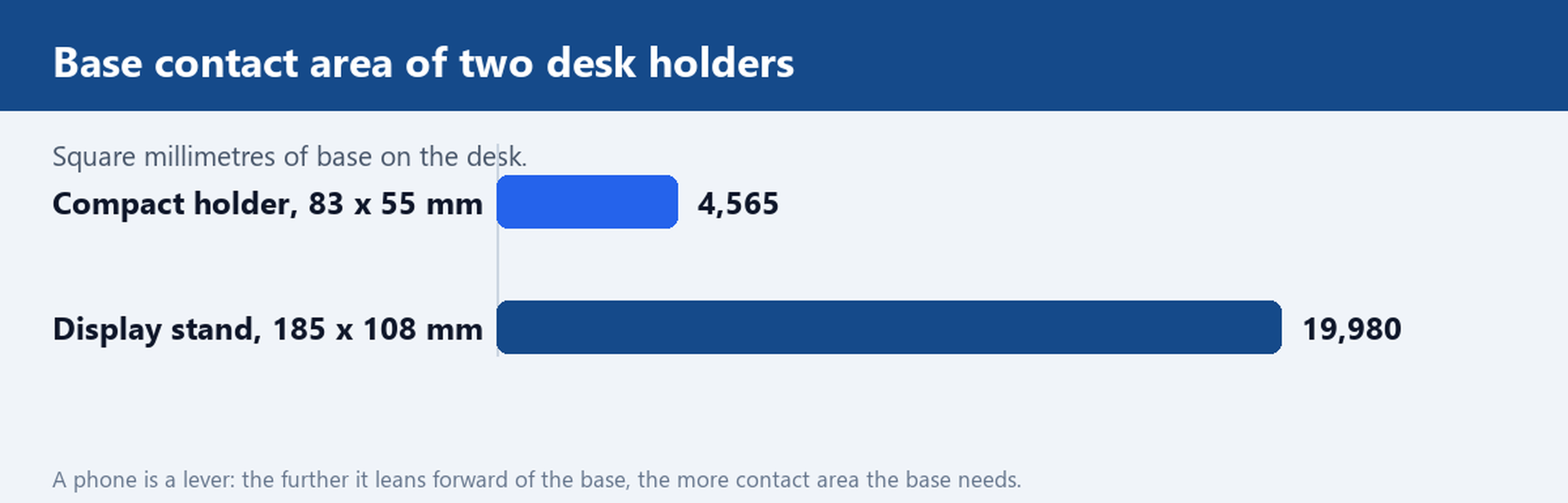
Footprint is the specification that decides stability, and it is easy to compare once the numbers are on the table. A compact desk holder in the current range measures about 83 by 55 mm at the base, which is roughly 4,565 square millimetres. A larger display stand measures about 185 by 108 mm, which is roughly 19,980 square millimetres, more than four times the contact area.
That difference is not cosmetic. A phone is a lever: a device held at a 60 degree lean puts its weight forward of the base, and the further forward, the more the base has to resist. Three practical rules follow.
- Match footprint to phone mass, not to phone size. A light phone on a small base is fine; the same base under a large handset with a thick case is a tip-over waiting for a cable pull.
- Put the mass low and back. A base that carries weight at the rear resists a forward lean far better than one that is merely wide.
- Check the underside. Silicone pads or a rubber foot ring on a smooth desk give grip that a bare wooden base does not have.
Ask for a footprint drawing to scale with any sample. It is the cheapest way to test a shelf plan before committing, because a holder that overhangs a shelf edge is a holder that falls off it.
Weight From 85 g to 360 g and What It Buys You on a Desk
Weight in this category runs from about 85 g for a small moulded unit to about 360 g for a solid wooden or plush body. The range is wide enough that the number should be read as a design statement rather than a quality score.
An 85 g unit is a travel and gift item. It is light enough to be moved, packed or handed out, and it should be sold as something that holds a phone at a comfortable angle rather than something that resists a knock. A 360 g unit is furniture. It does not move when a cable is pulled, and it can carry a larger device at a steeper angle, which is what a desk buyer actually wants.
The useful middle ground is a unit heavy enough to stay put and light enough to ship cheaply. Two things buy stability without adding much mass: a wider base, and a lower centre of gravity. A holder that carries its weight in the base rather than in the upright can be both lighter and steadier than a heavier unit with a high centre of gravity.
Weigh the sample, then set it on a desk and pull a cable sideways. If it slides rather than tips, the base has grip. If it tips, the footprint is too small for the phone you intend to sell with it.
Viewing Angle, Chin Clearance and Where the Charging Cable Goes
Angle and cable routing decide whether a holder is used or abandoned. A desk user wants the screen readable from a seated position, which usually means a lean of about 60 to 75 degrees from horizontal. A bedside user wants a shallower angle for watching, and a stand that only offers one position will be bought once and then replaced.
Three details that are easy to miss on a sample:
- Chin clearance. The front lip has to clear the phone bottom without covering the charging port or a speaker grille. A lip that is too tall blocks the cable; too shallow and the phone slides forward.
- Cable path. A slot or a gap behind the cradle lets the cable drop away instead of looping forward across the desk, which is what pulls a light holder over.
- Case tolerance. Most phones arrive in a case. Confirm the cradle depth against a phone with a case fitted, not against a bare handset.
Where the unit is adjustable, check the hinge. A friction hinge that holds after a hundred cycles is worth more than a wider angle range that sags by the second week. A plastic ratchet with visible teeth is easier to inspect than a hidden friction joint.
Mixing Materials in One Carton Without Breaking the Label Rules
A mixed carton is normal for this channel and it is where paperwork goes wrong. Four rules keep a mixed shipment clean.
- One model code per material. A wood holder and a plush holder sharing a code makes a stock count impossible and a claim harder to argue.
- Material on the carton, not only on the inner box. Customs and retail receiving both read the outer carton.
- Separate inner packing per material. Plush next to a wooden base in one bag arrives with fibre on the timber finish.
- Photograph the mixed carton before sealing. It settles most short-shipment disputes in one message.
The three formats can be quoted together, which is the practical reason to buy them from one place. The mounts and stands range holds the desk formats, the wooden universal phone holder is the reference for a timber base, the anti-skid phone holder shows the grip-pad approach on a moulded body, and the plastic cell phone stand is the light end of the weight range. Buying the three in one carton also means one set of carton marks instead of three shipments with three sets.
Send your shelf or desk plan and we will quote a mixed-material carton with footprints drawn to scale.