

A clear case fails in three ways that a buyer notices within weeks: the back turns amber, the edges become slick, and the case that was bought for wireless charging starts dropping the connection. Each failure traces back to a decision made at the sample stage, and each can be tested before the order is placed. The material choice decides yellowing, the back-wall thickness decides charging, and the edge geometry decides grip and protection. This guide takes the three in order and finishes with the checks that settle them on a real unit.
Why Clear Cases Yellow and Which TPU Grades Slow It Down
Yellowing is an oxidation reaction in the soft plastic, not dirt and not dye transfer. Clear soft cases are almost always thermoplastic polyurethane, and the grade of that TPU decides how the case behaves under light. Aromatic TPU, built on a toluene or diphenylmethane based isocyanate, carries benzene rings in its backbone. Those rings absorb ultraviolet light and oxidise, and the visible result is the amber shift that appears first around the edges and the camera opening, where the material is thin and the light path is short.
Aliphatic TPU uses a different isocyanate and does not have that absorption path, so it holds colour far longer. It also costs more and is softer at the same hardness reading, which changes how the case feels in the hand. That is the trade a buyer is making when two clear cases are quoted at different prices.
A third option is the hybrid: a polycarbonate back with a TPU bumper. Polycarbonate does not yellow, so the large clear panel stays clear, and the TPU is confined to the rim where the change is less visible and the flexibility is needed. The honest description of this construction is that it slows the visible shift rather than removing it, because the bumper still ages.
Additives help without solving the problem. UV absorbers and hindered amine stabilisers delay the shift, and a supplier who can name the additive package is more credible than one who claims a clear case will not change colour at all.
MagSafe Ring Placement: The Thickness That Still Charges
A wireless charging case has one geometric job: keep the magnet ring aligned with the coil in the handset while adding as little material as possible between the two coils. Alignment is set by the ring position and efficiency is set by the gap. Both are dimensional questions, which means both can be settled with a caliper and a charger instead of argued about across a quotation.
Ring position follows the handset model and cannot be averaged across models. A ring placed for one generation sits off centre on another, and an off-centre ring does two things: it reduces coupling, which slows the charge, and it concentrates heat in the misaligned area. Heat is what makes a phone throttle its charging, so the symptom a user reports is rarely slow charging. It is a phone that stops charging for a while and then resumes.
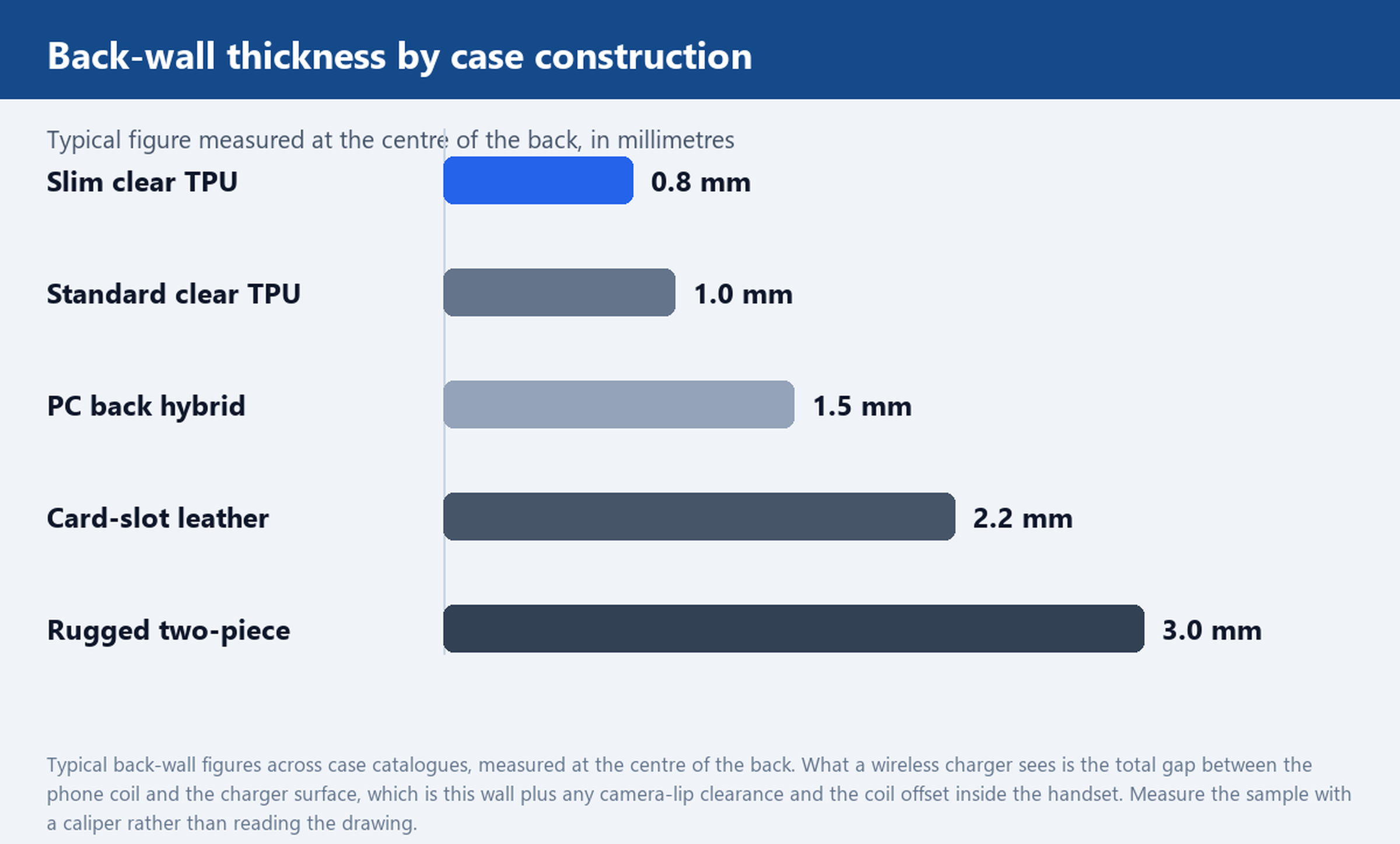
Gap is set by the back wall. A slim clear case measures about 0.8 mm at the centre, a standard clear build about 1.0 mm, a hybrid with a polycarbonate back about 1.5 mm, card-slot leather around 2.2 mm, and a rugged two-piece build up to 3.0 mm. Those figures are typical rather than universal. What matters is the total distance from the coil inside the phone to the charger surface, which is the case back plus any clearance designed into the camera lip.
The decisive test is not a specification line, it is a session. Charge a phone from a low battery through the case and watch for connect and drop cycles. A clear MagSafe case that charges but repeatedly disconnects has too much gap or a ring that is off centre, and the fix is a thinner back or a repositioned ring rather than a stronger magnet.
Grip, Drop and Button Cut-outs: What Edge Height Changes
Grip is friction plus shape. Clear TPU is naturally grippier than a polycarbonate shell, and a matte finish is grippier than a polished one, but the largest single factor is the edge profile. A rounded rim that rolls away from the fingers slides; a squared rim with a slight undercut holds. This is the part of a case that buyers describe as feeling cheap, and it is fixed by a tool that costs money to change.
Edge height above the screen and above the camera is a protection decision with a usability cost. A lip of roughly one millimetre keeps the glass off a flat surface and still lets a thumb reach the screen edge. Much more than that interferes with edge gestures and collects dust in the channel. At the corners, the extra material is what absorbs a drop, and the corners are where a thin case fails first.
Buttons are the third detail. Cut-outs are cheaper and give a direct press; moulded covers cost more, keep dust out and can feel vague. Either is acceptable when it is consistent: press each button ten times on a sample and check for a positive click and no rattle in the surrounding shell. A button that works on one unit and not on the next is a tooling tolerance problem, and it will come back as a return reason rather than as a defect report.
Card-Slot Leather Against Clear: Who Actually Buys Which
The clear case and the card-slot leather case are bought by different customers, and treating them as variants of one product is how a range ends up with stock that does not move. The clear case sells on showing the handset, on charging without removal, and on a landed cost that suits impulse and accessory aisles. The card-slot leather case sells on carrying two cards and a note without a wallet, on a finish that looks right in a meeting, and on not needing to be removed at a payment terminal.
They fail differently too. A card-slot case fails when the stack of cards bows the back, when the latch loosens, or when a card with a chip or a metal layer interferes with wireless charging. That last point belongs on the packaging: a case that charges perfectly while empty can stop charging once two cards are inside, and the customer blames the case rather than the card.
A sensible range carries both, positioned by use rather than by price. What it should not carry is a clear case with a card slot in the back, which combines the thickness of the leather product with the alignment sensitivity of the clear one and satisfies neither customer.
Sample Checks Before a Retail Order
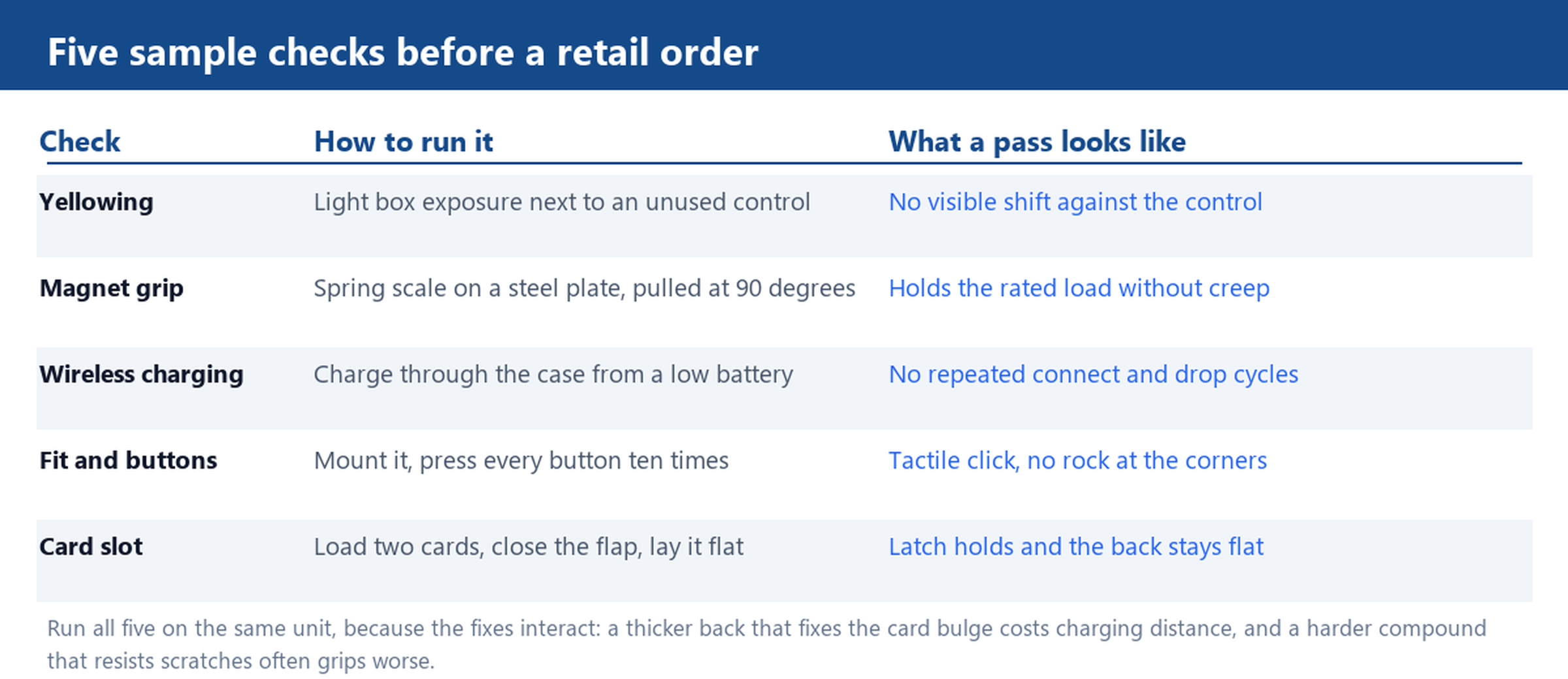
Five checks on a real unit settle most of the risk, and they fit into an afternoon. The table below is the sequence used on this category. Run them on the same unit, because the fixes interact: a thicker back that removes the card bulge costs charging distance, and a harder compound that resists scratches usually grips worse.
Two of the five deserve special weight on any clear order. Comparing the sample against an unused control from the same batch under a light box is the most reliable way to see the start of a yellow shift before daylight shows it, and a full charging session from a low battery is the most reliable way to catch a connect and drop cycle that a short test at high charge will miss.
Our cases and covers range includes a non-yellowing MagSafe build and a leather case with card slots, and the cell phone accessories section collects the mounts and stylus pens that usually ship in the same order. For programmes that combine cases with other categories in one container, the services page covers mixed sourcing, and the contact page is where a model list can be sent.
Send your retail price band and the phone models, and we will ship a non-yellowing MagSafe case and a card-slot leather case so your team can run the light-box and magnet checks on real units.