

When a grid outage hits, the flashlight a buyer reaches for was decided long before the lights went out: by the battery platform sitting inside it. A dry cell torch can wait in a drawer and still run the moment it is needed. A rechargeable unit is bright and ready, but slowly loses charge on a shelf. A solar model tops itself up in daylight and can even feed a phone. For a blackout kit built for the EU market, the practical question is not which single light wins, but which of these three platforms belongs in each carton, and how a sourcing decision changes that answer. Every specification below is taken from current product pages for models listed on this site, so the comparison can be checked line by line. 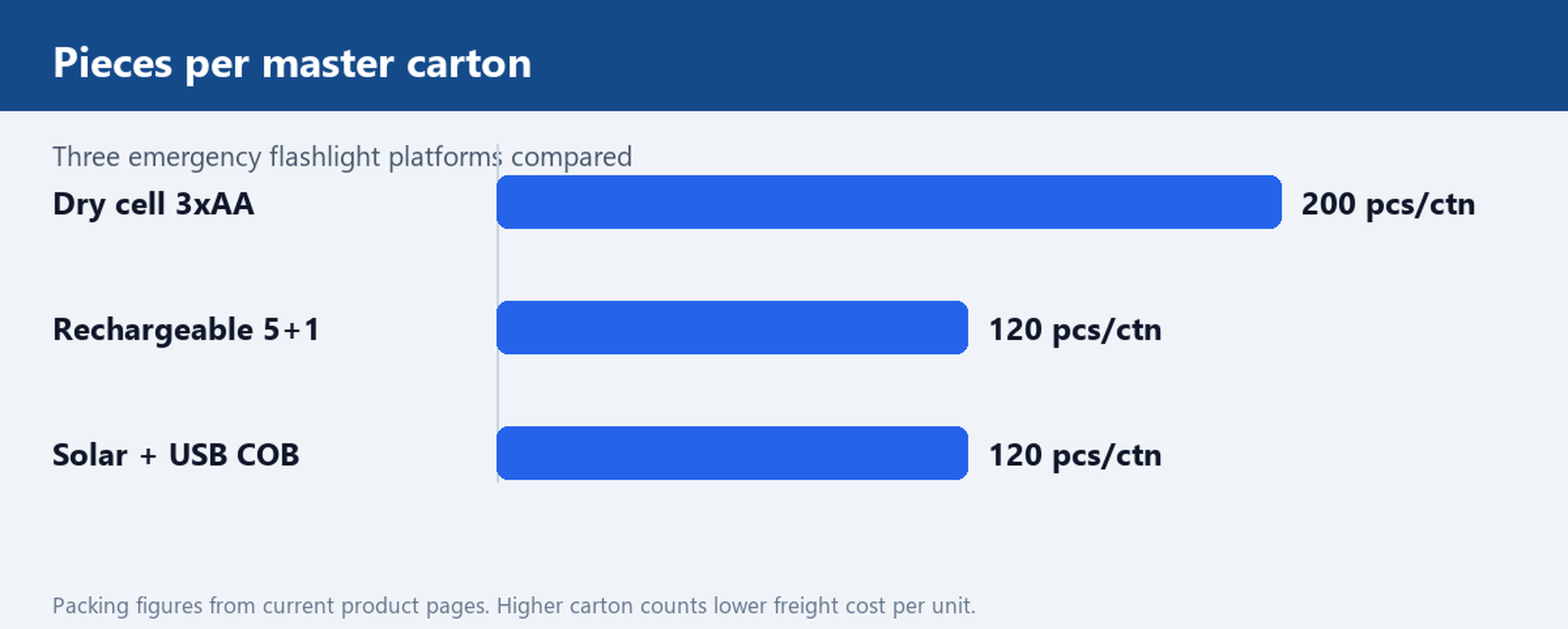
The Three Battery Platforms in a Blackout Kit
Sort emergency lights by how they store energy before the outage, not by how bright the beam looks in a showroom. The first group uses replaceable dry cells: AA or AAA batteries the distributor can ship separately and the household can buy anywhere. The second carries an onboard rechargeable pack that must be plugged in on a schedule. The third pairs a small battery with a solar panel that trickles in charge during daylight, often with a mains input as a backstop.
The distinction matters because a blackout kit is a storage problem before it is a lighting problem. A light that is brilliant but flat after eight weeks in a cupboard has failed the task it was bought for. Three models on this site state Emergency as their listed usage: the 5+1 LED Torch Flashlight (LGP6493), the 3xAA Dimming SMD2835 LED Torch Flashlight (LGP6485) and the Push Button LED Flashlight (LGP6463). They are sold for this scenario rather than adapted to it, which makes their product pages a fair basis for a first-pass comparison. 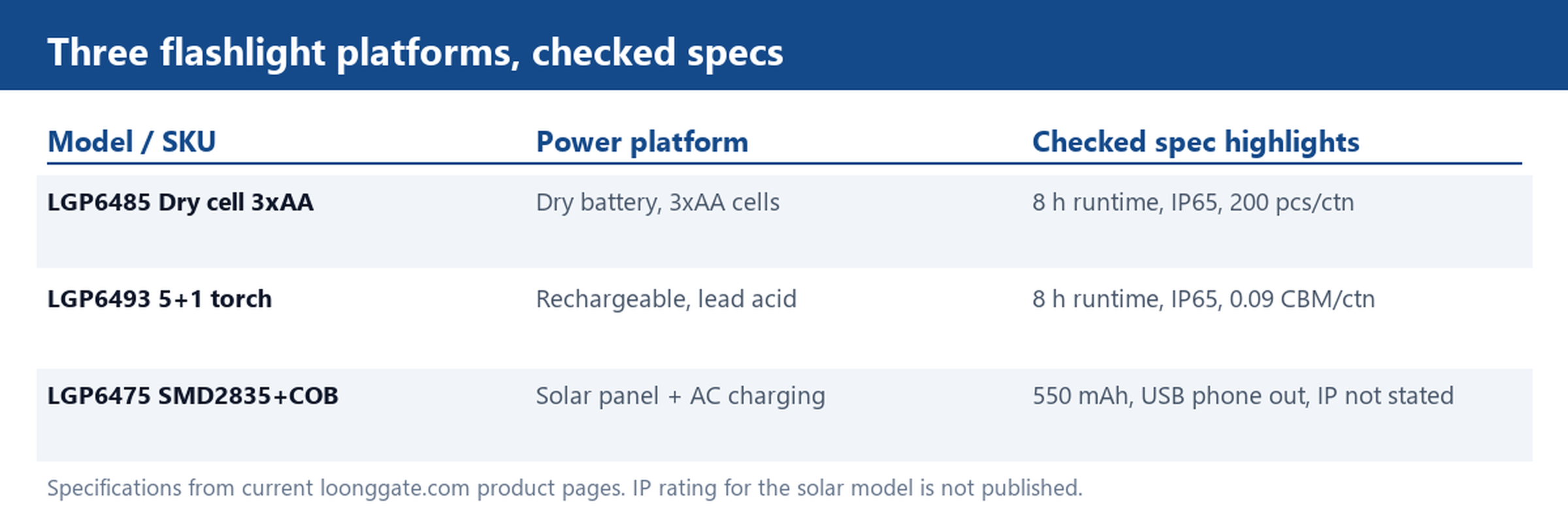
Dry Cell Lights: 3xAA Units and What Storage Costs You
The 3xAA Dimming SMD2835 LED Torch Flashlight lists Power Source: Dry Battery, a lighting period of eight hours, IP65 protection and an ABS body, packed 200 pieces to a master carton in a color box. Its dimming function lets a user trade output for hours, which is exactly what a multi-night outage demands.
The strength of this platform is that the energy and the tool are separate. Ship the light with no cells fitted and the shelf life problem moves to the battery, where it is cheap to solve: a buyer can rotate stock, specify alkaline cells for longer storage, and keep spares in the same carton. The trade-off is ongoing cost and discipline. Once the cells are installed they slowly discharge and, in a lower-grade cell, can leak into the compartment. A sourcing brief should therefore say whether torches ship with cells fitted or bagged separately, and state the accepted cell chemistry in writing.
Carton math also favors this platform. At 200 pieces per carton, the dry cell model puts more units into the same freight space than the 120-piece cartons quoted for the other two models below. For a distributor stocking a national chain, that difference shows up in landed cost per unit, not in the lamp price alone.
Rechargeable Units and the Lead-Acid Trade-Off
The 5+1 LED Torch Flashlight is a straightforward rechargeable example. Its page lists Power Source: Rechargeable Battery, Battery Type: lead acid, an eight-hour lighting period, IP65 protection and an ABS body, with CCC, CE, CQC and RoHS among the listed certifications. Packing is 120 pieces per carton at 0.09 CBM, with a sliding card for each piece.
Lead acid is robust and cheap, but it wants a top-up even when nobody uses the light. A torch that sits charged in a drawer for a season can arrive at the blackout with far less capacity than its eight-hour rating suggests. That is not a defect in the lamp; it is a property of the cell, and it changes what a kit program should promise. Any buyer who specifies this platform should build a recharge interval into the household instruction leaflet, or pair the carton with a simple reminder to plug the units in at the change of season.
The Push Button LED Flashlight offers a useful middle case: its page lists Rechargeable Battery and 3xAAA as alternative power sources, an eight-hour period, two push switches, an 80 g ABS body 15.6 cm high and 5.4 cm across, with CE and IP33. The ability to fall back to AAA cells is attractive for a kit that may sit untouched. The IP33 rating, however, places it in shelter or indoor use rather than a wet porch.
Solar Tops and the USB Out That Charges a Phone
The SMD2835+COB LED Torch Flashlight is the solar-and-USB option. Its product page lists Power Source: Solar panel and AC charging, a 550 mAh battery, two dimming levels, an ABS body of 19.2 by 6 by 6 cm, and a USB port that can charge a mobile phone. Packing is 120 pieces per carton at 0.114 CBM.
Solar is a supplement, not a guarantee. The panel needs daylight and a clear line to a window or outdoor space; a torch stored in a cupboard gains nothing from a sunny week. That is why the listed AC charging input matters as much as the panel: it gives the distributor a way to prepare stock before it ships and gives the household a recovery path after several cloudy days.
The USB output introduces a priority decision. The 550 mAh cell can go into the beam or into the phone, and a blackout kit should say which wins. Two dimming levels help here, because a lower setting can stretch the same charge across more hours. Buyers should ask for the actual output current at the USB port and test it with the phone model they expect to support; the presence of a port alone does not establish how quickly it charges. The product page for this model states no IP rating, so protection level is a question for the supplier rather than an assumption.
IP Rating and Where the Light Actually Lives
Protection rating decides where each platform can be kept and used during an outage, and it is easy to overlook when the buying conversation stays on lumens. The dry cell 3xAA model and the 5+1 rechargeable torch both list IP65, which suits a workshop, a garage or an exposed doorway where rain and dust are plausible. The push-button model lists IP33 and belongs in a sheltered room. The solar-and-USB model lists no rating on its page, so a kit program needs a written answer before it is specified for outdoor storage.
A sensible blackout assortment mixes the platforms instead of choosing one. Put dry cell units in the long-storage tier, where the cells ship separately and the shelf life is manageable. Put rechargeable units with households that will follow a recharge schedule. Put solar-and-USB units where daylight is reliable and a phone is likely to be the second priority. Link the tiers to the LED flashlight range and the lights and lighting category when building the shortlist, and confirm branding options against the stated OEM and ODM availability.
Ask for samples across the three battery platforms with your branding requirement, then run the same drill on each: charge state after eight weeks on a shelf, beam output after a full night, and whether the USB port delivers what the specification claims. For a quote against the models discussed here, use the contact page with quantities per platform.