

Buyers who search for bicycle light lifespan are rarely asking about the LED chip. In the models we list, the parts that end the useful life of a light are the cell, the charging pattern and the seals around the body. A rechargeable front light with a 2×18650 pack is rated at 1,200 lumens for four hours on high and 300 lumens for eight hours on low, while a simple front and rear set runs on three AAA dry cells you can swap in a minute. Which of these stays useful for more winters depends on how you ride and how you store it, not on a single number printed on the box. This guide uses only the published figures for the listed models so a buyer can compare like with like. 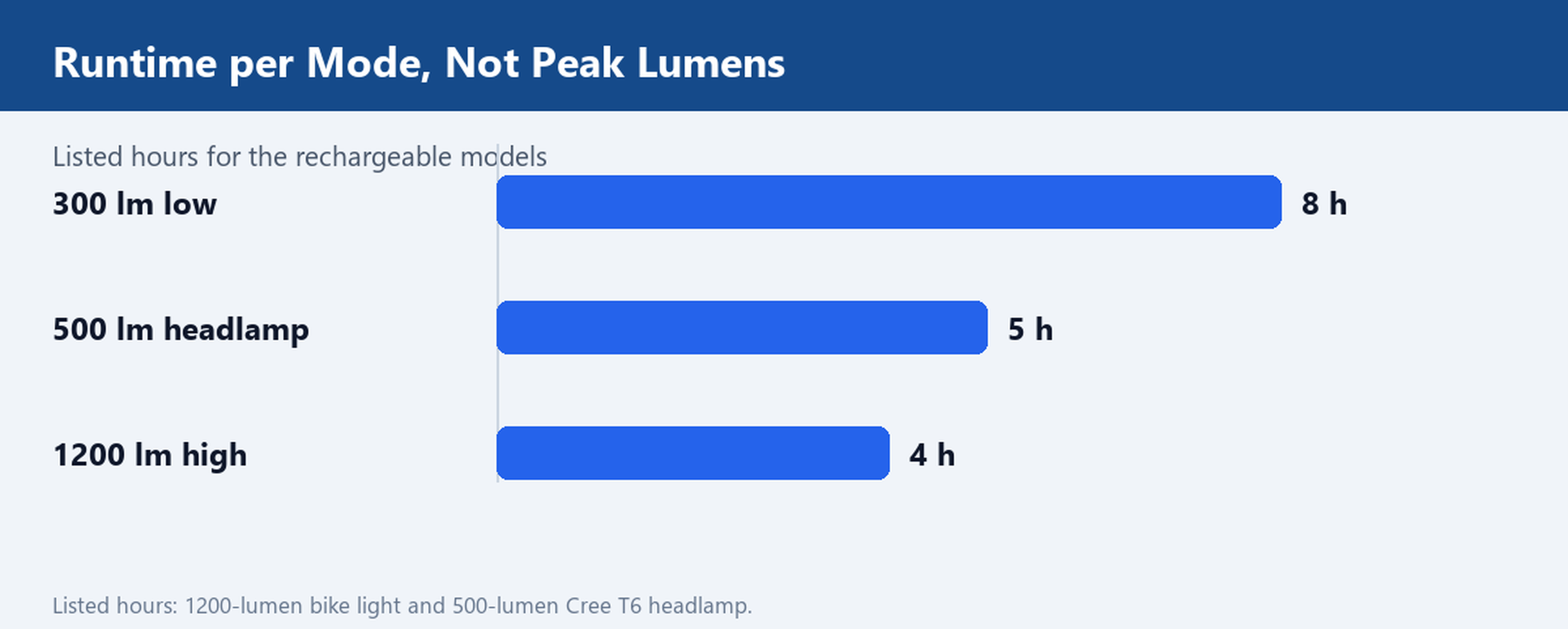
Runtime per Mode Is the Fair Way to Compare Cells
Peak lumens make a good headline and a poor comparison. The 1200 Lumen CREE XM-L T6 Bike Light quotes 1,200 lumens at high and 300 lumens at weak light, with four hours at high and eight hours at weak. That is a two-to-one spread in runtime from the same pack. The 50-lumen front and rear set quotes 50 lumens and three modes, high, low and flash, without a separate hour figure for each mode. The 500-lumen Cree T6 headlamps quote five hours of runtime at their listed output. If a buyer compares only the 1,200 versus 500 versus 50 lumen numbers, the dry-cell set looks weak. If the buyer compares how long each one actually emits usable light on a night commute, the answer changes. Ask a supplier for hours at each mode, not just a peak figure, and ask whether the quoted hours are measured on a fresh pack or after a season of charging. A mode that halves output but doubles runtime is often the setting that decides whether a light stays useful through a winter of short, repeated rides.
Dry Cells, 18650 Packs and What Each Buys
Cell size sets both the energy you carry and the way a light ages. The front and rear set uses three AAA dry cells. Dry cells are cheap, can be replaced anywhere, and do not suffer from charge-cycle wear, so a light built around them can hold its original output as long as you fit fresh cells. The trade-off is a 50-lumen ceiling and the recurring cost and waste of batteries. The 1200 Lumen CREE XM-L T6 Bike Light uses a 2×18650 lithium pack at 7.4V and 2,200mAh. That pack is what allows 1,200 lumens at high, and it is rechargeable, but a lithium pack slowly loses capacity with charge cycles. The two Cree T6 headlamps use 2×18650 Li-ion cells at 3.7V with 500 lumens and a five-hour runtime. When a buyer asks how many winters a light will last, the honest answer starts with which of these cell formats the light uses and whether those cells can be replaced by the user or by the factory alone. 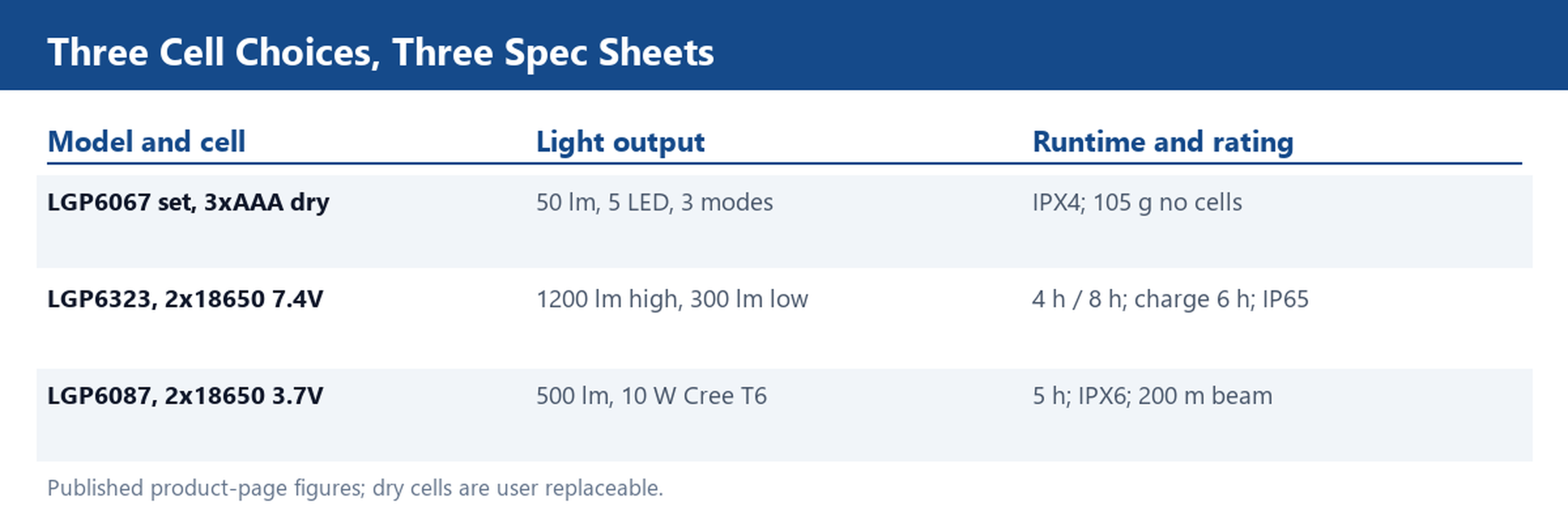
Charge Time Against Ride Time, the Ratio Buyers Forget
The 1200 Lumen CREE XM-L T6 Bike Light lists a six-hour charging time. On high mode it delivers four hours; on weak mode, eight. A buyer who rides one hour a day on high will charge roughly every four rides and spend six hours at the wall between them. The same light on weak mode runs longer than it takes to recharge, which changes how you plan a week of commuting. The dry-cell set has no charging time at all, because swapping three AAA cells takes less than a minute. That ratio, hours of light per hour of charging, is a better predictor of daily satisfaction than peak lumens. Ask for the charging time together with the runtime per mode, and ask whether charging a partly discharged pack each evening harms it over a season. A light with a long charge and a short high mode spends more evenings unplugged and dim than one with a modest output and a short charge.
Seals, Clamps and the Parts That Fail Before the LED
Water ingress and mounting hardware end more lights than the emitter does. The front and rear set is rated IPX4, which suits rain and spray but not a pressure wash or a submerged puddle. The 1200-lumen bike light is rated IP65, and the two Cree T6 headlamps are rated IPX6. Those ratings describe the seal at the time of sale; the gasket still ages, and a light that has been opened to charge or to fit cells has a seal that has been disturbed. The plastic mount on the 50-lumen set fits handlebars from 20 to 30 millimetres and is the part most likely to crack or loosen on rough roads. The aluminium-bodied models trade some weight for a sturdier shell, but their headbands and clamps wear too. Before a light is retired, check the seal for hardening, check the clamp for play, and look inside the lens for fog after a wet ride. Those three checks catch failures early, long before output drops. The bicycle light range lists the mount style next to each model so you can match it to your bar diameter.
Lumen Drop and When a Light Is Worth Replacing
There is no single hour count at which every light becomes worthless. Watch for changes you can measure. If a pack that used to hold eight hours on low now fades after a few, the cells are losing capacity. If the high mode no longer looks twice as bright as low, the driver or the emitter is drifting. If the seal has hardened or the clamp slips on a 25-millimetre bar, the light is no longer safe to rely on even when it still shines. A dry-cell set in that condition is cheap to keep going, because the cells and the mount are the parts that wear out. A rechargeable unit with a sealed 18650 pack needs a different decision, and the practical question for a buyer is whether a replacement pack or a new unit costs less over the seasons you plan to ride. Tell us your runtime target per mode and we will send a sample in the cell size that matches it.