

A buyer looking at an led light certification requirement for a mixed container is really asking which papers belong to which lamp. An AA lantern, a torch with a built-in rechargeable pack and a solar work light can share one carton, but their files are not interchangeable. Sort the order by power path first; the lumen number on the sheet will not tell you which documents to request. 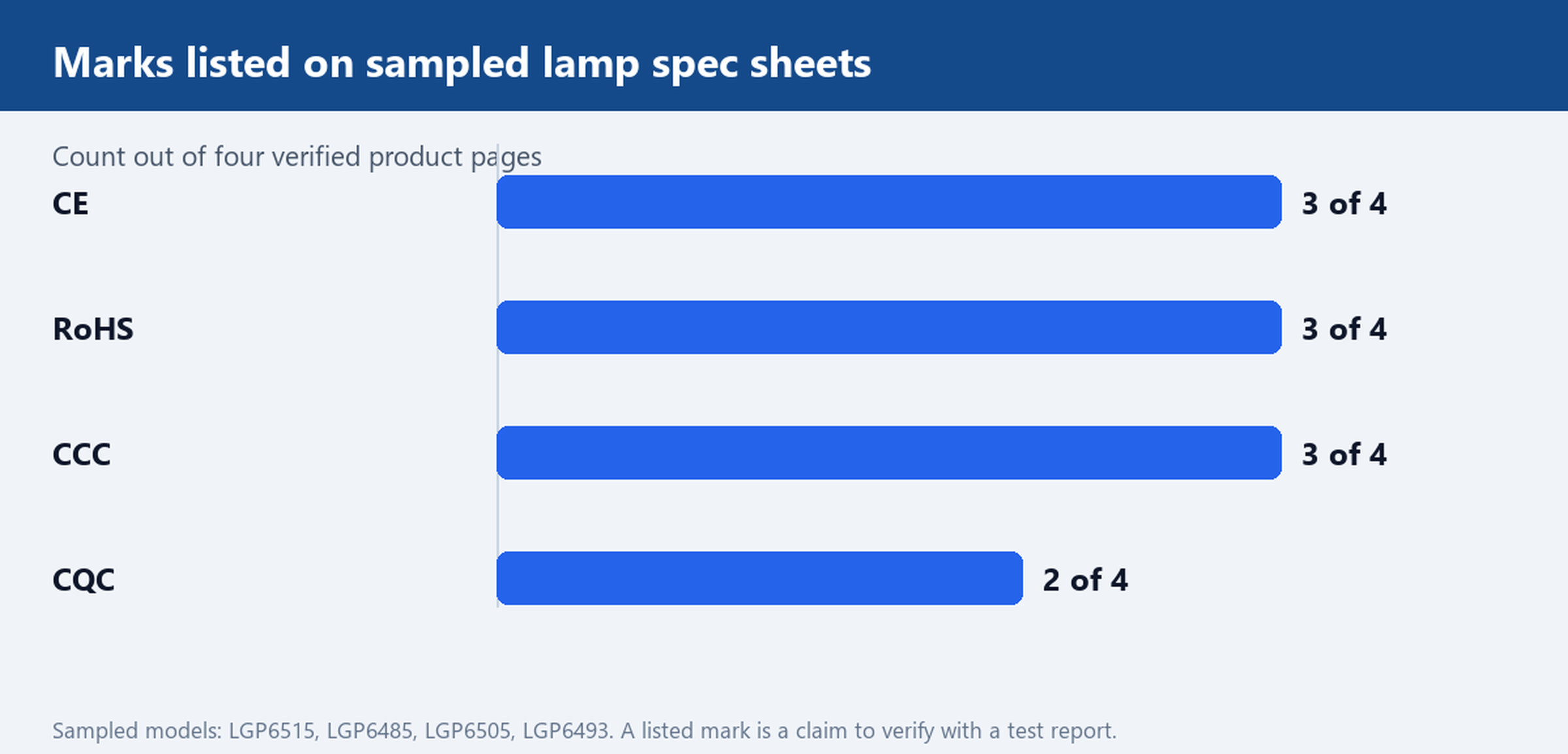
Three Power Paths, Three Paper Trails
Start by splitting every line item into three energy groups. The first group runs on replaceable dry cells: the LGP6515 camping lantern lists AA cells, 4 W, 320 lm, 80 lm per W and IP65 on its product page, while the LGP6505 headlamp lists three size-7 dry cells, 1 W and IP55. The second group carries a built-in rechargeable source: the LGP6493 torch lists a rechargeable battery and IP65, and the LGP6443 desk lamp is a 500 mAh unit. The third group is solar charging with an onboard storage cell.
This split matters because the paperwork follows the energy source, not the body shape or the brightness. Two torches that look alike on a catalogue page can need very different shipping documents if one takes AA cells and the other carries a sealed pack. The LED flashlight range and the lights and lighting range should therefore be read as specification sheets, not as a single family with one file.
Treat the Certification line printed on a product page as a claim to verify. Several sheets in this range list CE, RoHS, CCC or CQC. A mark in a table is not the certificate, and a code quoted in an email is not the test report. Ask for the report that supports the mark and the declaration that puts it on the product.
Dry-Cell Lamps: CE, EMC, LVD and No Transport File
For a lantern running on ordinary AA or AAA dry cells, there is no lithium dangerous-goods file to collect. The cells ship as normal retail goods, so UN38.3 and a lithium battery safety data sheet are not part of this group. The product-level file is the CE technical file covering electromagnetic compatibility, a RoHS statement, and an ingress protection report whose code matches the number printed on the housing.
LVD deserves a careful reading. The low-voltage directive applies when a mains supply is part of the delivered configuration. The LGP6515 sheet lists both an input range of 110 to 220 V and AA cells, so ask which configuration is actually shipped. A bare dry-cell lantern usually sits under EMC and RoHS; a version bundled with a mains charger needs the mains-side file as well. Confirming this in writing early avoids a document request arriving after the goods.
The IP code is another place where the sheet must match the test. The LGP6485 torch page lists IP65 together with CE, CQC and RoHS, while the LGP6505 headlamp lists IP55 with CE and RoHS. Those are different protection levels, and neither should be upgraded in the invoice or the artwork without a test report for that exact model. A family-level IP claim across a whole catalogue is not a substitute for a model-level report.
Useful references while you build this part of the file: the 3xAA dimming torch and the belt headlamp.
Lithium Lamps: UN38.3, MSDS and IEC 62133
Once a lamp carries a built-in rechargeable cell, three more documents enter the file. UN38.3 is the transport test summary the carrier will ask for, the material safety data sheet describes the cell chemistry and emergency handling, and IEC 62133 (or its EN adoption) is the safety report for the cell and pack. CE and RoHS still apply to the finished luminaire.
Do not assume that rechargeable always means lithium. The LGP6485 sheet, for example, names a lead acid battery type while listing a dry battery power source, and the LGP6493 sheet names a rechargeable battery. Such mixed wording is common on legacy spec sheets, and it is exactly why the chemistry line must be confirmed against the cell label and the safety data sheet before booking freight. Getting this wrong changes the transport classification of the whole carton.
For a compact built-in unit such as the LGP6443 reading lamp with its 500 mAh cell, also request the cell datasheet and the charge cycle specification. Those are not marketing details: they tell you what the pack can tolerate in storage and how the unit should be packed for a long sea leg. Keep the cell model number on the packing list so the document set can be matched to the goods at the port.
Solar Units: Panel, Cell and the IP Claim
Solar is not a certification category on its own. A solar lamp is judged by the panel, by whatever cell stores the charge, and by the housing. If a storage cell is onboard, the lithium document set from the previous section still applies to that cell; adding a panel does not remove it.
Ask for two extra items for each solar model: the panel datasheet with its rated output and cell type, and the charge controller specification. Together they explain what the light can actually collect and store, which is the number buyers are really trying to check when they request a solar option. Where a supplier quotes a panel figure, ask whether it is measured at the panel or at the lamp output after conversion.
The IP claim on a solar unit is often the weakest part of the file because the panel and the housing are assembled together. Request the ingress protection report for the finished assembly, not for the housing shell alone, and check that the code printed on the carton is the code in the report. Treat any higher number offered in conversation as a change to be documented before it appears in a listing.
Assembling the File for a Mixed Carton
With the three groups identified, build one folder per model and one index for the container. The table below sets out the documents to request against each power path; it is a checklist for the buyer, not a declaration that any given model already holds every paper. 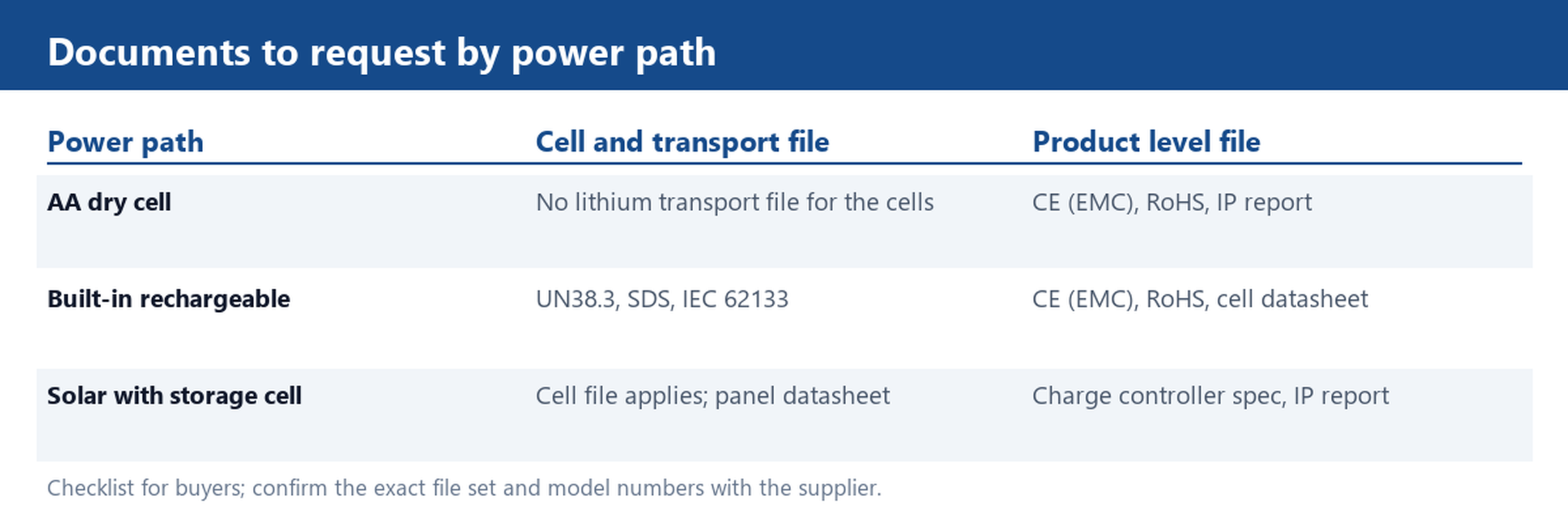
Finally, align the paperwork with the packing data. The LGP6515 sheet gives 120 pieces per carton at 0.08 CBM and the LGP6493 sheet gives 120 pieces per carton at 0.09 CBM, so a mixed container has both carton footprints. Put the carton counts, the cell chemistry and the model numbers on the same index sheet. When a forwarder or a customs desk asks a question, one line should answer which lamp is in which box and which file belongs to it.
Send your lamp list with battery type and we will map the documents each model needs before the PO.