

When a gift or retail buyer puts a phone case vs phone holder on the same purchase order, the question is not which design wins on its own. It is how two very different shapes and weights share one carton, and which one the customer is likely to keep. A rotating stand case ships flat and light with the phone protection built in. A separate holder, especially a wood base, ships as a bulkier object that has to earn its place with a lower return rate and a better gift presentation. This page compares them the way a mixed-order buyer actually does: by what gets unboxed, by volume and weight in the carton, and by the channel each suits.
Short version: the ring stand case is the lower-risk line for counter retail and for any order that cares about cubic metres; the separate base is the gift-shelf item where a heavier, more substantial object is part of the value. Most mixed orders carry both, and the trick is weighting the carton toward the case without letting the base dominate the freight. The arithmetic is below.
One Piece or Two: What the Buyer Actually Unboxes
A rotating stand case arrives as one item. The customer fits the phone, and the stand is already there, recessed into the back. There is no second box, no loose part to misplace and no assembly step at the counter. For a retail buyer that is a simple SKU: one barcode, one shelf facing, one thing to explain to a shopper. The trade-off is that the stand is fixed to one phone model, so the buyer must match case inventory to phone inventory.
A separate holder is a different proposition. It is bought once and used with whatever phone the customer happens to own, which makes it model-agnostic and safer against a phone mix that changes during a season. A gift buyer likes that: the item can sit in a drawer and be given without knowing the recipient device. But it is two things in the customer mind, the phone and the stand, and the stand has to be stable enough that a phone does not slide off a desk edge. For a mixed order, that difference in unboxing is the first thing to write into the brief: one-piece convenience against model-agnostic flexibility.
The Ring Case: 360-Degree Tilt in a Recessed Channel
The stand case in this comparison uses a ring that rotates through a full 360 degrees and folds into a recessed channel on the back of the shell. The ring gives both a landscape kickstand and a grip for the hand, which is why it sells as two features in one SKU. The design details a buyer should check are the depth of the recess, the tightness of the hinge and whether the ring sits flush when folded. A ring that protrudes from a flat-laid phone is a common complaint, because the phone rocks on the table and the camera lens takes the load.
On a sample, lay the phone flat on a hard surface and press the corners. Any rocking means the ring is not fully recessed. Then open the ring and set it at the angle a customer would use for video, and check that the hinge holds that angle under the weight of the phone rather than folding shut. These checks take a minute and say more than a spec line. Our rotating stand case shows the configuration, and the same criteria apply to any ring design in the range.
The Separate Base: Wood at 360 g Against Suction Pads
A separate holder can be a small suction pad or a substantial wood base. The wood version is the one that changes a carton: a quoted 360 g base measuring about 185 by 108 by 78 mm is an object with real volume, not a flat accessory. That weight is part of its appeal on a gift shelf, where a solid base reads as a considered present rather than a plastic giveaway. It is also the part that shows up in freight, as the arithmetic in the next section makes clear.
Suction pads sit at the other end of the scale. They are cheap, flat and light, but they need a smooth surface and they lose grip on textured desks. A mixed order can carry both tiers: a wood base for the gift channel and a pad for the counter impulse rack. Check the base footprint against the display space allocated, because a 185 mm wide object takes a different shelf slot from a phone case. The mounts and stands range groups these formats together for comparison.
Weight, Volume and the Mixed-Order Unit Price
Now the part that decides the order. A 185 by 108 by 78 mm base occupies roughly 1.56 litres of rectangular space before packing gaps. At 360 g each, forty bases are 14.4 kg of product alone, before cartons. A ring stand case is a few grammes of extra material over an ordinary shell and stacks almost flat, so the same carton can hold many times as many cases for a fraction of the weight. In a mixed container, the wood bases set the weight and the cases fill the remaining volume at very little freight cost.
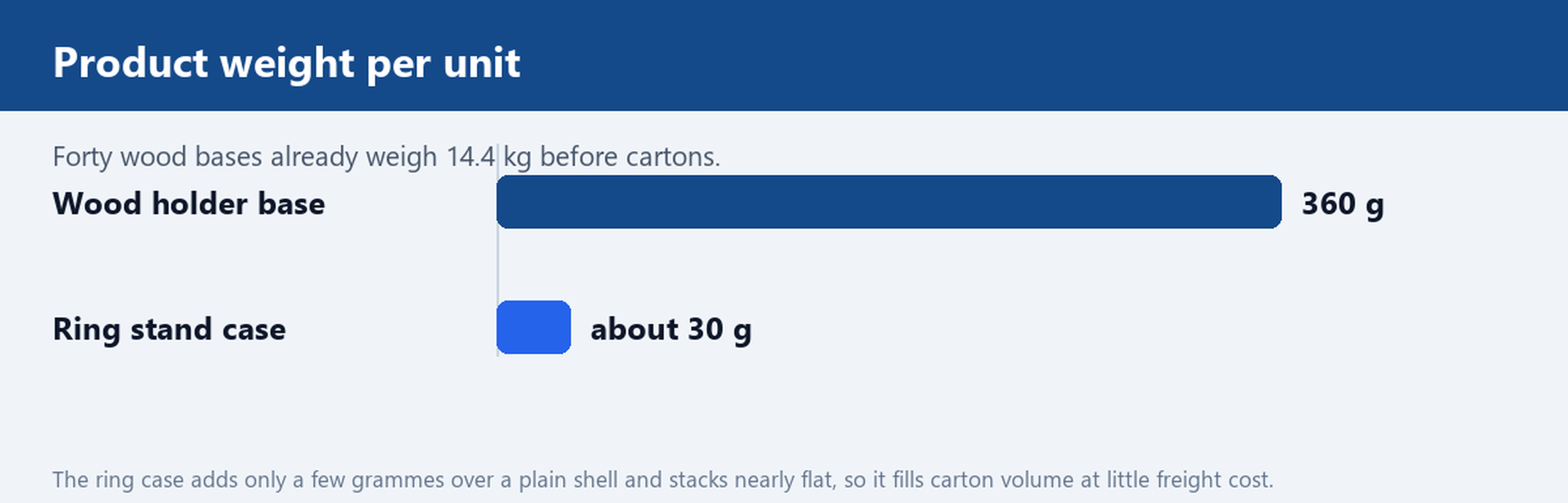
That is the case for weighting a mixed order toward the case. If the buyer needs a certain number of shelf entries in both categories, adding cases raises the unit count and the perceived value of the shipment without a proportional rise in freight; adding bases does the opposite. The right question is not which item has the better unit price but which item earns its kilograms. For a long lane, a lighter case-heavy carton often lands at a lower delivered cost per saleable unit even if the base carries a higher margin on the shelf.
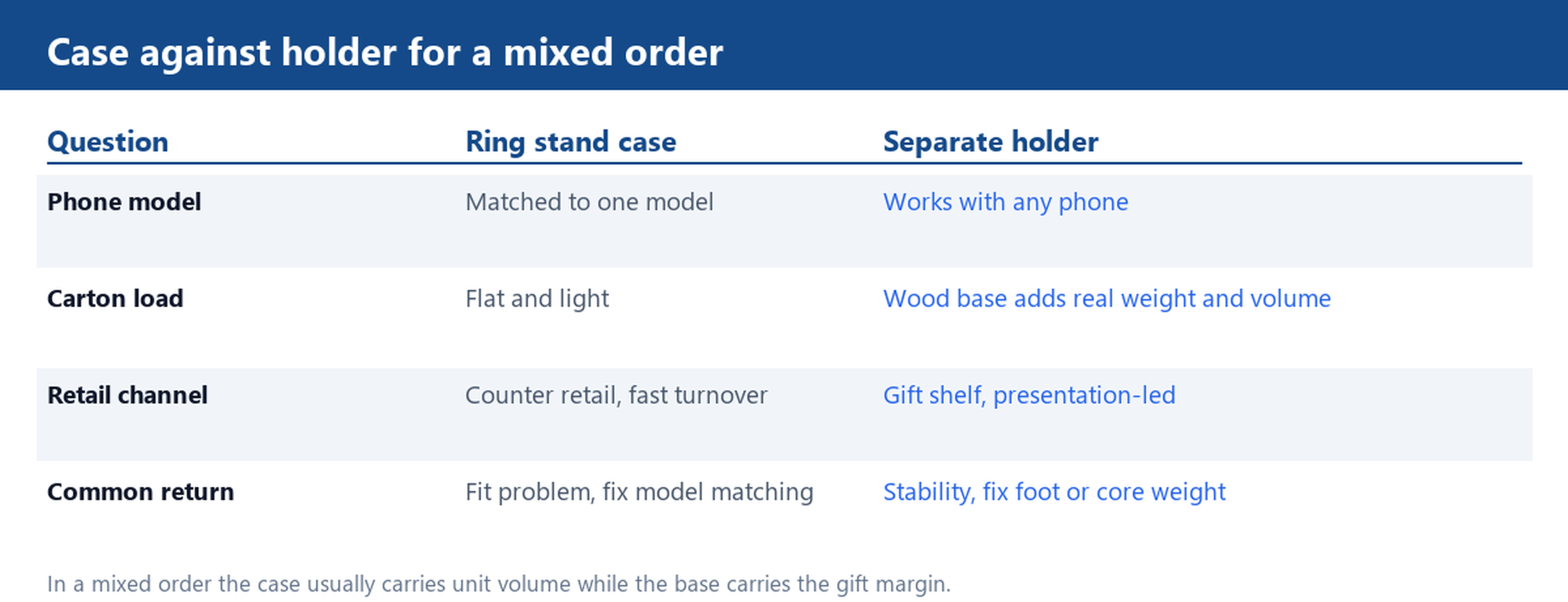
Ask the supplier for the packed dimensions and the carton count of each item, not just the unit weight. Two items with the same unit price can land at very different delivered costs once stacking and carton fill are counted. Put both figures on the same comparison sheet, then decide the mix.
Which to Stock for Gifting and Which for Counter Retail
The channel decides the split. A gift buyer wants an object that feels complete when wrapped: a wood base, a case with a distinctive finish, or a paired set in one box. The heavier base is an asset there, because weight reads as quality and the recipient does not need to know the phone model in advance. A counter retail buyer wants fast turnover, a small footprint and a low chance of a return. The ring stand case fits that: it is model-specific but cheap to explain, light to ship and easy to demonstrate at the point of sale.
For a mixed order, a practical starting point is to let the case carry the unit volume and the base carry the gift margin, then adjust after the first selling season. Track which line comes back: a stand case return is usually a fit problem and is fixed by better model matching; a base return is usually a stability or surface problem and is fixed by a wider foot or a heavier core. Those are different fixes, so keeping the two lines separate in the plan matters more than forcing one to replace the other. Send your mixed-order quantities for a sample pair and a quote, and we will price the case-heavy and base-heavy splits side by side. See our cases and covers range for the case options that pair with the holder line.