

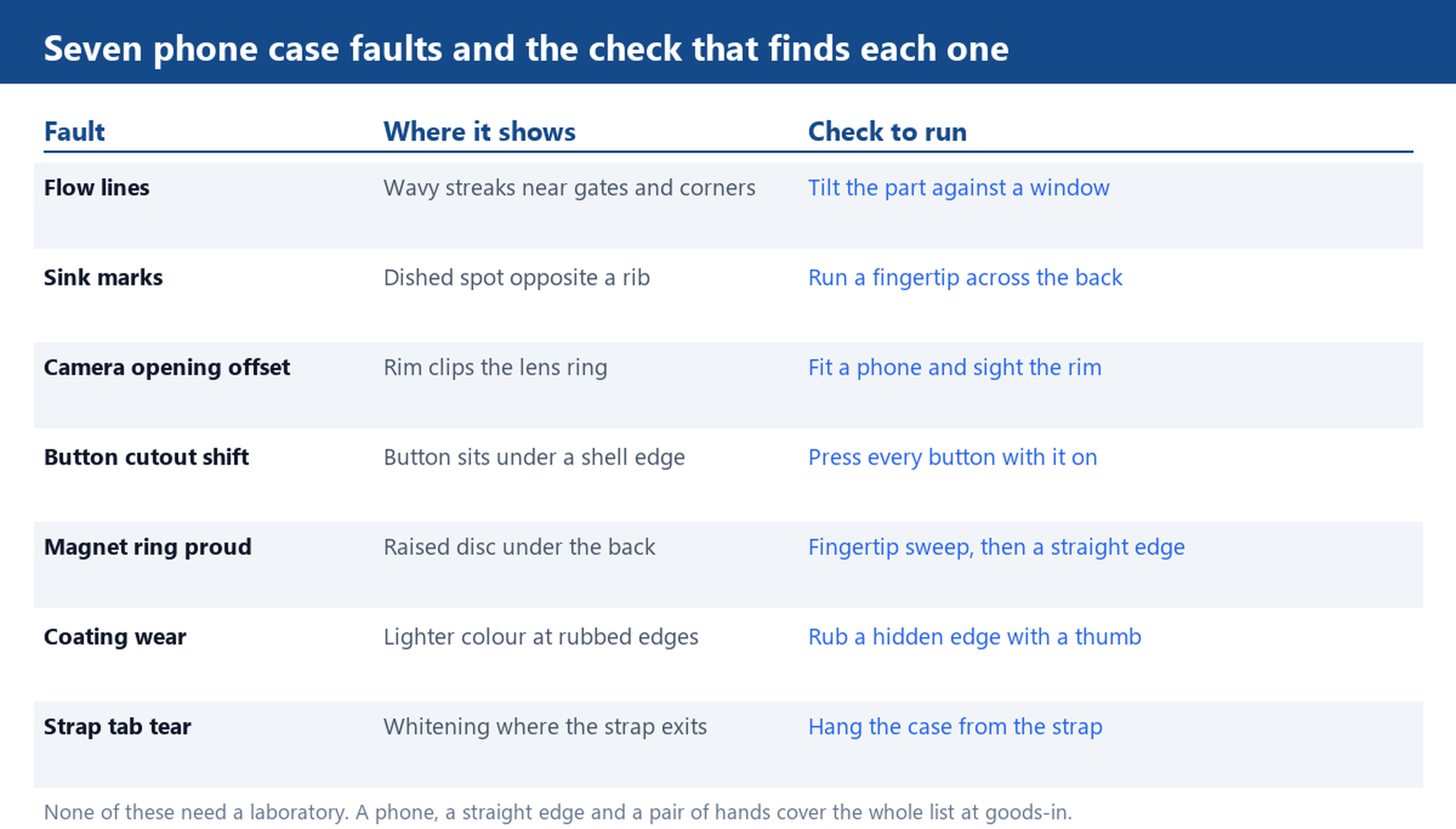
A carton of phone cases arrives, the first unit goes onto a phone, and something is wrong: the shell fights the frame, a button sits under an edge, or the phone will not hold flat on a magnetic mount. By the time the second carton is opened the question has moved from the part to the supplier. Seven faults account for most of that experience, and the phone case common defects behind them are all findable at goods-in with a phone, a straight edge and a pair of hands. Knowing which fault belongs to which check is what turns an argument into a rejection note.
Defects That Come From the Mold: Flow Lines and Sink Marks
Flow lines are the wavy streaks left where two melt fronts meet inside the cavity, and they gather near the gate and around corners where the wall changes section. On an opaque shell they read as a slight sheen change and most buyers accept them. On a clear or transparent case they are the first thing a shopper sees, because the material no longer looks uniform behind the phone. The check is simple: tilt the part against a window and look along the surface rather than at it. A streak that disappears when the angle changes is a flow line.
Sink marks are the opposite problem in the same family. Where a rib, a boss or a magnet pocket makes the wall locally thicker, the material shrinks as it cools and pulls the visible face inward, leaving a shallow dish. On the outside of a black shell it is nearly invisible until a fingertip crosses it; on a transparent back it acts like a lens and distorts whatever is behind it. Run a fingertip across the back in both directions and note where it dips. A single mark in a random position is a process variation. The same mark in the same place on every unit is tooling, and no amount of sorting will fix it.
Camera Opening and Button Cutouts: Alignment You Can Check With One Phone
Nothing on a case drawing survives contact with a real handset. Fit a phone, then look at the camera opening from the back at a shallow angle. If the rim of the opening overlaps the lens ring even slightly, one corner of every photograph picks up a shadow or a haze, and the customer will report it as a camera fault rather than a case fault. The check takes ten seconds and it is the single most useful thing to do with the first unit out of the carton.
Buttons are the second alignment fault, and it hides in a different way. With the case fitted, press every button in turn. A cutout that sits a fraction off centre leaves the button partly under the shell edge, so the press feels mushy, needs more force than usual, or works from one side only. Volume rockers are the usual victim because the cutout is long and the tolerance stacks at the ends. Note which button and which end, because that detail is what tells a tooling engineer where the shift is.
Both faults share a cause worth naming in the report: a case tooled for one sub-variant of a model may not fit another that shares the name but moved a button by a millimetre. Ask which variant the tool was cut for before the next order, not after.
Magnet Ring Depth: Why a Ring Sitting Proud Weakens the Magnetic Grip
On a magnetic case the ring of magnets sits under the back surface, and the depth of that pocket decides how the case behaves on a mount. When the ring sits proud, the back is no longer flat: the phone rests on the ring rather than on the panel, so it rocks, and any sideways push slides it instead of holding it. When the ring sits too deep, the layer of material above it is thicker than intended and the pull felt at the mount drops. The flush-ring magnetic case in this range is built so the magnets sit under a thin clear layer with nothing protruding, which is the geometry to ask for rather than a depth in millimetres.
The goods-in check is two steps. Sweep a fingertip across the back, then lay a straight edge across the ring and look for light underneath; any rock means the ring is proud. Then attach a phone and push it sideways with two fingers. A case that holds without sliding passes, whatever the drawing says.
Coating and Strap Anchors: Paint Wear and Tearing at the Tab
Paint wear is the fault that appears after the goods-in check rather than during it, which is why it needs a deliberate test. A soft-touch metallic finish on the outer shell looks right on day one and goes lighter at the edges and corners after a few weeks in a pocket. Rub a hidden edge with a thumb for a few seconds and compare the colour with the centre of the back panel. A visible change means the coating is thin at the edges, where the spray gun reaches least.
Strap anchors fail differently. A wrist strap loops through anchor tabs on a lower corner, and the tab mouth is where a tear starts: a whitening line at the exit point, before any visible split. The TPU and PC case with a wrist strap puts that anchor on the lower corner, so the load pulls across the tab rather than along it. Hang the case from the strap and let it swing; a tab that whitens at the mouth on the first swing will not survive a season of use.
Writing the Incoming Report: Sample Size, Pass Criteria and the Photo Set
A report written after the argument is a defence. A report written before the lot lands is a specification. Three parts make the difference:
- Sample size and accept number, agreed with the supplier in advance and written into the purchase order, so the inspection has a rule rather than an opinion.
- A pass or fail line per fault, not one overall verdict, because a lot that fails on the magnet ring but passes on the cutouts is a different conversation from a lot that fails on both.
- A photo set shot at a fixed distance and light, with a scale in frame for anything dimensional. A close-up with no reference is an argument, not evidence.
Keep one golden sample per finish and per model, sealed and dated. Half of the disputes about flow lines and coating wear are settled by putting the arriving unit next to the approved one under the same lamp, and the other half are settled by the fact that nobody kept one.
Send the model list and the finish you ordered, and we will send a case set with the magnet ring and cutout dimensions marked so your incoming check has a reference. The cases and covers range covers clear, magnetic and dual-layer builds, and the check list above applies to all of them unchanged.