

Three camping lanterns on one purchase order can be three different products with three different failure modes, and the difference is not the light output. It is where the electricity comes from. A 3 x AA dry-cell lantern is a shelf item that a shop can sell and forget. A rechargeable solar lantern is a service item that comes back when the cell inside it ages. The same campsite can use both, and a buyer who orders one plan for a mixed channel ends up with stock that fits half the customers. This is the comparison to run before the quantity is agreed, along with the three packing decisions that follow from it.
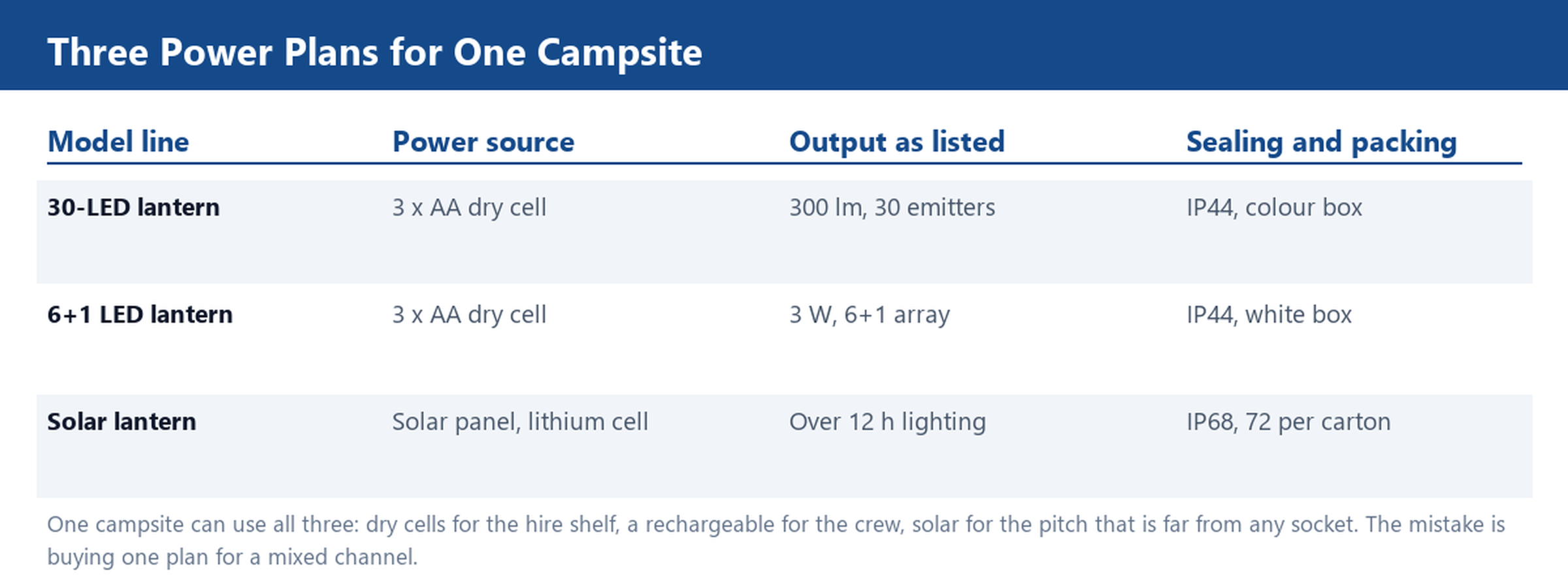
Three Power Plans for One Campsite
The dry-cell plan is the cheapest to buy and the most expensive to run. Three AA cells are a commodity the end user already owns, the lantern weighs 230 g without them, and nothing inside the product degrades while it sits on a shelf. That is why the format survives in rental fleets and in shops that sell to occasional campers. The weakness is the opposite of its strength: the cells are the customer problem, and a lantern that sat in a damp shed with cells installed arrives at the campsite with corroded contacts rather than a flat battery.
The rechargeable plan moves the cell inside the product and the warranty with it. A lithium cell that is charged a few times a year will still age, and the buyer inherits the returns when it does. In exchange the product works out of the box, needs no consumable, and can be sold as a sealed unit with a stated runtime.
The solar plan is the rechargeable plan plus a panel, and it is the one that changes where the product can be used. A solar lantern hanging at a pitch with no socket is the whole point of the category, and the published figures for that model are a lithium cell, IP68 sealing, more than 12 hours of lighting and 72 units per carton. The trade is that the panel sets the recharge rate and the weather sets the panel, so a buyer has to be honest about the market: solar sells to campers who plan, and it disappoints the ones who expect a socket.
Reading Output Honestly: 300 lm From 30 Emitters Against a 3 W Array
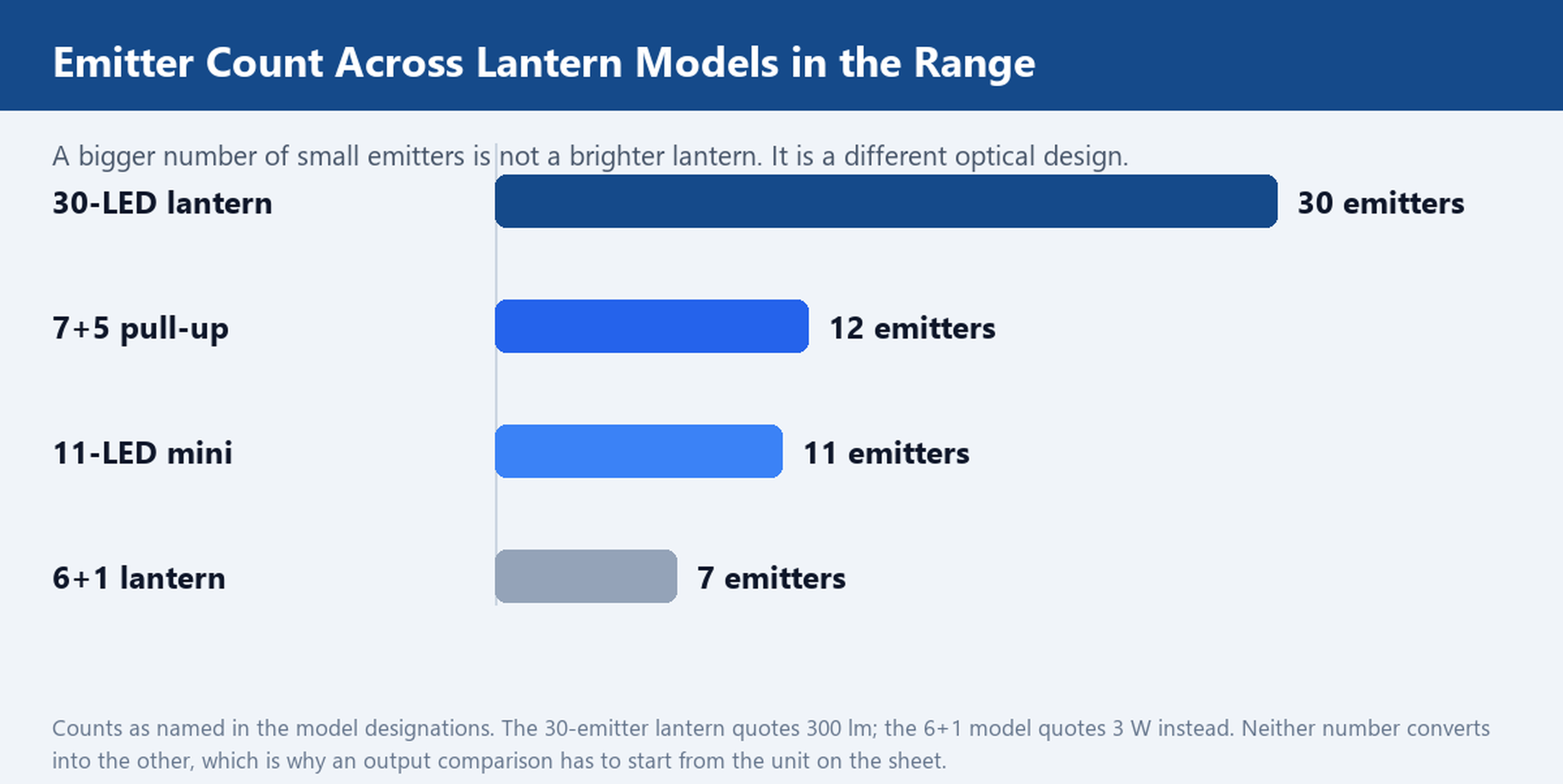
Two lanterns in the same range describe their output in two different units, and mixing them is the most common buying error in this category. The 30-LED model quotes 300 lm. The 6+1 model quotes 3 W. A lumen is light leaving the product; a watt is power going into the emitters, and the ratio between them depends on the emitter and the optics rather than on the array. Asking a supplier to convert one into the other is asking for a calculation that will be optimistic.
The emitter count explains the shape of the light rather than its quantity. Thirty small emitters spread across an 85 by 126 mm body produce a broad, low-glare pool with no single hot spot, which is what a tent or a table wants. A 6+1 array concentrates the work in one central emitter with six around it, which produces a brighter centre and a harder edge. Neither is better. They are different products for different jobs, and the count in the model name is a description of the design, not a score.
What a buyer should ask for is the same unit across every line on the quote: lumens at a stated drive level, or watts with the emitter type named. Once both are in lumens, the comparison is fair. Until then, the model name with the larger number wins an argument it has not earned.
Sealing and Temperature: IP44 Under a Tent Against IP68 in Rain
The two dry-cell models publish IP44, which is protection against splashing water from any direction. That is the right rating for a lantern that lives inside a tent, gets knocked over on wet grass and is wiped with a cloth. It is not a rating for a lantern left out in rain overnight, because water pools on the lens and finds the switch boot, which is the seal that fails first on almost every lantern design.
The solar model publishes IP68, which covers dust ingress and continuous immersion under the conditions the manufacturer states. That rating is what makes the product viable on a pitch rather than in a porch, and it is also the rating a buyer should test with a sample rather than trust from a specification sheet. Immerse the sample, leave it, and then operate the switch and check the charge port for water.
Temperature is the figure that gets ignored. The 30-LED model publishes a working range of minus 25 to 45 degrees Celsius, which sounds generous until it is read against the cell chemistry: alkaline AA cells lose a large part of their capacity as they approach the cold end of that range. A lantern rated to minus 25 with alkaline cells inside is a lantern that works to minus 25 on paper and dims much earlier in a frost. If the market is winter camping, the rechargeable or solar plan is the honest answer, and the temperature line belongs in the brief either way.
Packing for a Mixed Order: Colour Box, White Box and 72 per Carton
Packing is where a mixed order turns into a freight calculation. The 30-LED model ships in a colour box, which is a printed retail unit that can go straight to a shelf. The 6+1 model ships in a white box, which is the right answer for a rental fleet, a wholesaler or anybody who applies their own label later. The solar model lists 72 units per carton, and that single number is what sets the container arithmetic for the whole order.
The colour box is not free. A printed box adds board, a sleeve and usually an inner tray, which reduces the number of units a carton can hold and raises the volumetric weight of the same product. On a mixed order, the cost per unit of the retail line is therefore higher than the unit price suggests, and the difference shows up at the freight line rather than at the product line.
Two packing questions belong in the enquiry. First, whether the box is the standard print or a custom one, because a custom print has a minimum and a lead time of its own. Second, whether the lantern ships with cells installed, cells in the box, or no cells at all. A dry-cell product that ships with alkaline cells inside is a product with a shelf life and a leakage risk in transit; one that ships without them is a product that will be reviewed as incomplete by a consumer who did not read the listing.
What to Buy First: A Starter Mix for a Rental Fleet and a Retail Shelf
A first order does not need to cover the range. It needs to cover the two customers the channel actually has, and those two customers want opposite things. The retail shelf wants a printed box, a lumen figure on the front and a product that works when the buyer gets it home, which points at the 30-LED model and, for the customer who plans, the solar unit. The rental fleet wants a low unit cost, a robust body and a consumable it can replace without a service desk, which points at the white-box dry-cell model.
A workable starting split is weighted toward the dry-cell line because it has no service cost and no shelf life, with a smaller allocation of the solar unit as the premium option that justifies the shelf space. The quantity per model matters less than the ratio, because the ratio is what the second order repeats.
Order one sample of each power type before fixing the ratio. Compare them at the same distance, in the same room, and check three things that no specification sheet carries: where the switch sits when the lantern hangs, how the light behaves when it is set on a table rather than hung, and whether the battery door can be opened with cold hands. Those three checks decide more returns than the lumen figure does.
When the Second Order Goes Wrong
A lantern programme rarely fails on the first order. It fails on the reorder, and it fails in three places that a buyer can protect against with a clause and a golden sample. The emitter bin is the first: two batches of the same model can differ in colour temperature, and cool white that drifts warm is visible side by side on a shelf even when nobody can name the difference. Ask for the colour temperature on the specification sheet and keep one unit from the approved batch.
The switch boot is the second. It is the smallest moulded part on the product and the first one a factory will change when the tool wears, and a change there is a change in the seal that the IP rating depends on. The third is the carton print, which is usually produced by a different supplier from the lantern and is the part most likely to arrive with a colour that does not match the previous shipment.
Write the clause once: no change of emitter, switch boot or cell without written approval and a new sample. Then keep the approved unit in a drawer with the date on it. Every dispute about a reorder is settled by putting the new unit next to the old one, and that comparison is only possible if somebody kept the old one.
The LED lantern range is organised by power plan for exactly this reason, and the wider lights and lighting section is where a mixed programme usually grows next, with the LED flashlight and LED lamp lines following the same logic. The full product list is the place to build a model sheet from when the mix spans several lighting categories.
Tell us whether your buyers are rental fleets or retail shelves, and we will send one unit of each power type so you can compare light output and sealing before choosing the mix.