

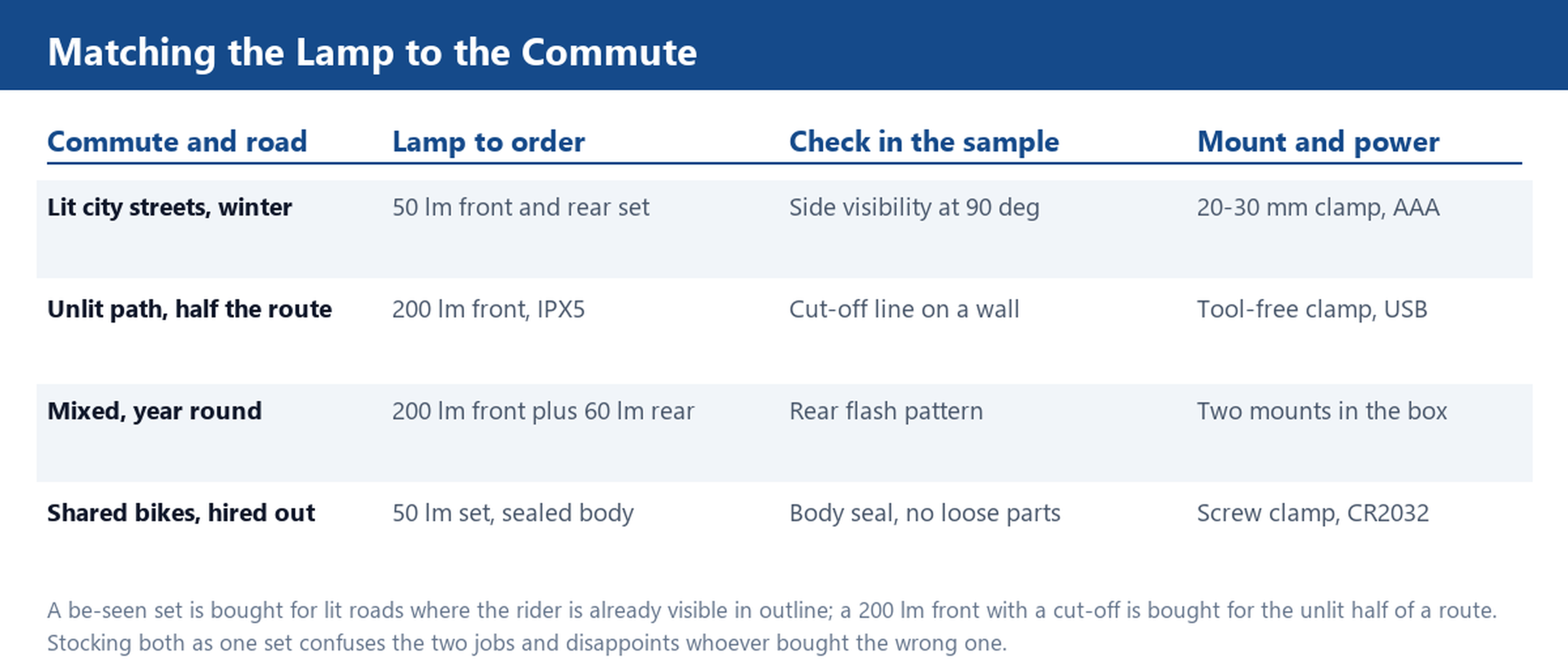
Two riders buy a commuter bike light on the same day and one of them is disappointed within a week. The difference is almost never brightness: it is whether the lamp was bought for being seen or for seeing. On a lit city street the rider is already visible in outline, and a 50 lm front with a wide spread plus a 60 lm rear does the job; on an unlit canal path or a rural lane the same set leaves the rider riding into their own shadow. A 200 lm front with a shaped cut-off solves that, and it is a different product with a different mount and a different water rating. This guide separates the two jobs, then turns each one into the numbers a buyer can put on a purchase order.
See or Be Seen: Two Jobs That Need Two Lamps
Being seen is a signalling problem. The lamp needs to be noticed from the side at a junction, from behind by a driver approaching at speed, and from the front by someone waiting to pull out. Total output matters far less than spread and pattern: a 50 lm lamp with a diffused lens and side windows is picked out at a junction where a 200 lm spot pointed straight ahead is invisible. That is why commuter sets pair a modest front with a rear that has a wide horizontal spread, and why the rear is the lamp that prevents the most common collision, which comes from behind.
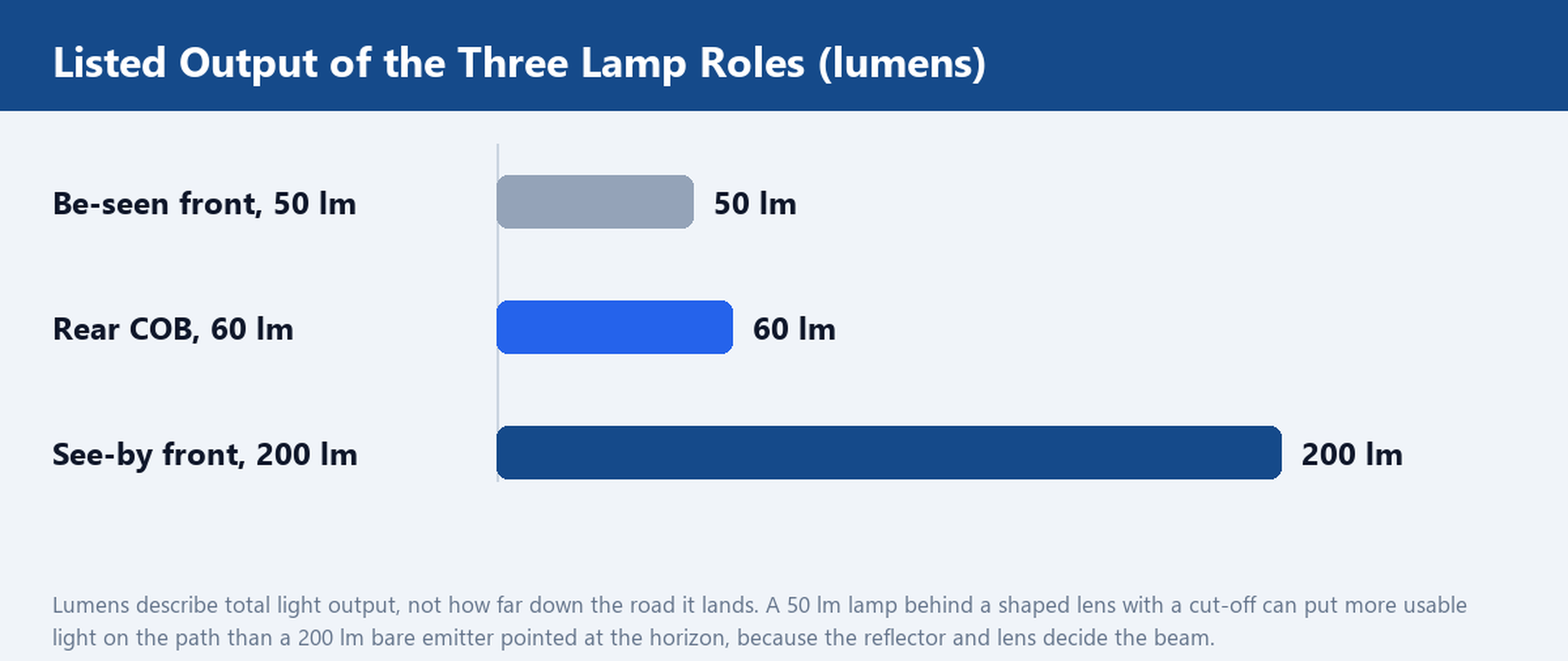
Seeing is an illumination problem, and it scales with usable light on the ground rather than with the number on the box. A rider needs to identify a pothole, a kerb edge or a parked car door early enough to react, and that requires a beam that reaches the road rather than the treeline. Lumens describe total output; the reflector and lens decide where it lands. A shaped beam with a cut-off can put more usable light on the path than a higher-output bare emitter aimed at the horizon, because none of the output is wasted above the horizon line.
Most commuters need both jobs on one bike, and the honest way to specify it is by route rather than by budget. If the route is lit for its whole length, a be-seen set is the correct purchase. If any section is unlit, the front has to be a see-by lamp, and the rear stays a be-seen lamp because nobody needs to illuminate behind them.
Front Light Choices: 50 lm Set Unit, 200 lm IPX5 and the StVZO Cut-Off
The 50 lm unit is the economical tier and it is not a compromise on lit roads. A unit such as LGP6019 exists to make the rider conspicuous at junctions and to satisfy the lighting requirement that most jurisdictions apply after dark, and it does that with a wide, soft pattern rather than a long throw. It is also small, light and cheap enough to be bundled into a front and rear set, which is how most of this volume actually ships.
The 200 lm front is the entry point for seeing where you are going. At that output a shaped lens becomes necessary rather than optional: the beam has to be cut off above the horizon so that the light lands on the road and not in the eyes of an oncoming driver or a pedestrian on the shared path. The German road lighting rule known as StVZO is the reference most buyers use for this, because it defines the cut-off and the beam shape in a way that a factory can test against. A 200 lm lamp with a proper cut-off is a road lamp; the same output with a round spot is a torch on a bracket, and it will be reported as dazzling even when it is legal.
The practical check is a wall test. Mount the lamp at handlebar height a few metres from a flat wall in a dark room and look at the top edge of the beam: a cut-off lamp produces a horizontal line with the light below it, and a spot lamp produces a circle with a bright centre above the line. Photograph that wall for the sample record, because the beam shape is the specification that no lumen figure captures. For higher-output units such as the waterproof LGP6043 the same test decides whether the extra output is usable or just scattered.
Rear Lights: 60 lm COB vs Multi-LED, and 3xAAA vs CR2032
A rear lamp is judged on pattern and on runtime, in that order. A COB strip produces a broad, even bar of light that reads as a solid shape to a driver at distance, and a 60 lm COB is bright enough to be unmistakable without being a hazard to the rider behind. A multi-LED cluster is cheaper and produces distinct points of light, which is fine in dry weather and less effective in rain, where the individual points blur into a dim smear. For a commuter range the COB pattern is the one to standardise on, and the multi-LED version belongs in the promotional and gift tier where cost dominates.
Flash patterns deserve a decision rather than a default. A steady rear is easier for a driver to judge distance against, a slow pulse attracts attention without being read as a hazard warning, and a fast irregular flash is the pattern most often criticised by other road users. Offering two modes, steady and slow pulse, covers the commuter case without a mode chart that nobody reads.
Power choice follows the same logic. Three AAA cells are the right answer for a rental or shared bike fleet, because the cells are available in any shop and a flat battery does not take the bike out of service. A CR2032 coin cell keeps the lamp small and light and is the right answer for a sealed set that is replaced rather than serviced. Whichever cell is chosen, the runtime at the steady setting belongs on the packaging, and the battery door needs a seal that survives being opened by a rider with cold hands in the rain.
Rain, Mounts and Handlebar Fit: IPX4 vs IPX5 and 20-30 mm Clamps
The IP rating is a test description, not a marketing word. IPX4 means water splashed against the enclosure from any direction does no harm, which covers road spray and most rain. IPX5 means water projected by a nozzle is resisted, which is the rating to specify when the lamp will be ridden in heavy rain at speed or washed with a hose. Both ratings are meaningful for a commuter lamp; neither covers immersion, so a lamp dropped in a puddle is outside both.
The seal that matters in practice is the charging port, because that is the opening the rider touches. A rubber flap that is moulded into the housing and presses into a recessed seat survives years of use; a plug that pushes into a slot falls out and is lost within a season. On USB rechargeable units, ask for the flap to be captive and check that the port sits above the lowest point of the housing, so water that does enter drains away from it rather than into it.
Handlebar fit is where returns concentrate, because bars are not a standard size. A clamp specified for 20 to 30 mm covers most town and hybrid bars, but a bare 22.2 mm bar needs a shim and a 31.8 mm oversized bar will not take the same clamp at all. Tool-free clamps are worth the small extra cost on anything sold to a commuter, because a lamp that needs an Allen key to move between bikes is a lamp that stays on one bike. For shared and rental fleets, the reverse is true: a screw clamp that needs a tool is the anti-theft feature, and it should be specified that way.
Stocking a Commuter Range: Front-Rear Sets, Mixed Cartons and Spares
A commuter range is easier to sell as sets than as individual lamps, because the customer who needs a front almost always needs a rear and a boxed set removes the decision. Two set tiers cover most of the market: a 50 lm front with a COB rear in a sealed body for lit routes, and a 200 lm cut-off front with a 60 lm rear for mixed routes. Units such as the LGP6067 and the LGP6055 sit in the set tier, and the front-only and rear-only versions of the same housings exist for replacement sales.
Mixed cartons are where the margin hides in this category. Lamps are small, so a carton can carry a ratio of sets, front-only units and spare brackets without exceeding a sensible weight, and a retailer can stock a display from one carton instead of three. Write the ratio, the barcode allocation and the bag printing into the order, and keep the bracket type consistent across the range so a spare bracket fits every SKU.
Spares are the last line and the one most often skipped. Brackets break, rubber straps perish, and charging flaps get lost; a small spare-parts bag per carton converts those failures into a cheap resale instead of a return. The bicycle light range carries the set and single versions, the wider lights and lighting section covers the lamp families these housings come from, and the brackets interchange with the mounts and stands range.
Tell us whether your riders face oncoming traffic and what handlebar sizes you see, and we will send a front-rear set plus a StVZO unit to compare on the bike.