

Buyers who stock both categories in one order are not comparing two products, they are balancing two power models. A lamp plugs into a wall or hangs a small solar panel and then works for years on the same installation; a torch carries its own cell and has to be recharged or refilled by the user. That difference decides the channel, the packaging, the price band and the return reason, and it is the reason a mixed load needs a ratio set before the cartons are booked rather than after.
LED light vs LED flashlight: two power models, two retail stories
A mains lamp is bought for a place, not for a person. It goes on a wall, under a shelf or over a desk, it stays there, and the buyer evaluates it on installation and on how the light falls. The lights and lighting range reflects that: the unit is judged in situ, and the retail question is whether the buyer can understand the mounting from the box.
A torch is bought for the glovebox, the kitchen drawer or the toolbox, and it is evaluated on how bright it is, how long it runs and whether the battery is easy to change. Its light output is quoted in lumens, and at roughly 100 lumens per watt a 1 W emitter lands near 100 lumens while a 3 W emitter lands near 300. Those are useful numbers to sanity-check a supplier claim, because a moulding described as high power with a 1 W emitter inside will not deliver a 300 lumen beam.
Solar lamps sit between the two models and are the most misread. A small panel on a garden or camping lamp is a maintenance-free trickle source, not a power station. A panel delivering about 0.4 W of effective output across five hours of good sun puts roughly 2 Wh into the cell, while a 1200 mAh cell at 3.7 V holds about 4.4 Wh. In practice that means more than one full day of direct sun for a single full charge, which is why a solar lamp placed in shade behaves like a dim lamp rather than a faulty one.
Mounting and handling: hook, stand, clip or belt
Handling is where the two categories diverge most for a wholesale buyer, because it decides the carton count as much as the product count. Lamps are sold with a hook, a magnetic base, a stand or a screw plate, and each of those adds a moulding and a fixing that has to be in the box. A lamp with a magnetic base needs a steel plate or a ferrous surface to be useful, so the retail copy has to say so; a lamp with a hook needs a hook strong enough to hold the unit when it is knocked.
Torches are carried, so the interface is a clip, a lanyard hole or a belt loop, and the switch has to work with a thumb in the dark. A three-position switch that cycles high, low and off is easier to sell than a single button that requires a long press, because the long press is the first thing users get wrong and the first thing they report as a fault.
The handling difference also drives the accessory list. Lamps need fixings, and the fixings are the part that goes missing in the warehouse. Torches need batteries, and the battery format is a purchasing decision: an alkaline AAA torch is cheap to make and expensive to run, while a built-in lithium cell removes the refill but adds a charging cable to the box and a charging port to the warranty conversation. Decide which of those two stories the channel wants before the tooling is cut.
Packing for retail: box, blister or display carton
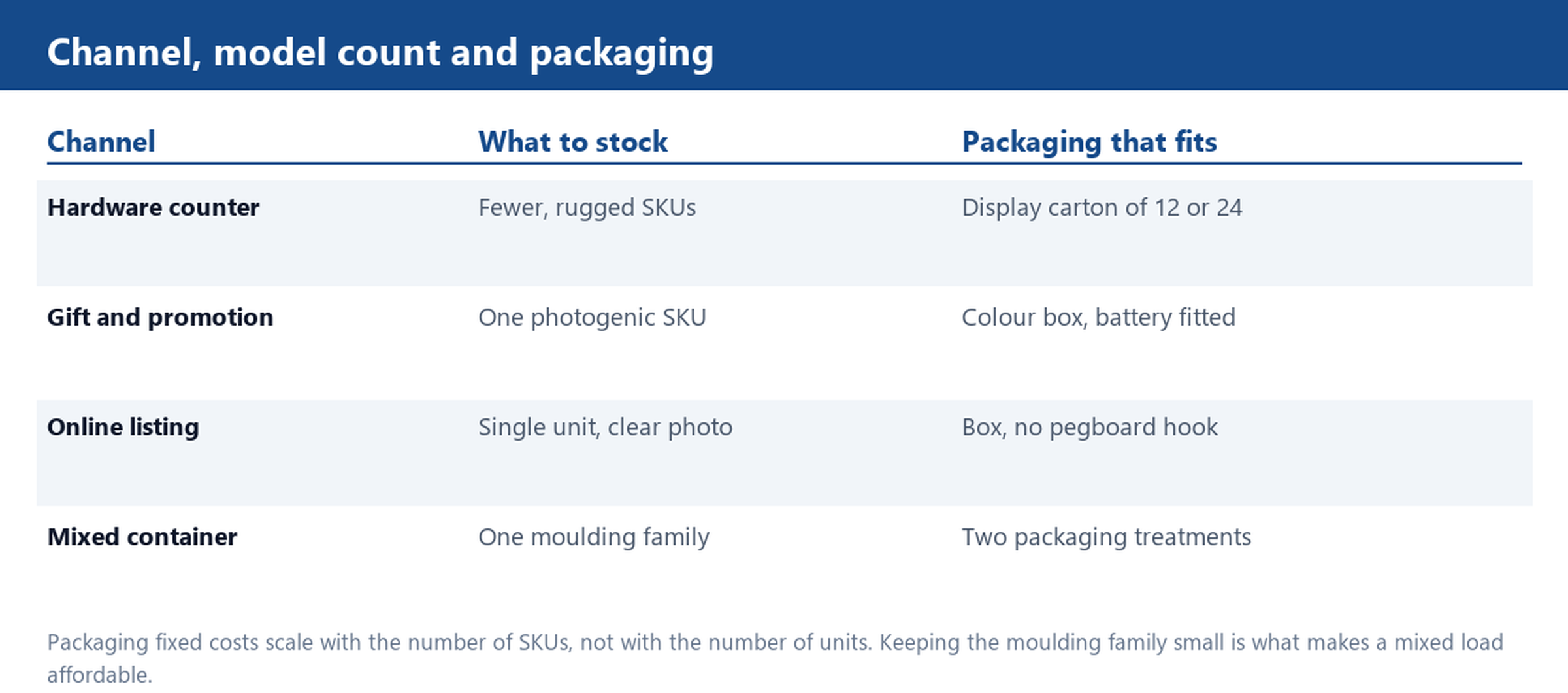
The same product can ship in three packagings that sell into three different channels, and the packaging usually costs more per unit than the difference between two similar mouldings. A printed colour box suits a gift or online listing, because the box is what the buyer sees before purchase and it can carry the story. A blister on a printed card suits a hardware or supermarket pegboard, where the product has to be visible and the card has to hang. A plain display carton of 12 or 24 pieces suits a wholesale counter, where the retailer wants to open one carton and put the units in a basket.
Each choice carries its own fixed cost. A blister needs a card design and a sealing die; a colour box needs a print run with a minimum quantity per SKU; a display carton needs an inner divider so the units do not rub together in transit. For a mixed container, those fixed costs multiply by the number of SKUs rather than by the number of units, which is the argument for keeping the packaging family small and using stickers or sleeves to differentiate versions.
One practical rule from the warehouse side: the carton markings have to match the packaging. If the outer carton says 24 pieces and the inner boxes hold 20, the receiving count is wrong before the container is opened, and that error follows the goods all the way to the retail shelf.
Splitting a mixed container between hardware and gift channels
Do the split in cartons, not in units. A 40-foot high cube carries roughly 68 cubic metres, so a carton of 0.06 cubic metres fits about 1,100 cartons. If the plan is 60 percent lamps and 40 percent torches, that is about 660 cartons against 440, and the real question is whether each of those groups is made up of two or three SKUs, because a group spread across six SKUs means six packaging runs and six sets of tooling approvals.
Hardware channels want fewer, more rugged models with a display carton and a replaceable battery. Gift channels want a colour box, a single SKU that photographs well, and a battery already in the unit so it works when the box is opened. Those two profiles pull in opposite directions on the same moulding, which is why a mixed order usually works with one moulding family and two packaging treatments rather than two completely separate product lines.
Leave part of the container unallocated. A mixed load that is fully committed to one ratio has no room for the model that turns out to sample badly, and re-cutting a ratio after the cartons are printed is not possible without new cartons.
Sample and carton checks before you mix the load
Check the light, not the label. Put a sample of each model on a wall at a fixed distance and compare the spread; a lamp sold for a stairwell needs a wide pool of light, while a torch sold for a glovebox needs a narrow beam that reaches. A phone camera set to a fixed exposure is enough to show the difference between two units that claim the same output.
Then check what the user will touch. Twist the hook, pull the clip, press the switch twenty times, and open and close the battery door on the torch. These are the parts that generate returns, and all of them can be tested in a minute per sample without any instrument.
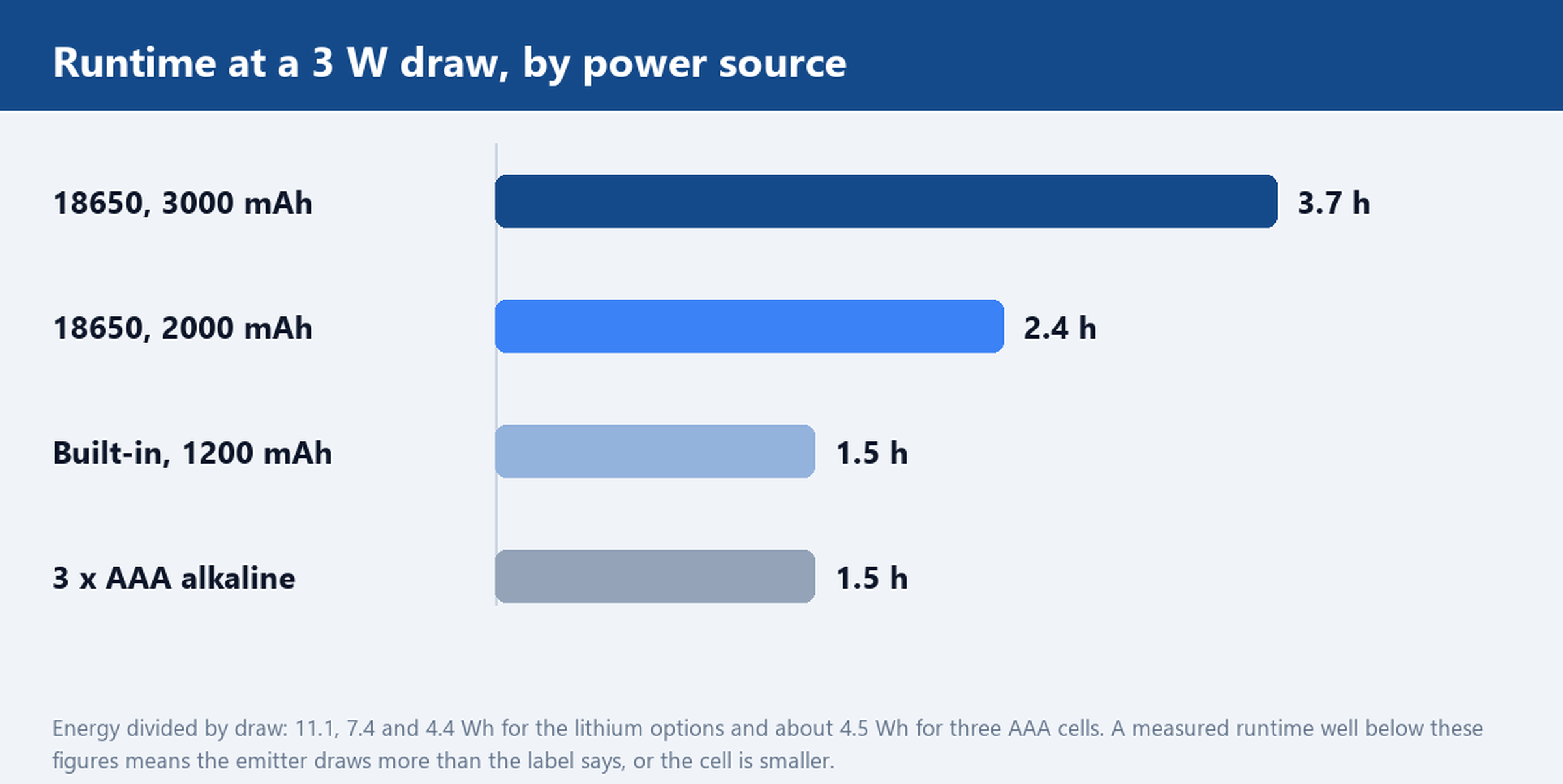
Run a runtime check on the battery versions. A 2000 mAh cell at 3.7 V holds about 7.4 Wh, so a 3 W draw empties it in roughly 2.4 hours, while a 3000 mAh cell gives about 3.7 hours and three AAA cells give about 1.5 hours at the same draw. If the measured runtime is well under those figures, the emitter is drawing more than the label claims or the cell is smaller than declared, and either one is a reason to hold the order.
Finally, open one carton from each SKU and count it. Check that the inner packaging matches the outer marking, that the accessories named on the box are present, and that a unit taken from the middle of the carton still works. The LED flashlight and LED lantern ranges are organised by mounting type, so a mix can be assembled from one family, and a 3xAA dimming torch or a 500 mAh reading lamp shows how the two power models look side by side in the same order.
Send your channel split and target retail price band, and we will propose a lamp and torch mix for one container, with packaging to match each channel and samples of both for your own wall test.