

Three figures on an LED lamp carton decide whether the shipment matches the sample: the lumen rating, the lumens per watt behind it, and the ingress rating printed on the box. Take the camping lantern on this range. The sheet reads 320 lm at 80 lm/W. Divide one by the other and the claim is a 4 W draw. That single division tells you in ten seconds whether the rest of the page came off a test report or was carried forward from a previous model.
Below is the pass worth putting a carton of area lights through: lanterns, work lights, desk lamps, anything with a diffuser rather than a reflector. It needs one carton, one hour, a tape measure, a lux meter and a white wall. This is how to inspect LED light shipments when all the equipment on hand is a purchase order, a sample and a bench.
320 lumens divided by 80 lumens per watt is where the checking starts
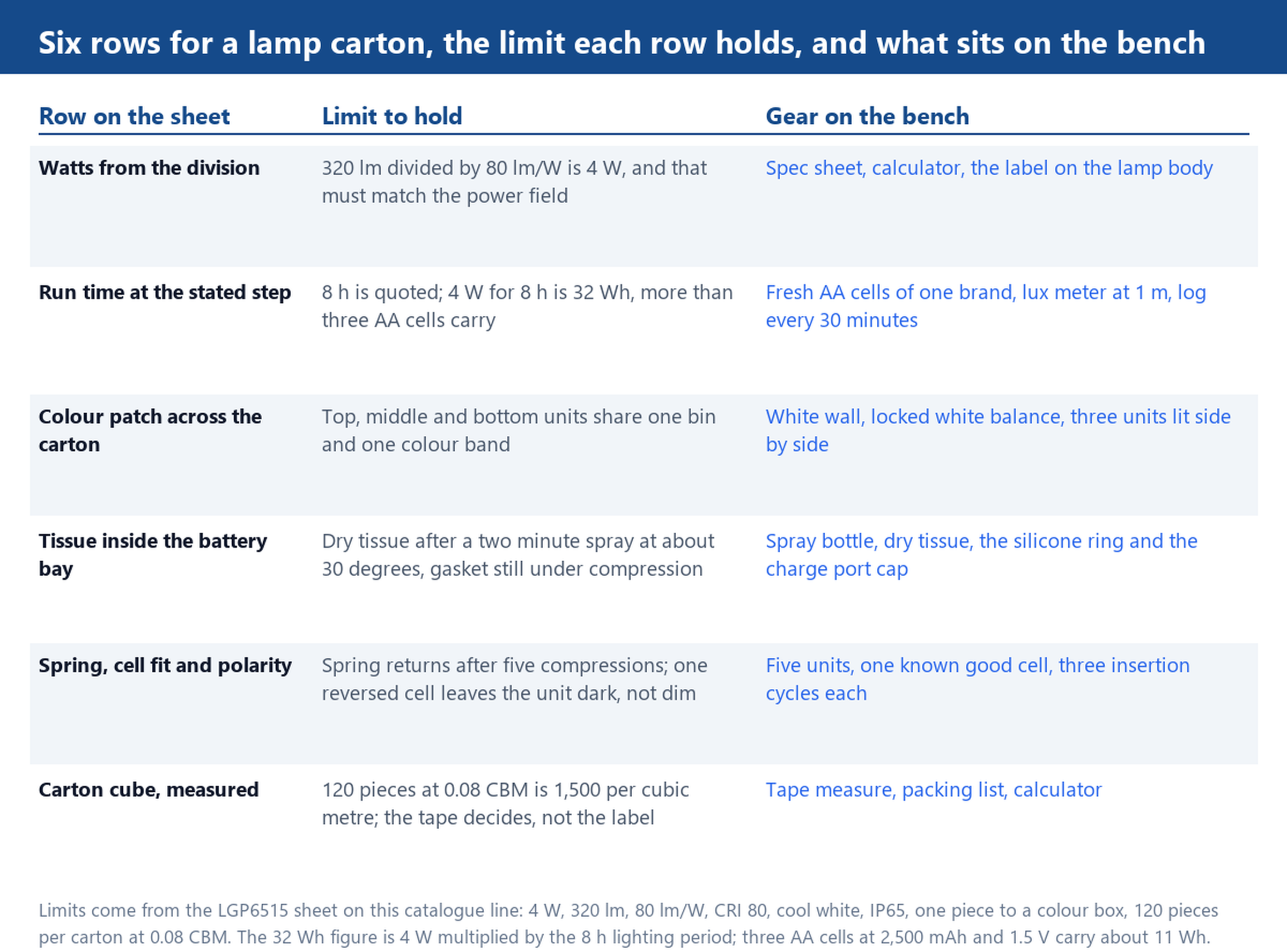
The 4 W result agrees with the power field on the same page, so the two numbers at least come out of one measurement. That agreement is the first thing to confirm, because a sheet where lumens, watts and efficiency fail to close was assembled by hand. Run the division on every model in the order. If a 4 W lamp is quoted at 500 lm, the sheet is claiming 125 lm/W at system level, and a diffused area light built on SMD2835 or SMD5730 emitters rarely reaches that once diffuser and driver losses are counted. Ask for the integrating sphere printout behind the figure. If the supplier cannot produce one, treat the lumen number as a design target and price the sample accordingly.
Then watch what the light does after switch-on rather than at switch-on. The same page for the SMD5730 magnetic camping light quotes an 8 hour lighting period against that 4 W figure. Eight hours at 4 W is 32 Wh. Three AA alkaline cells at 2,500 mAh and 1.5 V carry about 11 Wh on paper, and less than that under a load close to 1 A. Both statements can be true at once only if one of them describes a dimmed step, so ask which step the 8 hours refers to and reproduce it: fresh cells of a single brand, the lamp at the named step, a lux reading at 1 m every 30 minutes, and a note of the moment the reading falls below 70 percent of the first value.
One further line on that sheet deserves a question. Input voltage is listed as 110-220 V while the power source is a dry battery. If the sample leaves the box with no mains lead, that field is a template entry carried over from another product and should be corrected before the page reaches a retail buyer who reads specifications for a living.
CRI 80 and cool white: the shift visible inside one carton
CRI 80 is a floor, not a description. At that level skin tones and the darker end of a fabric range begin to flatten, and two emitters that both print CRI 80 can still sit visibly apart next to each other. Colour temperature has the same looseness: cool white is a band, and suppliers quote it anywhere from 5,000 K to 6,500 K. When two bins land in one carton, the result is a seam on a white wall and a green or violet cast on one unit in a handful.
The test takes ten minutes and needs no instrument. Pull three units from the top, the middle and the bottom of the carton, light them at equal distance against a white wall, lock the white balance on the camera and photograph all three in one frame. Compare the patches side by side rather than one at a time, because the eye adapts to a single source and stops adapting the moment two share the frame. A visible difference means the carton is bin-mixed, and the fix belongs on the purchase order as a bin code, not on your warehouse floor as a sorting step.
Look at the diffuser while the units are up. A milky 2 mm acrylic or polycarbonate cover hides the emitter rows; a thin one shows them as bright spots on the wall, and that spot pattern is what a retail customer photographs first when the review goes up. The same check separates a lantern from a work light in this range, since the lantern group uses a domed cover while the bar lights use a flat panel.
IP65 is a gasket, a cap and a boot, not a word on the box
IP65 covers dust tight plus protection against water jets. It does not cover immersion, and a lamp that survives a bucket of water can still fail a jet aimed at the seam. On an area light the rating lives in three places: the silicone ring where the lens meets the body, the rubber cap over the charge port, and the boot around the switch.
Put a dry tissue inside the battery bay, close the unit, spray it from roughly 30 degrees for two minutes at arm length, dry the outside, then open it and read the tissue. A damp patch means the ring is under-compressed or the cap lip is not seating on its spigot. Check the ring for compression set as well as presence: a gasket held flat inside a carton for six weeks can take a set and stay flat, and the leak then appears in the field rather than on the bench. Squeeze the ring between thumb and forefinger and watch whether it returns.
Do not carry that test across the whole range. The 28.6 cm COB magnetic work light is marked IP33, which is spray protection with no dust rating, so it gets a damp cloth and a check that the switch boot sits flush against the housing. Running the lantern test on it produces a failure that says nothing about the product and a great deal about the test.
The AA bay, the spring contacts and a cell put in backwards
Two models in this range differ here. The camping lantern runs on AA dry cells. The work light takes a rechargeable pack or three AA cells, with a two button switch that keeps the two circuits apart. Both bays deserve the same three checks.
- Spring tension and plating. Compress the spring five times. A spring that stays compressed lets the cell rattle, and the light flickers whenever the unit is carried rather than set down.
- Cell fit at the wide end of the tolerance. An AA cell is nominally 14.5 mm across and 50.5 mm long, and production cells run to the top of that range with the wrapper on. A bay cut tight cracks at the holder rib, usually on the second insertion.
- Reverse polarity. Insert one cell backwards in a three cell bay. A unit with a blocking diode stays dark; a unit without one runs at reduced output or starts charging the reversed cell. Neither belongs on a retail shelf, and the second is the worse of the two.
Run five units, three insertion cycles each, and record which of the three behaviours appears. Then press the battery door shut and pull it once by hand with the cells loaded, because a latch that opens under a thumb is the complaint that arrives with the first battery change.
Magnet pull, the hook, and 120 pieces in 0.08 cubic metres
The work light hangs from a magnet or a rope, and both are tested with the unit at full extension rather than folded. Set the magnet on a vertical steel plate, hook a kitchen scale to the body at 28.6 cm out and pull straight down until the face releases. Record the peak. An 80 g unit on a 28.6 cm arm puts a bending load on the magnet that a folded unit never shows, and that is the failure behind the report of a light that fell once and never held again.
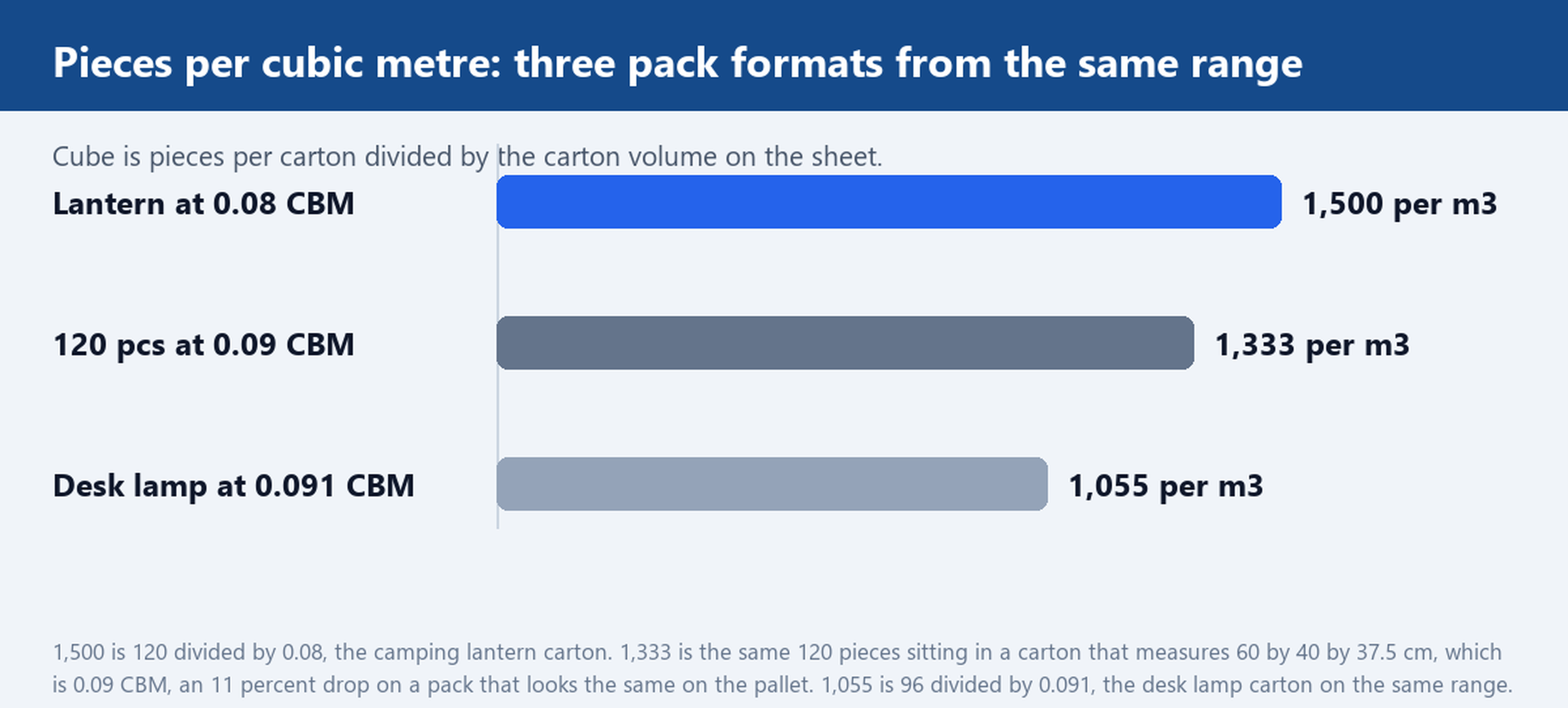
Then measure the carton yourself. Length times width times height in centimetres, divided by one million, is the cube. The lantern packs 120 pieces to a carton at 0.08 CBM, which is 1,500 pieces per cubic metre. The same 120 pieces in a carton measuring 60 by 40 by 37.5 cm occupy 0.09 CBM and give 1,333 per cubic metre, an 11 percent loss on a pack that looks identical on the pallet.
Pack format moves that number further than the product does. The SMD5730 reading desk lamp ships one piece to an opp bag, 96 pieces to a carton at 0.091 CBM, which works out at 1,055 per cubic metre and 0.000948 CBM for every lamp. The lantern at one piece to a colour box sits at 0.000667 CBM. Book 20 cubic metres and the gap is 30,000 lanterns against 21,100 lamps, which is the difference between two purchase orders and one.
Six rows on one sheet before the next container
None of the above needs a laboratory, and none of it fills a day. Put the results on a single page with six rows: watts from the division, run time at the named step, the colour patch photograph, the tissue result, the spring and polarity result, and the measured cube. Sign it and keep it with the packing list. That sheet is worth more in a claim eight weeks later than it is on the day of inspection, because it converts an argument about what the sample used to do into a set of numbers with a date on them.
Send your target price band, the lamp family and the carton quantity, and we will ship a carton sample with the gasket and the switch boot exposed, so your QC team can run the same six rows on arrival without waiting for a tooling order. If the choice between lantern, work light and desk lamp is still open, start from the lights and lighting range and compare the published carton figures model by model, then send the sample request through the contact form with the dimming step and the pack format you want tested.