

Two headlamp families cover almost every purchase order on this site: a rechargeable 18650 unit in an aluminium body rated IP65, and a dry-cell unit running three AAA cells in an ABS body rated IP55. Choosing between them is not a brightness decision. It is a decision about what you are willing to stock and support: a charger, spare cells and a protection circuit on one side, or a battery the end user buys at a petrol station on the other. Five checks settle the LED headlamp sourcing decision before a quotation is worth asking for.
Two Headlamp Families: 18650 Rechargeable vs 3xAAA Dry Cell
The rechargeable side is represented by the 800 lumen rechargeable headlamp (LGP6125), which pairs a 10 W Cree T6 emitter with two auxiliary 5 W chips in an aluminium alloy and ABS body, runs on two 18650 cells, and carries an IP65 marking with four switch positions: main lamp, vice lamp, both, and strobe. The zoomable 1000 lumen headlamp (LGP5625) is the single-cell version: one 18650, a 10 W chip, IP65, and a zoom head instead of a second lamp cluster. The 500 lumen T6 headlamp (LGP6077) sits below both at 500 lumen with three modes.
The dry side is the AAA headlamp (LGP6113), a 3 W Cree XPE chip in an ABS body at IP55, running three AAA cells at a printed weight of 52 g without batteries. A second dry model, the COB belt strap headlamp (LGP6505), covers the low end at 1 W with a 10 hour printed lighting period on a three section battery bay.
The families differ in what the carton has to contain. An 18650 SKU ships with a charger, a cell, and a protection board inside the pack, so your spare parts list has three new lines and the cell becomes a separate article number that a customer can reorder. A dry-cell SKU ships with none of that, which removes the charger from the box and removes the charging port from the warranty conversation. Neither structure is cheaper in every market: the rechargeable SKU carries a higher landed cost per unit, the dry SKU carries a battery that leaks if it sits in a warehouse through a hot season.
IP65 Aluminium and IP55 ABS: Where Water Actually Gets In
An IP marking is two digits, and they answer two different questions. The first digit is solids, the second is water. IP55 means dust protected but not dust tight, and protected against low pressure water jets. IP65 means dust tight, and protected against jets from a 6.3 mm nozzle at 12.5 litres per minute. One model on this site is printed IPX6, where the X is the solid digit left unclaimed rather than a digit the unit passed, so the dust question is open until the supplier answers it in writing.
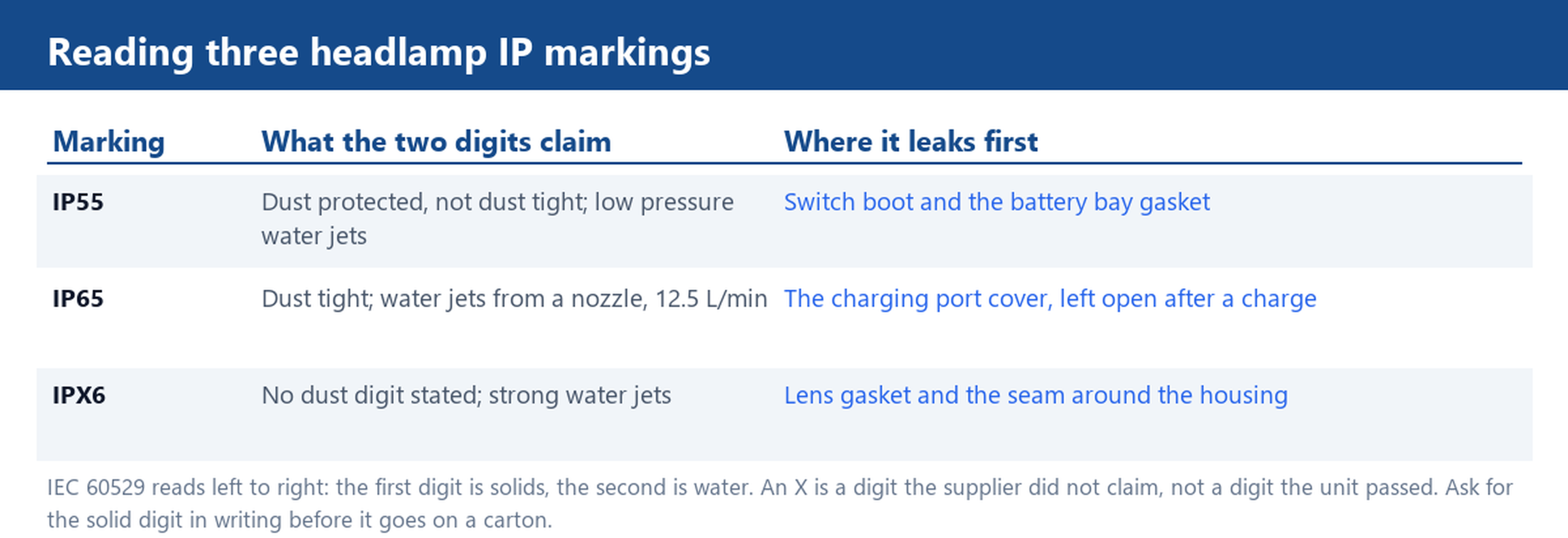
Water does not usually enter through the housing wall. It enters at the four places where a part has to move or be opened: the switch boot, the battery bay gasket, the charging port cover, and the joint between lens and bezel. On a headlamp the switch boot is the usual first failure, because the rubber has to flex on every press and the seal depends on the compression left in the moulding. On a rechargeable unit the port cover is the second, and it fails in the field rather than in the factory, because a cover left open after a charge is a user habit, not a defect.
Aluminium versus ABS is mostly a heat question, not a water question. A 10 W chip in a sealed head loses its heat through the housing, and an aluminium body spreads it; an ABS body on a 3 W chip has less heat to move. What ABS buys is moulding accuracy at the gasket seat and no corrosion at the seam. What it does not buy is forgiveness: a warped gasket seat leaks at IP55 and at IP65 alike. When you specify sealing, specify the seat as well as the marking: flatness at the bay gasket, a boot with a defined compression, and a port cover with a tether, so a cover that comes off is still attached to the lamp.
The 200 m Beam Claim and the Distance People Work At
Beam distance is defined at 0.25 lux, which is roughly the light of a full moon on a clear night. The printed 200 m on the AAA unit and 500 m on the 18650 units are honest under that definition and close to useless as a working number, because nobody reads a label or sets a fixing at 0.25 lux. Ten lux is a fair threshold for close work, and light falls with the square of distance, so the usable distance is the printed range divided by 6.3: about 32 m from a 200 m claim, about 79 m from a 500 m claim.
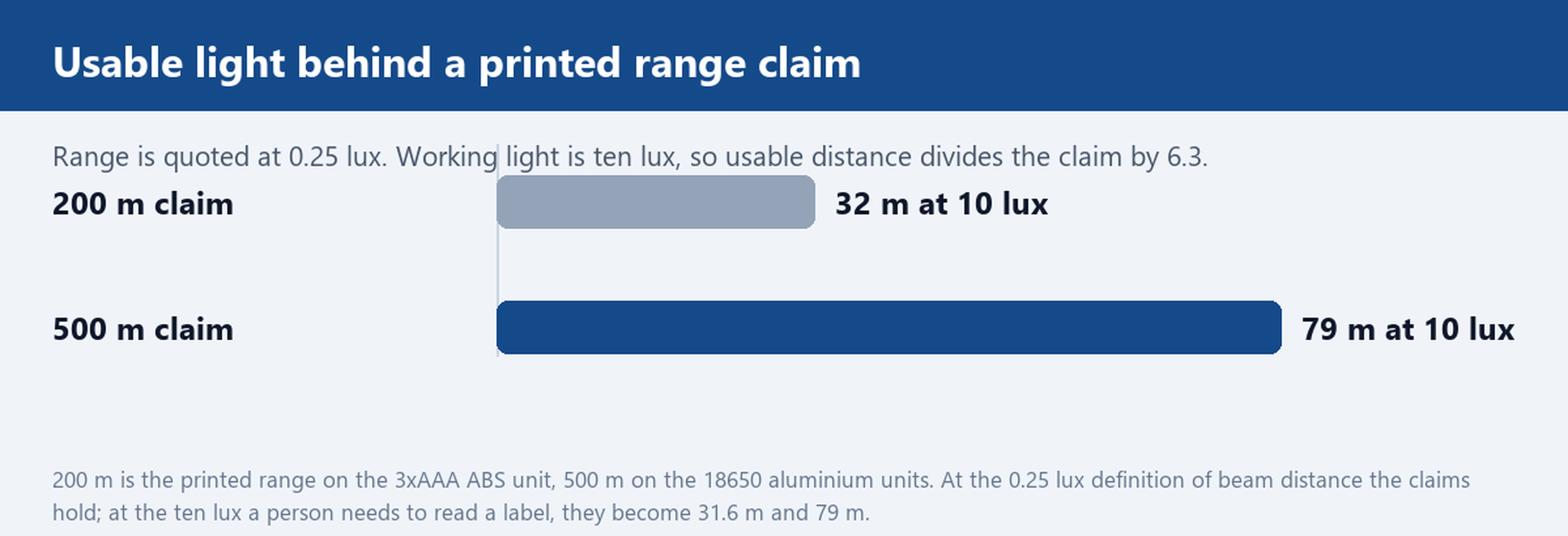
This is testable in a warehouse without a photometer lab. Put the lamp on a table, aim it at a wall 10 m away, and read the centre spot with an inexpensive lux meter. If the meter reads 640 lux at 10 m, the lamp reaches 10 lux at 80 m, because 640 divided by 10 is 64 and the square root of 64 is 8, which multiplies the 10 m test distance. Write that one number on the sample report instead of the catalogue claim, and the buyer conversation changes from marketing to measurement.
Two practical notes. A zoom head trades spot for flood, so the range figure belongs to the narrow end of the zoom and the wide end covers a work area at a fraction of that distance. And a headlamp that is aimed at the ground in front of the wearer is usually run at its middle setting, which is why the useful specification is not the maximum range but the range at the setting people leave it on.
Runtime Past 12 Hours: What the Battery Bay Decides
Two models here print a runtime above 12 hours: the AAA unit on a 3 W chip, and the single cell 18650 unit on a 10 W chip. Both figures are real, and neither is a full output figure. The arithmetic is short. A 10 W emitter at 3.7 V draws about 2.7 A, and a 2,600 mAh 18650 holds 9.6 Wh, so one cell runs the chip for under an hour at full output before driver losses. A 3 W emitter draws about 0.81 A, and three AAA alkalines hold roughly 5 Wh, which is around an hour and a half at the optimistic end once the cells are asked for that much current.
So the question to put to any headlamp supplier is not how many hours, but how many hours at which mode and at which lumen. Put three rows on the specification sheet and refuse the summary figure: hours at high with the measured lumen, hours at low with the measured lumen, and hours at the mode you expect the end user to leave it on. The 500 lumen T6 headlamp (LGP6077) is a useful reference point here, because it prints a 5 hour runtime against two 18650 cells and 500 lumen, a ratio that survives the arithmetic without an implied low mode.
The battery bay also decides the charging story. The two cell models print a 6 hour charge, which is what a 1 A charger does to a pair of 18650 cells in parallel. The dry-cell unit prints a 4 hour charging time next to a 3 x AAA dry battery specification, which cannot both be right on the same lamp. That kind of copy-paste row is worth flagging before the artwork goes to print, because whatever is printed on the box becomes the specification the customer holds you to. Ask which line is the real one, and get the answer in writing.
52 g Bare Head, Strap Tension and the Third Hour
Every bare weight on this site is quoted without cells, which is the honest way to quote it and the wrong way to judge comfort. Add the cells and the ranking changes. The AAA unit at 52 g carries three alkaline cells at roughly 11 g each, so it sits at about 85 g loaded. The single cell 18650 unit at 187 g carries one cell near 45 g, so about 232 g. The two cell unit at 231 g carries two cells, so about 320 g, which is close to four times the loaded weight of the AAA lamp.
Weight on a head is not carried the way weight in a hand is. The lamp sits forward of the strap, so the load is a moment arm, and the top strap over the crown is what stops it becoming neck strain. A 320 g lamp with a thin top strap and a soft brow pad will be pushed up the forehead by its own front weight; an 85 g lamp will stay put with almost any strap. The check takes twenty minutes, not a shift: load the cells, set the strap, and wear it while you read something at desk height. If you find yourself tilting your head back to keep the beam on the page, the strap is not carrying the lamp and the third hour will be uncomfortable.
Three details deserve a look at the same time. The tilt mechanism should hold its click with the loaded weight, not just bare. The strap anchors should be stitched rather than riveted through a single layer, since that is where a strap tears. And the brow pad should be a material that does not turn slick once it has been worn for an hour in warm air, because a pad that slides is a lamp that moves every time the wearer looks down.
What Goes on the Purchase Order
Six lines carry the whole decision, and each one is a question a supplier can answer in writing. Battery format and cell capacity, because that fixes the runtime arithmetic and the spare parts list. Both IP digits, with the dust digit stated even when the marketing sheet prints an X. Runtime at two named modes with the lumen at each mode, rather than a single hours figure. The basis of the beam claim, so 0.25 lux and ten lux do not get confused in a tender document. Weight with cells installed, since the bare figure flatters a two cell lamp. And the carton cube, measured on a sealed carton rather than copied from a quotation.
That last line has a cost attached. The AAA unit ships in a 32 x 27.5 x 36.5 cm carton, which is 0.0321 cubic metres, so 31 cartons fill a cubic metre: at 50 pieces per carton that is about 1,557 pieces per cubic metre, and at 60 pieces it is about 1,868. Measure the carton and count the pieces, because the same lamp packed two ways can move that number by a fifth, and freight is charged on the cube rather than on the piece count.
Tell us the battery format you plan to stock and the working distance your buyers use, and we will send a headlamp sample with the strap and zoom set so you can test it on site. Start from the LED headlamp range to compare the two families model by model, and send the sample request through the contact form.