

A custom bike light OEM order looks like one sealed product. On the order sheet it is four decisions: the head unit, the battery pack, the mount and the gift box. Get those four lines right and a private-label run moves without rework. Leave any one of them vague and the model number, the spec sheet and the spares list all have to be rebuilt around it.
Four Parts of a Bike Light an OEM Order Can Actually Change
Most first enquiries arrive as a logo request. The logo is the cheapest line on the order and the least interesting one, because it changes nothing downstream: artwork goes on the box, the light stays the same. The parts that move cost, tooling and documentation are the head unit, the pack, the mount and the box contents.
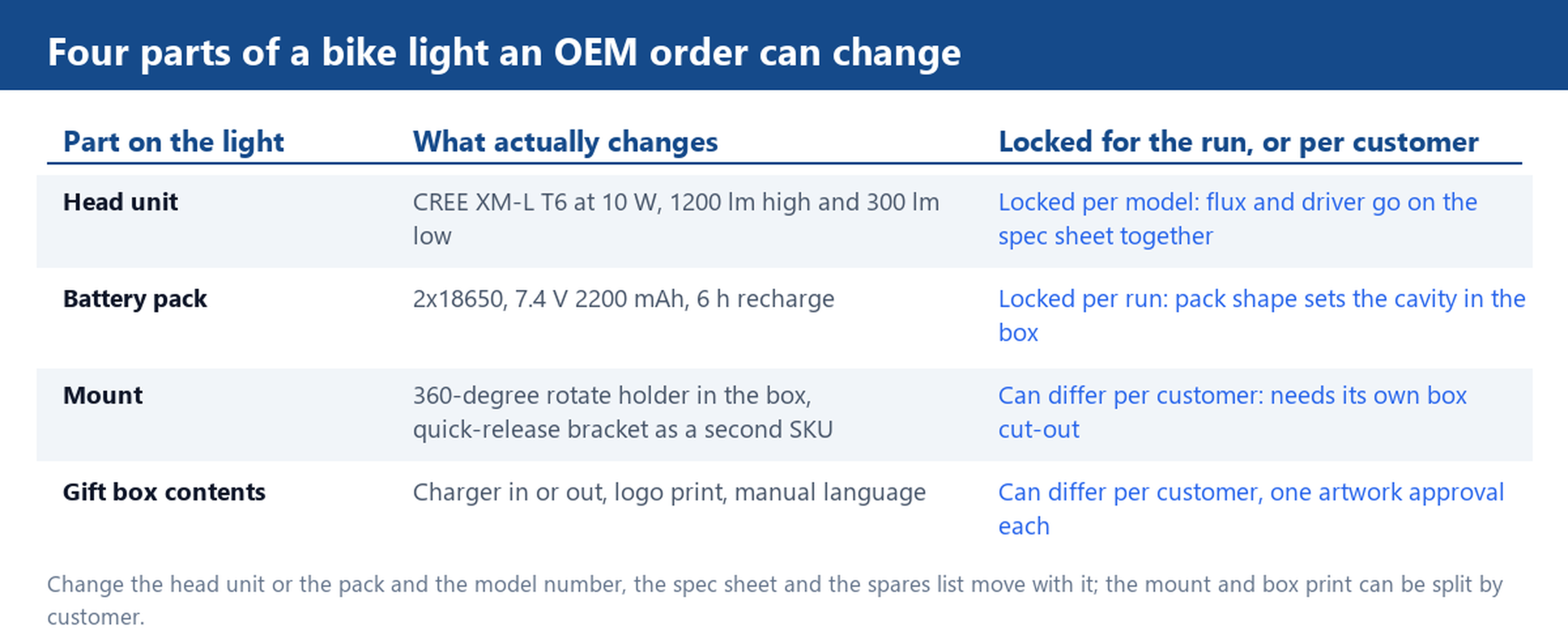
Two of those four are locked for the whole run. Changing the emitter or the pack changes the flux claim and the shipping paperwork, so those lines are fixed per model. The mount and the box print can be split customer by customer, which is how a buyer ends up with three SKUs out of one production run. The bicycle light range on this site is built on that split: one body, several pack and mount combinations.
The Head Unit: CREE XM-L T6 at 1200 lm High and 300 lm Low
The reference model runs a CREE XM-L T6 emitter at 10 W, in an aluminium alloy body rated IP65, with 1200 lm on high and 300 lm on low. Those two numbers are the ones to write into the spec sheet, together with the 10 W input, because a buyer who quotes only the lumen figure leaves the supplier free to reach it with a different emitter and a different driver.
What can change here is the mode logic, not the emitter. A two-mode switch (high and low) is the simplest build and the cheapest manual to print. Adding a flash or a strobe mode means a different driver board, a longer manual and a second line on the box print. Decide that before the sample, not after: a driver swap mid-run invalidates the sample the buyer already approved.
The body itself is worth fixing early. An aluminium housing carries heat away from a 10 W emitter, which is why the same 1200 lm claim is realistic in metal and optimistic in a plastic shell. If the target retail price pushes the build toward plastic, cut the flux claim rather than the housing. The 1200 lumen CREE XM-L T6 bike light is the reference build for this article, and its spec sheet is the baseline the other variants are measured against.
The 2×18650 Pack at 7.4 V: Run Time, Charging and Spares
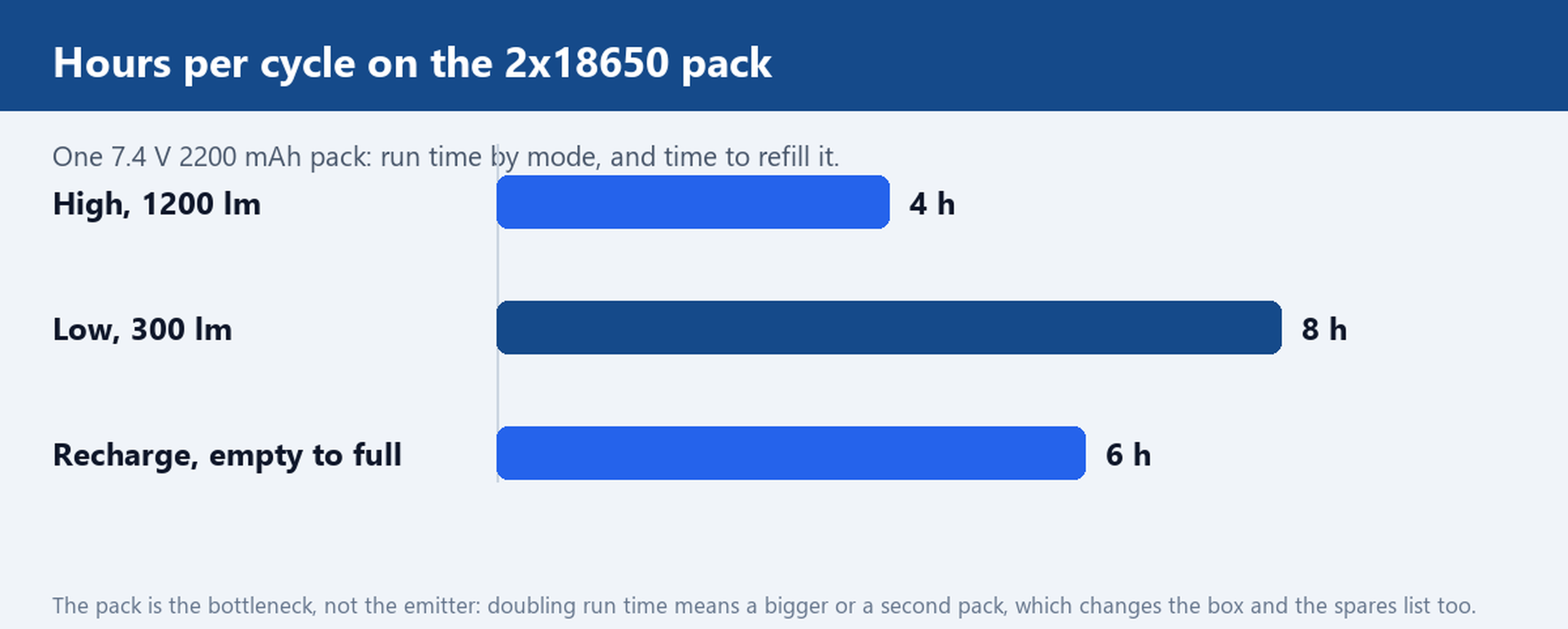
The pack is two 18650 cells in series, nominal 7.4 V at 2200 mAh, and it sets the real limits of the product. On the reference build the light runs 4 hours on the 1200 lm mode and 8 hours on the 300 lm mode, and takes 6 hours to recharge from empty. Note the shape of those numbers: a quarter of the flux buys twice the run time, so the low mode is the commuting mode and the high mode is for the unlit stretch of road.
Three things follow for the order. First, if a buyer asks for longer run time, the honest answer is a bigger or a second pack, not a higher lumen claim, and that changes the cavity in the box and the spares list at the same time. Second, cells are a regulated item: air freight asks for the UN38.3 test summary and a pack declaration, so a supplier who cannot produce those documents is not a supplier for this product. Third, quote the pack as a separate line in the spares schedule. A retail customer who sells 500 lights will want a handful of spare packs, and those ship in the same carton only if they were listed at order stage.
Charging is the part buyers forget to specify. The reference build ships a charger in the box and takes 6 hours to fill an empty pack. If the destination market expects USB charging from a phone adapter, that is a different charge circuit and a different box cut-out, so it belongs in the same version decision as the pack, not in a later email.
Mounts: The 360-Degree Holder or a Quick-Release Bracket
The reference build ships a 360-degree rotate holder in the box. It clamps to the bar, holds the angle a rider sets by hand, and costs nothing extra because it is already in the packaging list. The alternative is a quick-release bracket: the light clicks off the bar in one movement, which matters for anyone who parks on a street and does not want to leave the light behind.
Both start from the same measurement. Handlebar clamp sizes in common use are 22.2 mm, 25.4 mm and 31.8 mm, and a holder built for one will not grip the other two without a shim. Ask the buyer which bar the light is going on, and if the answer is a range of bikes, ship the shim set rather than a second holder. The mounts and stands range covers the clamp bodies; the light order only needs the one that matches the chosen bar.
Mount choice is also where a second SKU earns its keep. A front and rear pair sells to commuters who want to be seen from behind as well as to see ahead, and the front and rear LED bike light set is the packaged version of that idea. Same factory, same carton line, different insert.
What Goes in the Gift Box and What Stays Out
The reference packaging list is short: gift box, rechargeable battery, charger and 360-degree rotate holder. Every item on that list is a decision, because each one adds weight, a compartment and a line on the artwork.
The charger is the biggest lever. Leaving it out lowers box weight and removes a plug-type decision, but it also means the buyer has to source a charger locally and the light cannot be sold as ready to use. If the charger stays in, the plug type has to be named per market: US, EU, UK or AU pins are four different parts and four different box prints. A multi-pin charger solves the stock problem and adds cost to every unit, including the ones going to a single market.
Then the smaller lines: logo print on the box, manual language, whether the taillight is inside the same box or a separate carton. Each of these is cheap on its own and expensive when it is discovered after the cartons are printed. Write them into the version matrix before artwork approval and the print run only happens once.
The Version Matrix That Keeps a Mixed Order Straight
The practical tool is a one-page matrix. Rows are SKUs, columns are head unit, pack, mount, charger and box print. Each row gets a sample sign-off and an artwork approval, and the carton count is read off the matrix rather than counted by hand at the end of the run.
The matrix also makes mixed containers easy to reason about. Bike lights share a production floor with the 18650 flashlights in the LED flashlight range, and both use the same cell format, so a buyer who also sells torches can consolidate the two lines into one shipment from one factory. Keep them as separate carton lines rather than a combined box: one insert per product keeps the spec sheets apart and the retail packaging intact. The same rule applies to any Bluetooth speaker a retail customer wants to add. Plan it as its own carton in the same shipment, sold and specified on its own sheet, and the light order stays untouched.
Send your logo file, the target retail price and the preferred mount type, and we will quote a 1200 lm sample with your branding printed on the gift box. If the run is mixed, send the matrix with it and we will confirm the pack, charger and carton lines against it before the sample is built. Start from the contact page and the quote comes back with the four part lines listed separately, so nothing on the order stays implicit.